[Here are two short stories, from Japan’s The Mainichi and the UK’s Travelling for Business, about what sounds like a clever use of telepresence robots at airports in Japan. –Matthew]
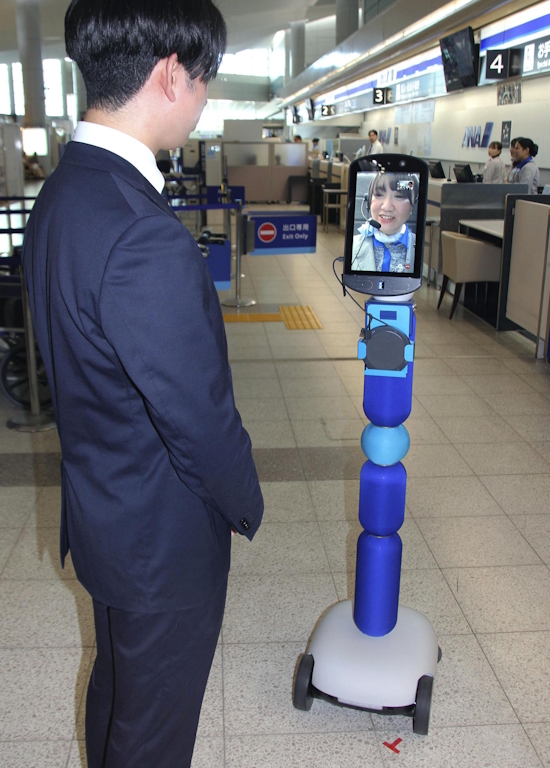
[Image: An All Nippon Airways Co. staff member (on screen) at Kansai International Airport provides assistance with check-in and other procedures remotely via a Newme robot at Hiroshima Airport in Mihara, Hiroshima Prefecture, on Aug. 21, 2026. Credit: Kyodo News via The Mainichi]
ANA launches inter-airport remote passenger support via telepresence robots
September 6, 2026
OKYO (Kyodo) — All Nippon Airways Co. has begun rolling out telepresence robots enabling skilled staff based at western Japan’s gateway Kansai International Airport to remotely guide passengers at other regional airports through check-in procedures and handle other inquiries, amid growing demand from inbound tourists.
The remote passenger assistance service will allow the airline to better utilize employees skilled in interacting with international travelers to provide assistance, as well as shorten customer wait times even when on-site staffing is limited between flights or during off-peak hours at the regional airports.
Two of the Newme robots, developed by Avatarin Inc., a spin-off venture company of ANA Holdings Inc., have been installed at Hiroshima Airport. Up to two each will also be deployed at Komatsu, Nagasaki, Tottori and Tsushima airports by the end of October, the airline said.
Inquiries submitted through the robots are handled centrally by a designated team at Kansai airport, a major international hub serving Osaka, Kyoto and other areas in western Japan.
During a demonstration to the press at Hiroshima Airport in late August, a person playing the role of a passenger pressed a button on the robot to start a conversation with a Kansai airport staff member, who then provided guidance on where to find check-in kiosks and directions to restaurants within the airport.
Maiko Imada, head of the passenger services department at ANA’s operation support center, said, “We are also exploring the possibility of having staff working from home to provide remote assistance in the future.”
—
[From Travelling for Business]
ANA rolls out remote passenger support robots across Japan, proving customer service can travel faster than staff
By Andrea Thompson
August 26, 2026
ANA has become the first Japanese airline to launch inter‑airport remote passenger support using newme robots, a move that blends human hospitality with digital precision and gives customer service an unexpected new superpower: the ability to be in two airports at once.
The rollout began on August 21, 2026, with staff based at Kansai International Airport assisting passengers at regional airports through telepresence robots operated from a central back‑office hub.
The idea sounds futuristic, but ANA has already tested it extensively at Haneda Airport, analysing more than twenty‑five thousand customer interactions. The results were striking. Remote staff resolved 98.4 per cent of inquiries with the same quality as face‑to‑face conversations, proving that a robot on wheels can be just as helpful as a human behind a counter, minus the need to sprint between gates during peak hours.
The robots act as mobile digital avatars, allowing ANA’s team to appear instantly wherever they are needed. A passenger at a small regional airport can ask a question, and a staff member in Kansai will appear on the robot’s screen, ready to help. It is customer service without geographical limits, designed to reduce wait times and ensure travellers get immediate guidance even when on‑site staffing is thin between flights.
Behind the scenes, the system is even more ambitious. ANA and avatarin are building a cross‑airport virtual support network that gathers and visualises passenger inquiry data in real time. For the first time, ANA can quantitatively track what travellers are asking at regional airports and use that insight to refine operations, improve service and support its wider sustainability goals. It is part of ANA’s Mid‑Term Management Strategy to evolve operations by blending human hospitality with digital technology, a philosophy that feels distinctly Japanese in its precision and warmth.
Future expansion will depend on how the robots perform in live airport environments, but ANA’s ambitions are clear. The airline sees remote support as a way to elevate frontline service, strengthen regional airports and pioneer a new model of digital‑human customer care across Japan’s aviation industry. It is innovation with a practical edge, designed not to replace people but to let them be everywhere they are needed at once.
For travellers, the experience is simple. You ask a question. A robot rolls up. A real ANA staff member appears on the screen and suddenly, customer service feels a little bit magical.
Leave a Reply