[In a new NSF-funded project based on his earlier “Scale Worlds,” a professor at North Carolina State University is working with colleagues to use presence-evoking virtual reality to help students better understand the huge distances involved in astrophysics. See a September 2022 ISPR Presence News post for more context on the earlier project and visit the Scale Worlds Public Resources website for more information and free versions of the Scale Worlds educational materials. (See also the website of the India-based company Astroverse that “bring[s] space closer to people through STEM education, immersive astrotourism, and hands-on exploration.”) –Matthew]
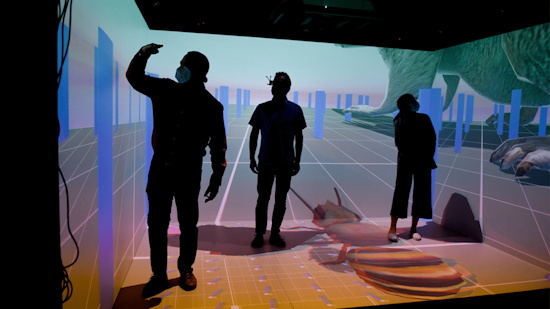
Associate Professor Cesar Delgado Uses Virtual Reality to Help Astrophysics Students Better Understand Scale through Grant-funded Project
By Janine Bowen
October 20, 2026
In college-level astrophysics courses, students often underestimate the distance between interstellar bodies like the sun and Earth, and those underestimations worsen for entities that are even farther apart, such as stars and galaxies.
Even after a semester of coursework, standard instructional techniques do not address this issue, which NC State College of Education Associate Professor of Science Education Cesar Delgado is aiming to solve through work as the co-principal investigator on a new grant-funded project.
Using a $1.8 million grant from the National Science Foundation – $399,455 of which will be allocated to the College of Education — Delgado will work alongside principal investigator Karen Chen, an associate professor in NC State’s College of Engineering, to transform undergraduate science instruction through embodied scale experiences in virtual reality (VR). It will build on previous work from Delgado, Chen and College of Design Associate Professor Matthew Peterson conducted through their “Scale Worlds” project.
“In this new project, we will leverage the virtual and desktop environments we developed to support student learning about scale in the context of science generally, customized to address astrophysics specifically,” Delgado said.
The new project will maintain the basic architecture of “Scale Worlds,” in which a user in a VR environment can virtually grow or shrink by factors of 10, “growing” to the size of a whale or the Brooklyn Bridge. However, the new digital environment entitled “Astrovese” would replace these objects with items related to astrophysics, such as the Gran Telescopio Canarias, the largest infrared telescope in the world.
Within “Astroverse” will be “Scale Stories,” which will support students to structure their mental conceptions of scale with connections to relationships. For example, students within the program might see the sun linked to the atomic-level nuclear fusion reactions that occur in its core, Delgado said.
“Our ultimate goal is to research and develop practical VR and desktop tools to improve STEM learning and teaching, and to increase interest in STEM in the general population,” Delgado said.
The original “Scale Worlds” project, which is now available to use for free at home or in classrooms, has already made an impact on STEM interest. K-12 students who interacted with the program were reported to be 64% more interested in pursuing a STEM career and a majority of students who used “Scale Worlds” reported experiencing the scientific phenomena of awe.
The project team hopes to see similar results in the latest project, introducing VR scale environments to students in undergraduate astrophysics classes.
“Using advanced multimedia technologies, this research will make an abstract but critical unifying concept–scale–tangible, concrete and accessible for students in the field of astrophysics,” Delgado said.
Leave a Reply