[This story from the New York Times describes the presence experiences evoked by a new, immersive filmed version of “The Nutcracker” ballet created for the multi-city network of Cosm domed event venues. See the original version of the story for two more images. For more details see a review from Hour Detroit and the Cosm website. –Matthew]
Sweat, Scuffs and Gasps: ‘The Nutcracker’ Enters Enhanced Reality
On a domed screen in Detroit, New York City Ballet’s production of “The Nutcracker” began a new, immersive chapter.
By Adam Nagourney, Reporting from Detroit
November 6, 2026
The audience at the Cosm Detroit burst into loud applause Wednesday night as the Sugarplum Fairy and her Cavalier — the New York City Ballet stars Tiler Peck and Roman Mejia — finished their grand pas de deux in the second act of “George Balanchine’s The Nutcracker.” And when Mejia led Peck on the “Sugarplum Slide” across the stage as she stood motionless on pointe, her leg stretched behind her, the crowd gasped.
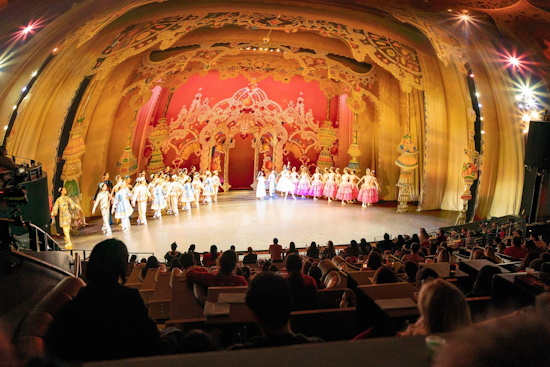
But Peck and Mejia were not onstage. They were seated in the audience, wide-eyed, like most in the crowd, watching a realistically jarring version of “The Nutcracker” that filled the LED dome on Cadillac Square. The crowd could be forgiven for forgetting they were watching a high-tech movie rather than an actual performance.
“It’s so immersive,” said Peck, who had flown in from New York earlier in the day. “But it’s really amazing that it can make you feel like you’re inside the production. I didn’t expect it to be like that.”
Wednesday’s opening at Cosm Detroit started a new chapter for “George Balanchine’s The Nutcracker,” which since its debut at New York City Ballet in 1954, has become not only a holiday staple but also one of the most popular and performed works in dance.
Cosm spent six days filming “The Nutcracker” in January, using 13 cameras to shoot from 84 positions, capturing perspectives that could never be seen from a conventional seat: next to the dancers, above the stage, inside the orchestra pit, from the wings. It was edited to create an immersive film — what Cosm calls Shared Reality, in effect, virtual reality without the clunky glasses — that will be presented over this holiday season in Atlanta, Dallas and Los Angeles, as well as Detroit.
This “Nutcracker” was a far cry from what is seen every year by nearly 100,000 people at Lincoln Center in New York. The audience sat under an 87-foot-diameter dome watching on a borderless, curved screen. By all appearances, there was a full orchestra in front of the stage — and real dancers moving around on it. When the Christmas tree grows, it really did seem to burst into the top of the theater, filling a side of the dome, with the requisite sounds of groaning wood.
The images were so sharp that the Tchaikovsky score could be read on the musicians’ stands. Scuff marks could be seen on the floor. “Even the sweat on the dancers,” Mejia said in an interview.
Jennifer Fisher, a professor of dance at the University of California, Irvine, who wrote the book “Nutcracker Nation,” said the Cosm production suggests that this ballet “continues to adapt to circumstances in North America, the latest of which is this expansion into a technologically enhanced life onscreen.”
“The ‘Nutcracker’ is nothing if not adaptable — this is the next step that could work,” she added.
For New York City Ballet, the network of Cosm theaters means the company can take its production to other parts of the country. And the look-at-me bells-and-whistles production could prove to be a way to bring in a new generation of viewers, at a time when ballet, like other performing arts, has been struggling with revenue shortfalls, changing tastes and declining audiences.
“It is going to be such a big introduction for people who haven’t seen the New York City Ballet and maybe haven’t seen a lot of ballet,” said Katherine E. Brown, the executive director of City Ballet. “‘Nutcracker’ is such a wonderful entry point for people.”
Until now, Cosm had used this technology to show hyper-realistic sporting events and Cirque du Soleil; the Detroit auditorium was used earlier this week for Monday Night Football.
Alexis Scalice, a vice president at Cosm, said the organization’s goal is to create a presentation where “the physical meets the digital.” Cosm has a “multiyear” commitment to “The Nutcracker,” she said.
While the Cosm theaters — a fifth is being built in Cleveland — might recall the Sphere in Las Vegas, they are a fraction of its size. The Sphere has about 17,600 seats. The domes in Los Angeles and Dallas have around 350; in Detroit and Atlanta, they have around 500.
Tickets will range from $45 to $60 or above (ticket prices fluctuate with demand), significantly less than the top ticket of $272 to see City Ballet’s production live. (And there’s a lot less competition to grab a seat as well.) New York City Ballet officials said they expected to make some money from the collaboration, though they said their main motivation was building a new audience for ballet.
City Ballet leaders did not know quite what to make of the idea when they first met with Cosm.
“It was hard to envision what they were pitching to us,” said Jonathan Stafford, the company’s artistic director. “So, we all went out to L.A. and went to see it. We were blown away.”
This kind of up-close production has its risks, said Fisher, who had wondered how the ballet would be filmed: “Will it focus on faces instead of the dancing body? That could be annoying for ballet fans.”
Mejia said he had been very aware of that close-up scrutiny when he was being filmed. He turned to Peck during a post-show interview to share a concern. “When I’m lifting you above my head, I’m conscious of the straining of my face,” he said, adding that was not usually something he thought about when dancing.
Brown said the company was sensitive to these issues. “This production is beloved, so cherished,” she said, “that we just wanted to be super careful about any partners that we work with to make sure that they bring the same care and respect to it that we do.”
Stafford said that seeing this production gave him a new view of a ballet he had watched hundreds of times.
“There’s something magical obviously about being in the theater with live performers,” he said. “But what we really discovered is that I was seeing things for the first time. We have never had this aspect of George Balanchine’s brilliant ballet. This is additive.”
Leave a Reply