[A new patent granted to the prominent semiconductor design company Arm incorporates ultrasound in virtual and augmented reality headsets to minimize motion sickness by stimulating the wearer’s vestibular system. The details are well-summarized in the story below from Road to VR, followed by additional details in excerpts from VR.org. –Matthew]
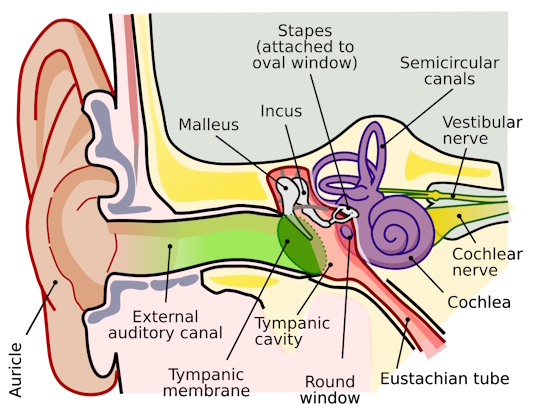
[Image: Lars Chittka and Axel Brockmann / Wikimedia Commons (CC BY 2.5). The three semicircular canals are the target. Source: VR.org]
Arm Patents Method to Reduce XR Motion Sickness Using Ultrasound
By Scott Hayden
August 24, 2026
A newly granted patent from Arm describes a head-mounted system that analyzes motion in the images headed to a display, then sends control signals to ultrasonic transducers intended to stimulate the wearer’s vestibular system and control their sense of balance. The basic aim is to reduce the discomfort, dizziness, and motion sickness that the application associates with a mismatch between what a wearer sees and what their balance system reports.
The patent, “Method for minimising motion sickness for head-mountable extended reality,” was first filed in the US on July 24, 2023 and officially granted on June 16, 2026.
Arm, a subsidiary of SoftBank, is a semiconductor design company whose technology is the essential foundation for processors used in most modern mobile devices like smartphones and XR headsets, including processor brands like Snapdragon and even Apple Silicon. When you hear a CPU being described as “Arm-based,” it’s this company the phrase refers to.
In Arm’s newly granted patent, a head-mounted device compares visual motion in a sequence of displayed images against a threshold. When that comparison calls for it, processing and control circuitry generate signals for multiple transducers that stimulate the wearer’s vestibular system. Put less formally: if the virtual world appears to move in a way that might conflict with the wearer’s felt movement, the system is designed to respond through the sensory system involved in balance.
The application specifically discusses low-intensity focused ultrasound, or LiFU, and ultrasonic transducers. One described scenario maps a small visual movement to the left to a corresponding physical feeling of leftward movement; a larger visual motion would use greater acoustic radiation force to stimulate the vestibular system to match. The patent also describes arrays with one or more transducers per ear, potentially using beamforming to target specific parts of the inner-ear.
Vestibular stimulation is not the filing’s only proposed response. The system described could also ask the XR application to reduce visual motion, fade the displayed image, introduce a vignette, or align displayed motion with the wearer’s sensed movement. The patent also describes basing stimulation on the wearer’s pose or motion, configured preferences, and sensor-derived signals; it proposes recalibration if sensed user movement does not align with the expected visual motion.
That combination suggests the patent is concerned with an adaptive form of comfort management rather than a single solution; one that could adjust either the visual content, the physical balance cue, or both. The important open question is whether a headset-based ultrasonic system could deliver that kind of precise, comfortable vestibular response across different wearers and real XR experiences.
This isn’t the first time we’ve seen vestibular stimulation proposed as a method for combating motion sickness. Other approaches have considered using electrical stimulation rather than ultrasound. But to date, no commercially available XR device has included any kind of direct vestibular stimulation.
A patent application shows what a company has sought to protect, but it is not proof that the described technology will appear in a product.
—
[From VR.org]
Arm’s Patent for Killing VR Motion Sickness Fires 5MHz Ultrasound Into Your Inner Ear
By Alex Reeves, Staff Writer, VR.org
August 24, 2026
[snip]
Motion sickness in a headset is a disagreement. Your eyes report a corner taken at speed. Your semicircular canals, three fluid-filled loops set at angles to one another, report a person sitting still in a chair. That conflict is the nausea. Every comfort feature shipped in the last decade works by reducing what the eyes claim, because the eyes are the half a developer can reach.
Arm’s patent goes after the other half. Instead of making the visuals lie less, it makes the inner ear agree with the lie.
[snip]
Apple has been filing in the same territory. US 12,411,543, “Orientation feedback devices and methods,” granted September 9, 2025, covers a head-mounted display with an orientation feedback device on the frame or facial interface. Its disclosed mechanisms include balls rolling in channels, fluid in chambers, and hanging masses. Two of the largest silicon companies on earth are patenting ways to tell your body which way is up, and one of them is proposing to do it with a weight on a string.
What headsets actually do about this today
Comfort in 2026 is still a settings menu. Vignette the periphery during artificial locomotion. Snap turning instead of smooth. Teleport instead of walking. Static reference frames, a cockpit or a virtual nose, so the eyes have something that holds still. Higher refresh rates and lower motion-to-photon latency, which help everyone a little and resolve the underlying conflict for nobody.
Those options work well enough that plenty of players stop noticing after a week. They do not work for everyone. The people they fail are the ones who buy a headset, feel awful in the first hour, and never open the box again. Nobody publishes that number.
[snip]
The buying advice is unchanged. If artificial locomotion makes you ill, choose on comfort options and on the games you actually want to play, and treat a patent as what it is. Our beginner’s guide covers which settings to turn on first, and the headset guide notes where the comfort tooling is strongest. Neither will be updated for ultrasound any time soon.
Leave a Reply