[A promising application of presence-evoking technologies externalizes the destructive inner voice people with eating disorders (and other conditions) hear as a digital avatar, allowing patients to confront and banish the voice. This abridged version of a story from The Sunday Times describes the treatment process; note references to the patients suspending disbelief, feeling transported, and the experience seeming real. See the original version of the story for five more pictures and links to other related stories. The research report for the study is available via medRxiv. –Matthew]
[Image: Illustration by lou kiss]
I cured my eating disorder using virtual reality
A pioneering project puts people with anorexia and bulimia in a room with a digital avatar of the demon voice inside their head. But will it work for everyone?
By Jenny Kleeman
July 16, 2026
[snip]
By 2024 Mikala had been living with bulimia for a third of her life. Her eating disorder felt like a fundamental part of who she was.
Then a Facebook advert appeared on Mikala’s feed: a Danish research team called Virtu was looking for people with eating disorders to take part in a trial for a new therapy. Participants would create a digital avatar of their eating disorder that they would meet in a virtual reality (VR) environment. In a series of carefully supported conversations, they would be encouraged to stand up against the dark force inside themselves. But to be accepted on to the trial, they had to experience their eating disorder as having a distinct voice.
Mikala thought it sounded ridiculous. “Virtual reality sounds like something my ten-year-old cousin is into,” she says. Her eating disorder didn’t have a voice; she was simply hearing her own thoughts. “And then I thought about it more and I realised, oh my God, it does have a voice,” she tells me with wide eyes.
“It would come into my head when I looked into a mirror, when I was being intimate with my boyfriend, if I was eating something or if I felt full. ‘You have to throw up, you have to work out, you have to sit differently. Everyone can see how fat you are now.’” It said things her logical mind would never say: that she would fail her exams because she was so fat; that she should cancel her plans because her friends were embarrassed to be seen with her. It was a bully.
By early 2025 Mikala’s eating disorder would be personified in front of her. After a decade of failed treatments, could this mind-bending new approach banish her best friend and worst enemy for good?
More than 1.25 million people in the UK are estimated to have an eating disorder. They are increasingly common and among the most difficult mental health conditions to treat. Conventional approaches involve family therapy and cognitive behavioural therapy, plus hospital admissions for those considered to be seriously unwell, but these have only moderate success rates, with long-term follow-up studies estimating the current recovery rate from anorexia and bulimia may be as low as 50 per cent. Anorexia has the highest mortality rate of any psychiatric disorder.
Avatar therapy is a British idea. It came to the retired psychiatrist and schizophrenia specialist Julian Leff nearly 20 years ago as a possible treatment for people with psychosis. Leff was sitting at home in Hampstead, north London, watching younger members of his family play computer games. “I thought, if I can somehow manage to create for the patient the image and voice of the person who they hear abusing them, maybe they could learn to overcome this awful persecution,” Leff said in a 2018 documentary three years before his death. Leff came out of retirement to conduct the first avatar therapy pilot study at University College London in 2008.
The first avatars were two-dimensional digital faces on a screen, designed by the patient alongside their therapist. The patient chose a voice that sounded right and created the face using a system adapted from police photofit software. The therapist, located in a separate room, operated the avatar, speaking the words the avatar says, their own voice altered by voice-changing software.
For some people — even for those who have been persecuted by voices for decades — the voices disappear altogether after a few sessions with their avatar. Recent research has found that almost everyone with psychosis makes some improvement after avatar therapy. No other psychological intervention has been proven to cause such a significant reduction in intrusive voices.
Louise Birkedal Glenthoj, associate professor of clinical psychology at the University of Copenhagen and head of research at Virtu, is a psychosis specialist. Once she saw the benefit of avatar therapy for people who have auditory hallucinations, she began exploring how the same approach could be expanded to other conditions.
“Almost all people with eating disorders — up to 94 per cent — have an inner critical voice. But it’s not a hallucination — it’s something within themselves,” she says from her office at Gentofte Hospital in Copenhagen. “It often starts as a helpful thing, having this critic make you perform better — when you lose weight, you get a lot of positive feedback — and then it becomes very unhelpful.”
By manifesting and externalising this inner critic in digital form, Glenthoj and her team hoped to create distance between the patient and their eating disorder. “It’s about separating the eating disorder from the self and seeing it as this different feature that they can actually control,” she says.
The course of treatment would involve only seven sessions. In the first phase the patient would be encouraged to stand up to their eating disorder voice, reclaiming power and control over it. In the second they would be helped to reconnect with everything else in their lives that has been drowned out by their eating disorder. “This is a very brief intervention. It’s not a cure for everyone,” she cautions. “But it could boost their motivation to do something different.”
“In my head, the voice was a monster,” Mikala says. But when she came to design her avatar, the software used by the Virtu team only had options in human form that she says looked like characters from the computer game The Sims. In the end she made her avatar look like an ideal version of herself — with a skinny face, dark curly hair and no glasses — but with a monstrous, frightening voice.
She took a picture of the avatar she’d designed and showed it to her mother and boyfriend after her introductory session. “I told them, ‘It’s my eating disorder! And now I’m going to talk to it in virtual reality.’”
With her therapist, Emma Slebsager Ries, she practised what the voice might say and how to respond. “I would try to use logic. I would say, ‘How I look has nothing to do with what my grade will be’, ‘My friends love me no matter how I look’, ‘Please don’t talk about my body in this way,” Mikala says.
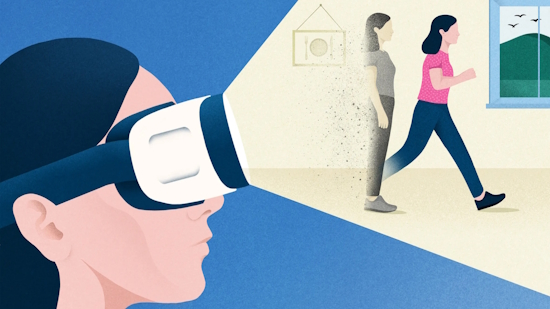
When she placed the VR headset over her eyes and noise-cancelling headphones over her ears, she was transported into a living room. There were potted plants and a blue sofa; trees swayed in the breeze outside the virtual windows. Her avatar was seated at a table at the far end of the room; Ries could bring it closer to Mikala’s face, and Mikala had a panic button on a handheld controller that could take it further away.
Her dialogue with the avatar felt “super-stiff” at first. Mikala couldn’t suspend the disbelief that she was talking to her eating disorder and not Ries using voice-changing software. But after three or four sessions of asserting herself against the voice in her head, things shifted. “Saying these words out loud — saying, ‘It really makes me sad when you use these words about me and it’s not true’ — that made it feel like the conversation was real.”
She would come away from the sessions feeling drained. “But I also felt empowered. It felt really good to separate my thoughts and the eating disorder’s thoughts. For so many years I felt like I was my eating disorder. Who was I without it?”
Of the 96 people who enrolled in the trial, only one was male. Half were kept as a control group and given treatment as usual, the other half received avatar therapy.
The therapy is, Glenthoj admits, “really confrontational.” For five of the 48 participants who received avatar therapy it was too much: they dropped out before completing their seven sessions. But Glenthoj regards this as a high retention rate. “If something is to change, you have to be in contact with what is difficult,” she says.
When Ginnie Brochner, 35, put the VR headset on for the first time, she came close to dropping out of the trial. “I was shaking so much,” she recalls. “He looked like the person I had tried to escape for so long. It was very real, to be staring into his eyes again.”
Ginnie’s anorexia began when she was 33. A kindergarten teacher and mother to a ten-year-old son and a six-year-old daughter, Ginnie had divorced her partner of 15 years, and had entered into a new relationship with a man who was coercive and abusive. “He kind of kick-started my eating disorder,” she says. “I lost 20 kilos in four months.” She worried about the impact her anorexia might have on her children. “They can’t grow up watching their mother not eat — they’re going to think that’s normal.”
When she came to Gentofte to design her avatar, she realised her inner critic had the face and voice of her abusive partner, now her ex. “The way my eating disorder spoke to me was the way he spoke to me in real life,” she says. “I’m just doing this to help you,” her voice would tell her. “This is what you want.” She would weigh herself three times a day, and if she was as little as 200g over her goal weight, the voice would make her feel mortified. When she skipped meals, or went on punishing long walks after eight hours of working in a nursery school on an empty stomach, he would congratulate her.
“In the first two sessions with the avatar, I couldn’t look at him. It was too intense,” Ginnie says. But as they progressed she felt stronger and was able to assert herself. “I told him things like, ‘I’m going to make the decisions now. I’m going to decide if my stomach is flat enough. I’m going to decide if the number on the scale is important or not. I have people in my life who want what’s best for me. I do not need you any more and I see that now.’” Her eyes sparkle. “It felt so good.”
At home, she found herself continuing to stand up to the anorexic voice in her head. “Instead of listening to him, I listened to my body. Whenever I felt hungry, I decided to eat.” By the time the seven sessions were over, Ginnie had stopped weighing herself.
The results of the study were published in May. The participants who had received avatar therapy reported significant improvements compared with the control group: their eating disorder voices were less malevolent, less demeaning and less controlling. The avatar therapy patients felt more motivation to change, had less rigid thinking, were more self-compassionate and reported improved quality of life. In other words, they were happier — and liked themselves more.
While the results showed a reduction in total eating disorder symptoms from the avatar therapy group, it was not enough to be statistically significant. But Glenthoj is delighted with their findings. “Trying to improve all eating disorder symptoms with a seven-session intervention is very ambitious,” she admits.
For Mikala, who had once been so sceptical, the therapy was life-changing. “The voice just slowly started to fade away,” she says, blinking in disbelief. “At one point — it sounds so weird, but I could make it stop. When it was starting to say that I’d eaten a lot and I should throw up, I could shut it down. I could control it.” By the sixth session, she had stopped vomiting. Her voice had disappeared entirely. “It was gone. It’s so strange.” She used her final session to say farewell to her eating disorder. “It felt bittersweet. It was my best friend, my comfort for so many years. But I was so ready.”
It was a huge personal victory for Mikala, but one her closest loved ones couldn’t fully appreciate: she’d been lying to her boyfriend and family about the extent of her bulimia for years. “When you have an eating disorder, it feels very shameful. There’s a feeling of, ‘Why can’t you just stop?’” Avatar therapy helped her articulate the reasons why her bulimia had been so hard to beat. “It was something bigger than myself that had occupied a lot of space in my head. It was easier for me to say goodbye now that I felt like it was not me, and I was not it.”
Given the pressing need for new approaches to eating disorder treatment, how feasible would it be to make it available for everyone? Glenthoj says it could be delivered to a wide population, so long as enough therapists can be adequately trained and supervised. “At this stage we’re going with psychologists and psychiatrists as therapists, but potentially you could train specialised nurses [to deliver the therapy].”
Across the world, psychologists who work with avatars are considering whether and how to use AI. Many among the Virtu team fear that fully digital avatars, voiced and animated by AI, might not be safe for their vulnerable patients. But Glenthoj says AI models could be used to give therapists options as they voice the avatar. “As a therapist, you need to be very flexible. If we could train an AI model based on all the audio recordings we have from these interventions, then we could have the system deliver suggestions. That would be a good thing to do.”
In the meantime, Heka, the Danish company that produces the VR software, is involved in ten trials across the world. A German group is experimenting with using it to treat obsessive-compulsive disorder in only three sessions, a Hungarian group is trying avatar therapy for bipolar disorder and a Slovenian group is looking at family therapy with avatars.
Glenthoj’s next project will investigate the use of avatars for treatment-resistant depression and self-harm. “That would be some of the same mechanisms — externalising the inner self-critic,” she says. “I could see it applied to many different disorders.” People without a diagnosable mental health condition might benefit from this approach. “Young people in a difficult phase of their life — you could get them into a dialogue with their self-critic.”
Avatar therapy for psychosis is already available in Danish hospitals. Glenthoj hopes it will be available for people with eating disorders within a few years. Despite being a British invention, avatar therapy is still years away from being available for any mental health disorder on the NHS.
There is no silver bullet for eating disorders. Even those who manage to survive them long-term know these are conditions that need to be managed over a lifetime. Ginnie had been warned that her voice might return — and a few months after completing avatar therapy it did, with a vengeance.
“Right now, it’s actually the worst it’s been since before I started here,” she says. “But knowing what I did before, I feel like I can do it again. I really want to fight back every single time I hear even as much as a whisper. But it will always be in the back of my head, I think.”
It is a year since Mikala last made herself vomit. “I’m trying to learn to accept my body,” she says. “Right now, I weigh the most I’ve ever weighed, so I’m trying to embrace all other things in my life. I just completed my master’s thesis. I’m really proud of myself.” She smiles. “I’m so happy I did this weird experiment.”
Leave a Reply