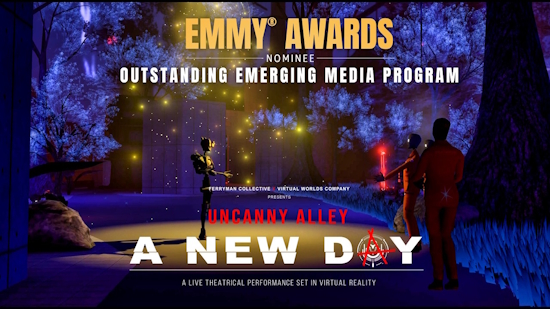
[An innovative immersive media experience called “Uncanny Alley: A New Day” recently won an Emmy Award for Outstanding Emerging Media Program. Excerpts from coverage by VR.org directly below are followed by a first-person report from The Hollywood Times on what the experience is like – including clear references to presence. See the original version of the latter story for eight more images; more details are available in a press release via EIN Presswire; the trailer for “Uncanny Alley” is available on YouTube. –Matthew]
[From VR.org]
A Live VRChat Show Won the Emerging Media Emmy Over Blumhouse and Fallout
By Nina Castillo, Staff Writer, VR.org
September 6, 2026
Uncanny Alley: A New Day plays to an audience of six. You pull on a headset, load a world inside VRChat, and for the next hour or so two performers play fifteen characters around you while you move through a cyberpunk city and talk back to them. Nothing is pre-recorded. Every performance is live, and every audience bends it a little.
On Saturday night in Los Angeles it won an Emmy.
The category was Outstanding Emerging Media Program, handed out on the first night of the Creative Arts ceremonies. The Television Academy’s category page makes the size of the upset easy to read. Blumhouse Enhanced Cinema, on Meta Quest, arrived with NBCUniversal, Blumhouse, Meta and Nexus Studios attached. The World Of Fallout, on Prime Video, had Amazon MGM Studios, Kilter Films, Magnopus and Bethesda Game Studios. The winner is credited to two small outfits. Ferryman Collective is an artist-led nonprofit theatre company. Virtual Worlds Company is an immersive studio in Cape Town.
All three nominees were headset work. That is a shift for a category which spent its early years rewarding companion sites and second-screen apps built around television shows. Forbes ran the odds on Ferryman two weeks ago under the assumption they would lose.
[snip]
How to actually see it
This is a live show with runs, not a permanent installation. So there is a schedule to catch. Ferryman has put a set of celebratory Emmy performances on Eventbrite, and that listing is where the current dates and prices live.
For the VR performance you need a VRChat account and a headset. The Raindance Immersive listing puts the runtime at 60 to 75 minutes for up to six players. It gives the compatible hardware as Quest 2, Quest 3, Quest 3S and Quest Pro, plus PC VR headsets. VRChat is free. A ticket and a showtime is genuinely all you are adding. No headset? The Eventbrite page describes a YouTube livestream running alongside the VR performance, which lets you watch it without being in it.
The part worth holding onto is where all of this lives. No platform greenlit it. No storefront had to approve it. A theatre company published a world on a social VR platform that anybody can publish to, sold tickets, and performed. When Horizon Worlds pulled out of VR earlier this year, the communities that packed up for VRChat and Resonite were betting on exactly that openness. Most of the growth in immersive entertainment right now is in venues you have to drive to. This one you attend from your couch. And it just beat Fallout.
—
[From The Hollywood Times]
Entering the Story: How Uncanny Alley: A New Day Is Redefining the Future of Live Entertainment
By Jessica Kenley
August 7, 2026
Los Angeles, CA (The Hollywood Times) 8/6/2026 – What if attending a play meant becoming one of its fugitives?
That’s the premise behind Uncanny Alley: A New Day, the Emmy-nominated immersive virtual reality production from Ferryman Collective and Virtual Worlds Company that blurs the boundaries between theater, gaming and cinema. Rather than watching the action unfold, audiences enter a cyberpunk world where they become escaped detainees racing to evade a powerful corporation determined to erase their memories using experimental radio frequency technology.
In the story, Adaptive Learning Industries is preparing to launch the controversial “New Day” update, a sweeping change that threatens the citizens, known as “Metizens”, of Uncanny Alley with an amnesia-like loss of memory. Their only hope lies with Gh0st, a brilliant hacker, and Atom, her increasingly self-aware service bot, who must guide a group of escaped prisoners through a hacked portal to safety. Along the way, participants must decide whether to abandon the only home they’ve ever known or stay and fight for their freedom.
During a recent virtual demonstration for The Hollywood Times, I wasn’t handed a headset. Instead, the creators guided me through the production from my computer screen while two live performers embodied multiple characters inside the virtual world in real time.
Within moments, I found myself, not as a journalist, but as a prisoner.
“Jessica, goodness gracious!” one character exclaimed as I appeared inside a prison cell. “Look around and enjoy your cellmates. You’re going to be part of the little experiment.”
What followed was less like watching a performance and more like living inside one.
As my character escaped prison with the help of the hacker Gh0st and the lovable digital companion Atom, the actors spoke directly to me, asked questions, reacted to my answers, and improvised naturally throughout the experience. When Atom unexpectedly began reciting poetry before asking whether the strange sensations in his circuitry might actually be “feelings,” I found myself answering as naturally as I would during any real conversation.
The illusion was surprisingly convincing.
Even though I knew I was watching actors inside a virtual environment, after only a few minutes I stopped thinking about the technology altogether.
That’s exactly the point.
Unlike traditional storytelling, every performance evolves based on the audience. No two experiences are exactly alike because every participant influences the unfolding narrative.
When the demonstration concluded, the performers briefly stepped out of character to explain what audiences had just experienced.
“The world is built in Unity and performed inside VRChat,” one explained. “It’s meant to be a fictional dystopian cyberpunk society based on MetaRick’s original world, Uncanny Alley.”
That world began as the vision of South African artist and worldbuilder Rick Treweek, known professionally as MetaRick.
“I really wanted to create a space that would be a home to my characters,” Treweek explained in a recorded presentation during the demonstration. “These spaces enable human connection that has never been possible before.”
Rather than simply adapting the original VRChat world, Ferryman Collective rebuilt the universe specifically for theatrical storytelling, combining cinematic environments, live performance, interactive design, and original music into a seamless production.
After the demonstration, I spoke with Ferryman Collective Artistic Director, producer, assistant director, and co-story creator Deirdre V. Lyons about the company’s remarkable journey.
Ferryman Collective launched in 2020 during the COVID-19 pandemic, when traditional theater abruptly shut down around the world. Instead of waiting for audiences to return to physical stages, the company began exploring what theater might become inside virtual reality.
Six years later, they’ve produced seven immersive productions, with four major works touring internationally.
“We’ve been doing this for about six years now,” Lyons said. “Some of our productions have been translated into other languages and have traveled to festivals around the world. Having Uncanny Alley: A New Day nominated for an Emmy is just kind of amazing.”
That Emmy nomination places the independent production alongside projects backed by entertainment giants including Amazon, Meta, Universal, Bethesda Games, and Blumhouse.
For Lyons, however, the technology is only part of what makes the experience special.
“The world is a combination of gaming, theater and film,” she explained. “You’ve got the gaming interactivity, the liveness of theater, and the cinematic aspects of film. The music, animations and sound design all work together to make the world feel epic and alive.”
Another key member of that creative process is Christopher Lane Davis, known professionally as Screaming Color, the production’s visual effects, animation and technical design specialist.
Davis described one of the greatest challenges as optimizing an enormous virtual world to run smoothly on consumer Meta Quest headsets, despite the platform’s technical limitations.
“The creation of the digital world compared to creating a theater space is completely different,” Davis explained. “The Quest is affordable and accessible, but optimizing for it is extremely challenging. We really pushed the boundaries of what should be possible.”
Behind the scenes, actors trigger animations, environmental effects, lighting cues and story beats while simultaneously performing as multiple characters, creating a production that feels both spontaneous and meticulously choreographed.
The result is something that feels surprisingly intimate despite taking place entirely inside a virtual world.
Rather than replacing human performance, the technology amplifies it.
Every conversation matters.
Every audience member becomes another character.
Every performance is unique.
Uncanny Alley: A New Day has already appeared at prestigious international events including Venice Immersive, SXSW, Raindance Immersive, NewImages Festival, Augmented World Expo and SIGGRAPH before earning its Emmy nomination for Outstanding Emerging Media Program.
After spending time inside its world, it’s easy to understand why.
Virtual reality has often been discussed as the future of entertainment.
Ferryman Collective isn’t waiting for that future to arrive.
They’re already inviting audiences to step inside it.
Leave a Reply