[This analysis from a story in Medscape highlights the many factors involved in successfully adopting new presence-evoking technologies in an application where there’s little margin for error. For related information see the “Dive deeper” feature in the original version. For earlier coverage on this topic see “With innovation of Medical Vision Goggles, no cancer cells left behind” from the University of Texas Southwestern Medical Center and “The future of surgery: Using augmented reality goggles in the operating room” from UC Davis Health. –Matthew]
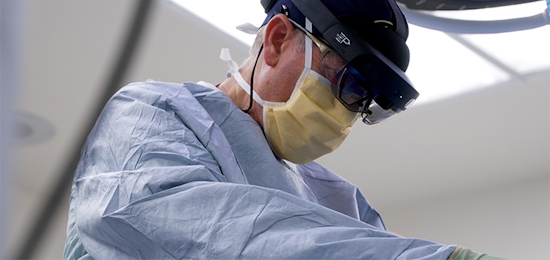
[Image: Source: UC Davis Health]
Will Immersive Goggles Change the Way Surgeons Operate?
By Silvia C. Carpallo
September 23, 2026
The use of immersive goggles in surgery is no longer a novelty but is becoming an established part of surgical practice. As evidence accumulates and clinical experience increases, the actual clinical impact needs to be assessed.
Speaking with El Médico Interactivo, part of the Medscape Professional Network, José María Balibrea del Castillo, MD, PhD, IMASMBS, secretary of the Scientific Committee of the Spanish Association of Surgeons and head of the Endocrine-Metabolic & Bariatric Surgery at the Germans Trias i Pujol University Hospital in Barcelona, Spain, said, “The decision to adopt this technology should be based on a specific need and an evaluation of results, not on the appeal of the device.”
On the basis of his own experience, Balibrea reported positive results in terms of technical performance, although the findings did not show a reduction in complications or net cost savings. “We in my department began in 2023-2024, integrating them into a multimedia platform for robotic surgery that we presented at MWC 2024 and whose performance we have been validating through multiple live surgeries,” he explained. In his department, he added, “In laparoscopy and robotics, we seek to improve and share the immersive experience, facilitate training and telepresence, and, above all, move toward a visualization system that allows us to stop relying on conventional screens.”
Evidence for the use of immersive goggles has emerged in different surgical specialties. A recent nonrandomized comparative study evaluated the Apple Vision Pro as a portable display for endoscopic dacryocystorhinostomy and associated its use with shorter operating times and lower surgeon-reported workloads while requiring minimal physical space.
The study also reported greater ergonomic comfort and a more neutral neck posture. These benefits were achieved at a minimal cost compared with standard operating room equipment. However, the study was small, so the findings should be considered hypothesis-generating.
Drawing on his clinical experience, Balibrea argued that comfort should not be assessed solely on the basis of the device’s functionality. “I would also evaluate weight distribution, pressure on the face, eye strain, duration of use, and the ability to maintain attention and performance.” In his experience, “having the freedom to position the image is not enough to conclude that the device is more comfortable over several hours. The criterion would be to adapt the tool to the person and the task without making continuous use of the headset mandatory. Immersion should be an available advantage, not a requirement that adds discomfort.”
Further evidence came from an article published in Clinical Ophthalmology that examined the use of this technology during cataract surgery at a single center. The authors reported that wireless head-mounted stereoscopic visualization could be feasible in a specialized surgical setting with backup support and warranted further controlled evaluation.
However, the authors emphasized that these data could not support routine use across specialties or establish comparative safety, clinical benefits, ergonomic benefits, routine clinical suitability, or broader applicability.
Training Investment
Cost and return on investment are also important considerations. “The relevant cost is not just that of the glasses, which is the least important part if we understand that they need software, but the cost of ensuring that the entire system works reliably,” he said.
From the hospital’s perspective, investment should be assessed in terms of what technology could offer, including facilitating the participation of remote experts, reducing travel related to training, and increasing the number of professionals who could observe a procedure.
Balibrea identified training as one of the most relevant potential benefits. “The most interesting benefit is precisely the training aspect: a professional located at another facility can access the 3D [three-dimensional] image from the console and, using a 360-degree camera, also observe the layout and activity in the operating room.”
This also raised the next question: Was additional training needed to perform procedures using this technology? Balibrea noted that “we must distinguish between learning a surgical technique and learning to use a tool to visualize it, share it, or receive support during its performance. Training to operate a robot is not the same as becoming familiar with a set of glasses that allow you to follow the procedure in three dimensions.”
Clinical Impact
Patient acceptance is another consideration. “I wouldn’t confuse accepting the use of a technology with having demonstrated that it builds greater trust. In that regard, it’s important to explain the use of the technology in simple terms: The team performing the procedure is still present and in control.”
More broadly, Balibrea emphasized that the technology needed to remain safe when technical problems occurred. “The challenge is to ensure that the experience isn’t just good when everything is working but that it remains safe even when something stops working.”
Balibrea noted that “currently, signal loss, pixelation, or interruptions in video or audio are rare. However, before using the system, it is necessary to check the quality of the connection, availability of technical support, and functionality of the various video sources. In this regard, I would be particularly concerned that a frozen or delayed image might be interpreted as current, or that an incomplete transmission might cause confusion.”
The question, therefore, is no longer simply how far this technology can go, but whether it can advance without introducing new risks into the operating room.
—
Balibrea reported receiving honoraria for lectures and consulting services from Intuitive, Rob Surgical, Smith & Nephew, Medtronic, B. Braun, Abex, Tecnalia, and iVascular.
This story was translated from El Médico Interactivo on Univadis, part of the Medscape Professional Network.
Leave a Reply