[A high school student in North Carolina learned to create virtual environments and then developed a proposal to use immersive digital environments to “allow learners to design virtual spaces using Unity, experience those spaces through VR and share their creations with other students.” The proposal has been approved and the learning experience will be available for students across the state. The story below from India Today is the most complete I’ve found; more information is available from Spectrum News, where it includes a 1:47 minute video report, and from a news release by Lexington Senior High School. Note: I believe this is the first time I’ve posted the image from a story in which the publication acknowledges the use of AI. –Matthew]
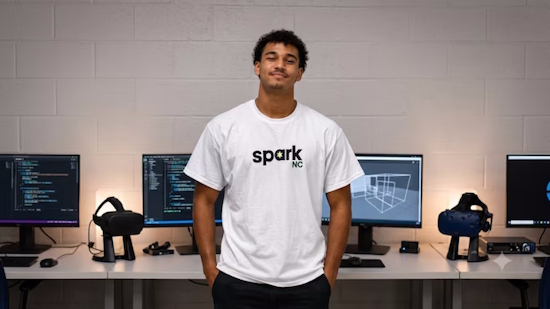
[Image: Lennox French, a senior at Lexington Senior High School, has been selected to create, design and implement a virtual reality learning unit for SparkNC’s statewide platform. Credit: sparknc.org/ AI-enhanced]
He built a virtual reality classroom. Now other students will learn from it
Lennox French has been selected to turn his school VR project into a SparkNC learning unit. The move makes it the programme’s first student-created statewide course and opens it to learners across North Carolina.
August 29, 2026
A virtual reality project that began inside a North Carolina high school is now set to become a learning experience for students across the state. Lennox French, a senior at Lexington Senior High School, has been selected to create, design and implement a virtual reality learning unit for SparkNC’s statewide platform.
French’s project, titled “Creating Digital Spaces in VR,” has been approved by the North Carolina Department of Public Instruction (NCDPI) after being reviewed for alignment with the state’s computer science standards. The approval means the unit meets SparkNC’s requirements for aggregation toward course credit.
FROM A SCHOOL LAB TO A STATEWIDE PLATFORM
French’s work began at the SparkNC Lab at Lexington Senior High School, where students work on technology-focused projects and explore ways to turn their interests into practical learning experiences.
Last year, French created an initial version of a virtual reality Spark Lab. His project explored how immersive digital environments could be used for learning, collaboration and exploration.
The project has now moved beyond the school lab. French will develop it into a structured learning unit that can be experienced by SparkNC students across North Carolina. SparkNC says the unit is expected to launch in 2027.
FIRST STUDENT TO CREATE A SPARKNC STATEWIDE UNIT
The project also marks a first for SparkNC. French will be the first student in the programme’s history to create, design and implement a learning unit for its statewide platform.
“This is what we hope to see through SparkNC: students moving from being consumers of tech to creators of it,” SparkNC said in its August update on the project.
For French, the project is an extension of his interest in virtual reality and game development. He had become interested in VR several years ago and began exploring how the technology could be used to build digital environments.
Speaking to Spectrum News, French described the process of creating a virtual environment as something that grows gradually, from designing a floor and walls to building a complete space. He said the platform could be not only fun to work with but also an impactful tool.
WHAT STUDENTS WILL LEARN
The planned unit will allow learners to design virtual spaces using Unity, experience those spaces through VR and share their creations with other students in the SparkNC network.
French and Spark Lab Leader Garland Beamer will work with NCDPI, SparkNC, technology companies and other stakeholders over the coming months to turn the concept into a complete learning experience.
The approach fits into SparkNC’s broader model, which allows students to choose learning experiences based on their interests. The organisation’s network uses SparkLabs as physical hubs where students can work on projects, complete learning experiences and build portfolios connected to technology careers.
FROM LEARNING TECHNOLOGY TO CREATING IT
French’s project represents a different model of technology education: instead of simply learning how to use emerging technology, students are given an opportunity to build with it and contribute to what other students will learn.
SparkNC operates nearly 50 labs across 30 North Carolina school districts and says its network serves thousands of learners. French’s VR unit will add a student-created experience to that wider ecosystem when it launches.
What started as one student’s experiment with virtual reality is therefore moving into a much larger classroom. French will now help turn his own project into a structured learning experience that other students across North Carolina can explore.
Leave a Reply