[An AI expert at a venture capital firm recently created a series of videos in which a fictional college student competed with her peers to join different sororities at the University of Alabama. The fact that the student and the videos were all AI creations was only revealed in the last video. This interview from Inc. with the creator of what became a viral experiment reveals some interesting assessments and predictions about how people respond to attempts to create presence misperceptions about the use of this fast-evolving technology (see in particular the last two paragraphs). –Matthew]
A Fake Sorority Hopeful Took Over RushTok. The Real Lesson Was What Happened After the Reveal
Andreessen Horowitz partner Olivia Moore breaks down her viral TikTok experiment.
By Annabel Burba, Editorial Assistant
August 28, 2026
Every August, college students flood TikTok with videos of themselves jockeying for spots at exclusive University of Alabama sororities—a phenomenon called “Bama Rush” or “#RushTok.” This year, one of those sorority hopefuls was completely fake.
Olivia Moore, a partner of AI applications at venture capital firm Andreessen Horowitz, revealed she was behind the stunt last week in a video that reached more than 76,500 views on TikTok.
It’s part of an experiment she started on a whim last year as a self-described “fan of the Bama Rush viewership experience” in order to determine how well consumers can recognize AI-generated content—and how they feel about it.
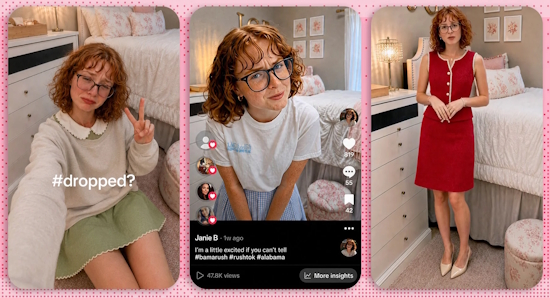
Knowing the digital landscape has shifted since 2025, when she used AI tools to create a conventionally attractive blonde character named Tinsley whose top video reached nearly 180,000 views, Moore opted to create a shy-looking redhead named Janie instead this year. She amassed more than 1 million views over seven days by posting 21 TikToks that showed Janie going through rush week, getting dropped by sororities, and eventually revealing she was AI-generated through a The Truman Show-inspired finale.
Inc. sat down with Moore to learn what the week-long experiment taught her about media literacy and consumer sentiment towards AI. This interview has been condensed and lightly edited.
Why did you decide to conduct this experiment?
We’re still so early in terms of AI’s dissemination into culture, everyday work, entertainment, social experiences. I’m always fascinated by the question of, as the models get better, what does that mean in terms of how people make and react to content that is AI-assisted?
Last year, there was really only one model, Google’s Veo, that unlocked video and lip sync matching. Looking back on those videos, they look so fake. The character looks considerably different every time. But most people hadn’t really seen AI content on their feed at that point, or at least live talking content versus static images or text.
Now, if you want a video with lip sync, there are 10 models that do that and people are more aware of how to detect AI content. So I was honestly just curious about how the response would differ—if people would root for her, root against her, all of that. As a consumer investor, it’s really important that I have a pulse on both how these tools work and how people are responding to them and using them.
Why focus on Bama Rush?
It’s one of these internet events where you can cold-start an account from literally zero followers and get tens of thousands, millions of views within a week. If you’re going to test an AI character, you need a certain amount of eyeballs to gauge the reaction.
What did you find by conducting the experiment last year?
The character itself was, to my eye, much more discernible as AI. If you zoomed in on her face, it would deform and morph, even within eight second clips. Despite the low objective quality of the videos, people were still having the debate in the comment section about, is she AI, is she not, all the way to the last video. The reveal video got the most views out of everything because people just really weren’t sure what they were looking at.
How did you create this year’s character, Janie?
I wanted something that would hook people because she looked different than most of the other girls doing rush and also set the standard that something was a little bit off.
I wanted Janie just to look like a college girl. I went back and forth with ChatGPT a lot: Let’s give her short curly red hair with bangs. Let’s give her glasses like mine. Let’s have her wear something that’s maybe a little bit more traditional-looking. Once I landed on an image of the character with her dorm room in the background, that [became the input I used] to create all of her content.
Which models did you use, and how much did it cost to use them?
I landed on Minimax 3, which is a Chinese model, for her talking videos and used X AI’s Grok Imagine 1.5 for videos of her dancing or spinning around. Some of the videos had sound effects; I used ElevenLabs for those. I used ChatGPT to write the prompts for all of the videos with movement and things like that. It was a pretty fairly tight stack of tools.
Because I do have a job, I was like, I can only spend 30 minutes a day on this. So if you watch some of the videos, there are definitely artifacts in there that could have been regenerated or edited out if I had more time.
Producing three or four takes of a video and picking the best one cost somewhere in the realm of $10 to $20 a day for a week. All in all, it probably ran me around $100. Maybe a little bit more, because the last video was a bunch of clips stitched together and I wanted it to be a little bit more precise.
What happened throughout the experiment?
When Janie popped up on the feeds of people who follow Bama Rush for the first time, a lot of them left very positive comments not detecting she was AI. Like, “you look so cute,” “you look so different, I hope you do well,” “keep your head up, this is a hard process.”
But there were a few sleuths in the comments. Anyone Gen Z, Gen Alpha has learned so much in the past year and has an eye and an ear for AI content, so they started to assemble on different platforms. There were a couple commenters that were able to educate everyone else, like, “she has six fingers in this frame” or “she had five dresser drawers, and now she has three.” The hive mind came to a consensus by day two and a half, day three.
Some people, once they realized it, were like, “I hate AI. I hate anything made with AI. I’m gonna block and report you.” Which I understand. That’s where a lot of people are emotionally with AI right now. But there was a pretty big category of viewers who watch Bama Rush for the entertainment, so even if it’s not a quote unquote real girl, if she’s bringing the entertainment, she can still earn a 15 second, 30 second daily viewership.
As I tracked the sentiment towards the account, people liked the first video but were suspicious, then it was determined she was AI and there was a sharp drop-off in sentiment. It then began climbing again and actually accelerated because I kept dropping Easter eggs and hints and having interesting things happen.
The face reveal video was, for the first 20,000 to 30,000 views, contained within the Bama Rush audience who had followed the character. [Their reaction] was shockingly positive. And then the video started to escape containment and reach a broader audience.
The interesting learning for me there was that the comments turned much more negative. If you haven’t been part of the experience, if you haven’t had the entertainment value or felt like the AI character made you think, you’re more likely to have that blanket negative response. But the people who were in on it want me to do it again next year.
What were your takeaways as an investor?
I learned a lot more than expected. I am a huge fan of AI. I invest in lots of products that consumers and businesses use to make things with AI, and I also create a lot of content myself everywhere from 100 percent AI to 100 percent human.
I was really racking my brain before this experiment on, should AI even be disclosed in content creation? Does it matter? The conclusion that I came to was, it’s a spectrum of content. There’s a lot of utility-based content that—I think everyone would agree—if AI does it, we can do more productive things with our time. I personally don’t think any human being should ever have to manually write a scheduling email ever again.
Then there’s content that falls closer to the opposite end of the spectrum: art. For that type of content, people still really care about human perspective and human authorship or creatorship. If there’s no disclosure there, the consumer feels like they’ve been tricked.
What’s your advice for business owners debating whether or not to disclose their use of AI?
It’s possible that in five years, disclosure doesn’t matter because people have come to accept that AI content is just as good or better than human content. It’s also possible that in five years, disclosure is the only thing that matters because we’re flooded with AI content and people want something that was touched by a human.
For now, I think people are happy to embrace AI used by businesses as long as they are in on the joke. When it’s clear that’s what it is, people appreciate it, and it can drive really strong engagement.
But when people feel like they’ve been duped, like it’s an AI video ad and the clothing item doesn’t quite lie in the way it would on a real human. That’s where, at least in the short-term, businesses get into a lot of trouble.
Leave a Reply