[The story below is an abridged version of a fascinating piece in IEEE Spectrum about the development, testing and future deployment of life-saving telesurgery to treat ischemic strokes. See the original version of the story for more details and eight more photos. —Matthew]
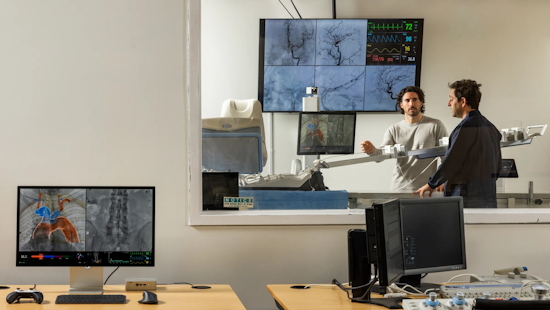
[Image: At Remedy Robotics, the N1 System’s prototype console (lower left) awaits its operator, with cofounders Jake Sganga (left) and David Bell and the surgical robot in an adjoining room. Credit: Christie Hemm Klok]
Can Robots Bring Stroke Surgery to Remote Hospitals?
Remedy Robotics is testing whether surgeons can operate from afar
By Max G. Levy
November 16, 2026
I am practicing brain surgery on a patient lying 6 meters away, out of my sight and reach. I press a foot pedal, activating the controller in my hand, and carefully steer a thin flexible tube called a catheter up through the patient’s blood vessels. I head for what I believe to be the brain, tracking my progress on the live X-ray feed. As I imagine finding a blood clot, David Bell, the surgeon seated to my right, helpfully reminds me that every minute a stroke goes untreated, millions of brain cells suffocate, swell, and die.
The patient under the X-ray in Bell’s office is not flesh and blood, but a plastic container holding long branches of silicone tubing. The controller I hold comes from an Xbox. But the surgical robot is real. The Remedy N1 is designed for emergency operations, including thrombectomies, the standard brain operation for acute ischemic strokes caused by blood clots. Ischemia, a restriction of blood flow, is the most common cause of stroke.
“We want it to feel a bit like a video game—a bit easy,” Bell says. “But we don’t want to dehumanize it as if there’s just another ‘game over.’” Bell, a clinician and former cardiac-surgery trainee from Australia, cofounded Remedy Robotics, based in San Francisco. With a team of engineers, he developed this robotic catheter and its related software to help ischemic stroke patients in remote and rural places, who lose crucial hours while being transferred away from hospitals incapable of providing care. According to 2025 data, at least 5 million people around the world suffer ischemic strokes every year. In the United States, stroke is the fourth leading cause of death.
The screen shows my catheter at a fork in the narrowing road, and I decide to take a sharp right; I think I can make it. This device feels easier to drive than a typical robotic instrument that I controlled on a hospital tour the summer prior. I say to Bell that here my movements are smoother, more precise—exactly the talking point you’d expect to hear from a surgical robotics company. Never mind that, Bell corrects me: “Smoothness and precision are not clinical outcomes. Neither is a surgeon’s ergonomics.”
For Bell, the outcome that matters is whether the robot can get stroke treatment to patients who otherwise wouldn’t receive it in time. Today, only about 1 in 10 patients eligible for thrombectomy receive one. That’s where the long-unrealized promise of telesurgery is meeting an urgent problem: providing access to thrombectomies before life-threatening damage takes hold.
But can putting a robot in one hospital and a surgeon somewhere else actually close that gap? Remedy has already taken a first step, remotely testing its system on a small group of patients. “The remote stroke need is well known,” says Jake Sganga, who cofounded Remedy with Bell and leads the technology side. “It’s just a hard problem to take on.” Making telesurgery a practical part of stroke care will require more than a capable robot: It will depend on communications infrastructure, hospital resources and workflows, and ultimately, evidence that patients actually benefit.
Why Telesurgery Starts With Stroke
As recently as the early ’90s, physicians who treated stroke struggled with “therapeutic nihilism.” A 1991 editorial by two lamenting neurologists expressed hope that a successful drug therapy for stroke would emerge that would “reverse the trend of nihilism.”Five years later, clot-busting drugs revolutionized stroke treatment, followed about a decade later by mechanical thrombectomy, in which a blood clot is physically removed from an artery.
In a standard thrombectomy a surgeon snakes a flexible wire through a small opening in the patient’s groin. This guide wire sets the route for a fine hollow tube around it, the catheter, to travel through the blood vessels to the brain, where instruments remove the clot. Suddenly a stroke was no longer a sentence of profound disability or death but a treatable event.
Yet decades later, thrombectomies remain inherently blind expeditions. The surgeon stands beside the patient, physically pushing these lines up, inch by inch. The only view comes from a live X-ray, which can’t see soft tissues like blood vessels. The surgeon shoots brief puffs of contrast dye through the catheter to illuminate the path ahead. A nimble operator can avoid scraping or piercing artery walls while bending the guide wire’s rounded tip around corners. But even these left or right turns are not intuitive. The guide wire can twist inside the body, and because the surgeon sees only a flat silhouette, steering it left may actually rotate the guidewire to the right.
If all goes as planned, the doctor reaches the brain and pushes instruments through the catheter to dislodge the clot, then carefully pulls everything back out. Bell remembers how thrombectomies felt when he performed them. “I’m one and a half meters away from my catheter tip. I’m not in control of it. I can’t see where the blood vessels are. I thought, what is the ideal way to do these procedures? It’s certainly not what I’m doing now.”
Sganga and Bell want their robots to do two things: see what surgeons can’t see and bewhere surgeons can’t be. When I visited Remedy’s office in January, the team showed me their robotic arm and instruments that snap onto it. Motorized cartridges live on the robotic arm, one containing several actuators that use small gears to grip the threadlike instruments to move them in and out of a body. The instruments include a stent, an expandable wire-mesh tube used to pierce, grab, and yank a clot back out. It’s all typical stroke operation equipment—except for the catheter.
Remedy’s catheter is steerable, so it doesn’t need a guide wire to pave its path. Outside the body, a robotic arm advances the catheter while tiny wires tug its leading tip in any direction, as if an inquisitive worm is navigating the narrow branches of a bloodstream. As I maneuver the catheter with the Xbox controller, Bell and Sganga tell me they made wayfinding a priority. Sganga toggles on a CT scan to overlay on the X-ray feed. Suddenly I see the bright three-dimensional routes of blood vessels along a path that had been invisible on X-ray.
I noticed a pattern of small markings on the catheter. Sganga tells me they’re not for the surgeon, but for a computer-vision algorithm that tracks the catheter’s rotation inside the body. If an operator wants to steer right, Remedy’s software automatically translates that intention into the correct action. Instead of squinting at a 2D silhouette on an X-ray and mentally compensating for every twist in the catheter, the surgeon simply toggles to the right on the X-ray image, the Remedy system adjusts, and the catheter moves in the correct direction.
This system grew out of ideas that Bell and Sganga were pursuing when they met at Stanford in 2019. Already a physician, Bell was completing an MBA and enrolled in a robotics class in hopes of meeting an engineer who might share his interest in creating a medical robot. The professor connected him to Sganga, a bioengineering doctoral student who was developing pathfinding algorithms for an FDA-approved robotic bronchoscope to navigate the lungs.
Sganga’s engineering work had exposed him to surgical robotics companies that failed because they hadn’t chosen a valuable enough problem to solve. He sought a medical problem where a robot could prove its worth well before human trials, and stroke stood out. “It’s an already verified clinical need,” Sganga says, “Time.”
[snip]
Telesurgery’s Second Act
Dreams of remote surgery predate modern stroke care. In the 1980s and 1990s, the companies Computer Motion and Intuitive developed bedside robots to assist surgeons. Then, in 2001, French surgeon Jacques Marescaux and Canadian surgeon Michel Gagner removed a patient’s gallbladder from more than 6,000 km away. In New York City, Marescaux used a computer connected via high-speed fiber optics to control a Computer Motion robot in Strasbourg, France. The milestone, known as the Lindbergh Operation, was completed safely with no complications.
But telesurgery did not take off after Lindbergh. Instead, companies invested in robots operated by surgeons in the same room. Computer Motion and Intuitive merged in 2003, more companies sprang up, and robotic surgery steadily entered the mainstream. Today thousands of surgical robots operate in hospitals around the country, assisting in roughly 22 percent of surgeries. In 2023 alone, more than 2 million surgeries were performed with da Vinci, Intuitive’s flagship platform.
In the summer of 2025, telesurgery appeared to regain momentum when surgeons near Orlando, Fla., removed the prostate from a man 11,000 km away in Luanda, Angola. Around the same time, Intuitive demonstrated what it called “telecollaboration,” in which two surgeons on different continents operated together on a tissue model. Meanwhile, India-based SS Innovations has been testing cardiac telesurgery; in Panama, the Texas-based medical robotics company XCath has tested a steerable guide wire for thrombectomies. These companies are building on advances in computer vision and machine learning, yet remote robotics is hardly a sure bet.
“The first procedures are going to be those procedures where time is critical,” says Brad Nelson, who develops surgical robots at ETH Zurich and is not affiliated with Remedy. Last year, Nelson coauthored a report in Science Robotics arguing that telesurgery’s future success hinges on finding emergency operations where patients can’t always reach specialists in time, including stroke, heart attack, and fetal operations.
Surgeries that occur within blood vessels seem an attractive proving ground for teleoperation in emergencies. “If you have a hiccup, the nice thing about vascular procedures is nothing bad can happen other than the thing stops moving,” Nelson says. There’s neither a large open cavity to tend to, nor the urgent choreography one might need in organ transplants. If the surgeon loses connection to the robot while the catheter is inside a blood vessel, the operation can pause in place without damage.
Nelson’s lab is also working on a stroke solution. He has partnered with the Mayo Clinic in Arizona to build microscopic robots—the size of a coffee grain—steered with magnets to dissolve a clot.
When Surgery Depends on the Network
After preliminary success […], Sganga and Bell turned their focus to the environment where the Remedy N1 would live. Doctors and nurses advised them to improve the live audio-video feed, as any surgery is a coordinated team effort requiring constant communication. They were told to improve setup time, maintenance, cleaning, and began a series of conversations about secure communication and cybersecurity.
Absent a cyberattack, the elephant in the room for any telesurgery hopeful is latency. Experts speak about latency, or lag, in terms of how many thousandths of a second it takes for a small packet of data to reach a destination then ping back to its original source. In a major city with strong 5G or fiber-optic internet, latency might measure in the tens of milliseconds. In rural areas, even in the United States, lag can drag above 100.
Noticeable lag may not be a dealbreaker. When researchers in Japan analyzed five years of surgical simulations and demonstrations, they reported surgeons adapting to the connection speed. They paused. They moved more slowly. Remedy has noticed similar behavior in test runs. “We’ve actually found that operators are quite resilient to latency,” Sganga says.
Still, Remedy targets a round-trip latency of no more than 150 milliseconds, below the average human reaction time of 200 milliseconds. Whenever latency sneaks above that threshold, the system pauses all surgical action. Bell and Sganga say they’ve tailored their system to work with the slower internet speeds common in rural areas that would benefit from better access to stroke care, claiming they recently operated their system from across the Pacific using a mobile hotspot.
But sorting out the engineering details raises more questions about how telesurgery might change surgical practice. Bell told me he worries about what a telesurgical future could bring. What if surgeons’ skills erode? What if trainees become dependent on specific platforms? What if two patients need care from the same remote surgeon at the same time? “Is the person suffering a stroke in America necessarily more important than the person suffering a stroke in India? No,” Bell says. “So how do you figure that out? That’s something I think about a lot.”
[snip]
As trials ramp up, Sganga says they will look at factors beyond safety and surgical speed. “How quickly are doctors picking up on this new technique? How smoothly are the bedside interactions going? How quickly are folks able to set up the draping and interact with the tools?” he says. Bell has wondered whether to add a photo or video of the patient’s face to the surgeon’s display to preserve the emotional stakes of surgery.
These ambitions draw Bell and Sganga’s 25-person company into uncharted waters. Beyond one-time demonstrations, no robotics company has earned full regulatory approval for telesurgery, and no patient has been operated on remotely in the United States. Remedy hopes to change that. Decades after stroke research conquered the “therapeutic nihilism” that once defined the field, Remedy hopes telesurgery can bring thrombectomy to everyone who needs it, no matter where they might be.
Leave a Reply