[The use of AI to create simulated versions of human actors who have died continues to raise concern and controversy. This story from IndieWire, about the appearance of the late Val Kilmer as lead actor in a new film, describes how the process might be carried out the ‘right’ way, both in terms of technical efforts and the involvement and consent of the actor and their estate. The original version of this story includes the extended trailer for the new film (it’s also on YouTube); more details follow below in excerpts from a June 2026 story in Vanity Fair. –Matthew]
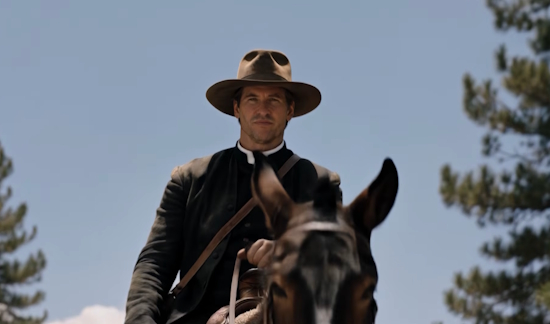
Val Kilmer Resurrected by AI: ‘As Deep as the Grave’ Releases Seven Minutes of Footage Featuring Younger Version of Actor
Exclusive: Filmmaker Coerte Voorhees used family archives and studied Kilmer’s work in “Heat” and “Batman Forever” to create the generative AI performance.
By Brent Lang
August 19, 2026
“As Deep as the Grave,” a historical drama that has generated headlines for featuring a performance from an AI version of the late Val Kilmer, has released nearly seven minutes of footage highlighting what the controversial technology has created.
In an IndieWire-exclusive clip, the AI-generated Kilmer’s character, Father Fintan, searches the Navajo Reservation with his “guide” (Jonathan Nez, former president of the Navajo Nation) for the origin of bad spirits poisoning the land. The scenes take place in the early 20th century, as Father Fintan tries to raise money to build a new church by collecting artifacts.
Kilmer, who died in 2025 after battling throat cancer, had originally been cast in “As Deep as the Grave” and was excited to appear in the film because it was set in the American Southwest, where he made his home in New Mexico. COVID delays and Kilmer’s illness prevented him from ever appearing on set. However, Kilmer’s family, including his children Mercedes and Jack, approved using AI to create a digital version of their father for the film. The production relied on SAG guidelines and compensated Kilmer’s estate for his appearance.
“We hope that we’re helping to lay the groundwork for how to do this properly,” said Coerte Voorhees, the film’s writer and director. “This process is about consent, collaboration, and compensation.”
The generated Kilmer we see on screen resembles the actor at the height of his 1990s fame. Voorhees said he studied Kilmer’s work in films like “Heat,” “Batman Forever,” and “Tombstone” to craft the performance.
“We are trying to be the best students of Val to construct this art creation of Val,” he said. “I have literally watched ‘Heat’ 10 times. There was a moment going through the footage where I saw Val walking and it was just like Doc Holliday.”
John Voorhees, the indie film’s producer and Coerte’s brother, argued the work with AI “makes the performance as true as possible to what Val wanted for this character, and that gets down to the way he grins, the way he has a very narrow stare, all of the things that make him such a powerful cinematic presence. My brother actually spends tons of time making sure that the digital performance is accurate right down to the mole on the left side of Val’s jawbone.”
Coerte Voorhees selected the scenes because they highlight the younger version of Father Fintan and because of their dramatic arc. “In the seven-minute sweep, you see that he’s wrestling with two identities — he’s a Catholic priest, but he has Cherokee heritage,” Coerte Voorhees said. “He’s conflicted.”
The AI-generated Kilmer will appear in “the ballpark” of an hour and 17 minutes of a film that currently clocks in at over three hours. The project uses both younger images of Kilmer, many of them provided from his personal archive by his family, and footage from his final years to show his character over several decades. The audio also utilizes recordings of Kilmer’s voice, which, in his later life, was damaged by a tracheal procedure. “As Deep as the Grave” combines the AI elements with filmed sequences involving a cast that includes Abigail Lawrie, Tom Felton, Wes Studi, and Abigail Breslin.
After premiering a trailer for the film last spring at CinemaCon, Coerte Voorhees said he’s spent most of the summer working on the Kilmer scenes. “It’s been about fleshing out the character and his backstory,” he said. “It’s a lot of work. Right up until the release of this clip, there was a version where Val looked slightly older in some shots and slightly younger in others, so you just have to go through and really make it consistent. Every beat counts.”
Despite its groundbreaking use of AI, “As Deep as the Grave” is a low-budget endeavor. But the technology is relatively affordable — John Voorhees pegs the cost in “the thousands.” “It’s remarkably inexpensive, and that’s helpful because we’re independent filmmakers,” Coerte Voorhees said. “We’re not on some huge studio budget.”
The brothers say that they’ve had a lot of interest from buyers and have ideas about what might make a good home for the film. “We’ve had meetings with the streamers, and they’re learning from us about how we’re doing this because we’re still the only film that has an A-list celebrity who’s given his consent to be an AI character,” John Voorhes said. “Nobody’s done AI characters on screen in this way, so this is something that’s still new for them. We would like ultimately to find a home with a streamer that wants to use this film as an example of a well-done generative AI performance combined with actual in-camera footage.”
And the brothers think that the estates of other celebrities might benefit from these types of productions. “We do love people from the past, and we want to stay connected to them,” said John Voorhees. “But it has to be done with consent and compensation. It has to be done right.”
Watch the exclusive [6:55 minute] clip [in the original story or via YouTube].
—
[From Vanity Fair]
The Filmmakers Bringing Val Kilmer Back to Life—and Stoking Anxiety About AI ‘Ghostploitation’—Explain Themselves
The creatives behind As Deep as the Grave—and Kilmer’s daughter—say the late actor would be happy for his likeness to “star” in this independent film. But others warn that projects like this could be setting a disturbing precedent.
By Joy Press
June 17, 2026
[snip]
As the technology improves exponentially, many in Hollywood are starting to feel increasingly jittery about where all this is leading—and about the prospect of a battle brewing over famous dead bodies.
Could a late famous actor’s careful career choices and dedicated artistry soon be soiled by posthumous AI slop? Might entire generations of potential stars be eclipsed by the unnaturally prolonged radiance of AI ghosts, superstars who refuse to stay in the past? Are we hurtling toward a world of ghost-ploitation?
[snip]
Although an AI replica might now get the same fee as a corporeal performer, using the replica can still save a lot of time and money. Instead of having to pay a crew for a week’s work in the New Mexico sun, the Voorheeses created new scenes with Kilmer entirely using AI. In some of them, Kilmer’s character even speaks an authentic 1920s version of the Navajo language, although the actor himself didn’t speak the language when he was alive.
“As independent filmmakers, it’s the most freeing thing,” Coerte says. “I love working with talent. But AI allows us to really reduce the elements that make it so complicated and expensive to tell a story. My friends feel lucky if they get one movie or one pilot a year. If you’re working with filmmakers of the modern era, you’re gonna be able to make 10 feature films a year.” John believes that the traditional way of making films—shooting on a set with a human cast and crew—is going to become “a niche, bespoke thing, like theater productions.” As Deep as the Grave’s production process, meanwhile, will become the norm.
To an AI skeptic, the Voorhees brothers’ manic enthusiasm for this tech can feel chilling. “One of the best things you learn very quickly is to actually just let the AI do as much of it on its own as possible,” Coerte raves. “It often comes up with even better ideas than you come up with. It’s trained on the best of everything.”
[snip]
Earlier this year, Cate Blanchett, Scarlett Johansson, Joseph Gordon-Levitt, and hundreds of other performers threw their support behind Stealing Isn’t Innovation, an initiative launched by the Human Artistry Campaign to protest AI’s unauthorized use of copyrighted material. Blanchett also cofounded the nonprofit RSL Media, which later this month is launching a public registry that will allow creatives to specifically grant or withhold AI permissions.
[snip]
Using a person’s voice or likeness after death without permission is a form of “digital grave robbing,” Hexum says. “Instead of taking jewelry or bones, though, it’s taking something that was deeply personal. The idea that that could be dug up and sold and made to perform words that they would never have chosen to use raises very serious ethical questions. Did the person agree to this when they are alive? Who gets to decide what their voice says now? Who profits from it? Does the AI version honor who they were?”
[snip]
The prospect of a world where art and entertainment are disconnected from human presence is nauseating. And as AI technology continues to improve, the queasy questions swirling around it will only multiply. “I’m hoping that this is the beginning of a very thoughtful conversation,” Hexum says. “But we will probably fuck it up before we make it right, because we’re human.”
Leave a Reply