[Presence-evoking virtual reality, especially with the addition of scents that correspond to the sights and sounds it provides to users, can bring isolated users some of the cognitive and emotional benefits of being in natural outdoors environments. As this story from Texas A&M University (and also available via Phys.org) notes, those users include not just the extreme case of astronauts. Others who may benefit include sailors (such as those currently on the USS Abraham Lincoln), office workers, those with limited mobility, etc. –Matthew]
[Image: Credit: Texas A&M Engineering]
VR supports research into spaceflight-related mental health
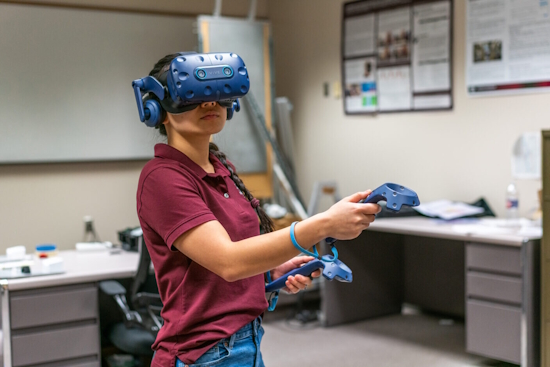
The Texas A&M study used sailors on a U.S. Navy ship to track the cognitive and emotional benefits of virtual reality nature scenes in an effort to reduce negative emotions and effects.
By Marina Vences, Contributor
August 19, 2026
As humanity gets closer to the possibility of long-term interplanetary travel, psychologists have started to raise concerns about mental health wellness in astronauts. Researchers at Texas A&M University conducted research on sailors in an isolated environment to address these concerns with virtual reality technology and by introducing other senses to the experience, such as smell and touch.
The study, led by Dr. Ana Diaz Artiles and funded by NASA, focused on subjects aboard a U.S. Navy ship who were confined to the vessel for two weeks. Those subjects were given HTC Vive Pro Eye headsets with real-world scenarios built in, such as a walk on the beach or a stroll through the park. The simulations were programmed to match a device called a compact scent generator that was preloaded with specific scents that were released at corresponding times.
“We all recognize certain distinctive smells, like the smell in the air just before it rains,” said Diaz Artiles, associate professor in the Department of Aerospace Engineering. “We wanted to explore what it would be like to put on a headset, see a forest, and at the same time smell the earth and vegetation around you, creating a much more realistic and immersive experience.”
The combined setup took four years to develop before the team was able to deploy the technology in an operationally relevant environment. According to Diaz Artiles, the ship was selected because it’s the closest representation to what the environment would be like in a confined and isolated spaceship for a long period of time.
The distance necessary to travel to Mars or other planets prohibits NASA from employing the current methods to improve mental wellness in astronauts, such as facilitating real-time conferencing with loved ones and delivering care packages.
“Nature has a lot of psychological and physiological benefits, it also has cognitive benefits,” said Renee Abbott, aerospace Ph.D. student. “What we’re trying to do is bring nature to astronauts in virtual reality.”
Results from the study showed that subjects with access to the VR headset and compact scent generator demonstrated a decrease in negative emotions and an increase in positive emotions immediately after use.
Diaz Artiles emphasized that the real-world applications of this research could go beyond astronauts. It would also serve to help other U.S. Navy sailors who spent long periods of time in submarines and warships with limited access to the outside world. She also said it could help long-term patients in hospitals who cannot leave for health or safety reasons.
“It’s remarkable how immersive VR can feel, even if you know the experience is not real,” said Diaz Artiles. “I think this technology has the potential to benefit a wide range of people, from office workers to individuals with limited mobility. It could give people access to experiences and environments that may otherwise be difficult to reach, and I believe that this could have an impact on pretty much anyone, from office workers to people with limited mobility. This can help a lot of people.”
—
Media Contact:
Alyson Chapman
Engineering News Staff
[email protected]
Leave a Reply