[This story from the United States Air More Material Command describes another valuable application of presence-evoking virtual reality: Training the people who paint military aircraft. See the original version of the story for a second image. See also the new related story (with video) from aviation manufacturer Boeing titled “Virtual reality makes aerospace painting safer.” –Matthew]
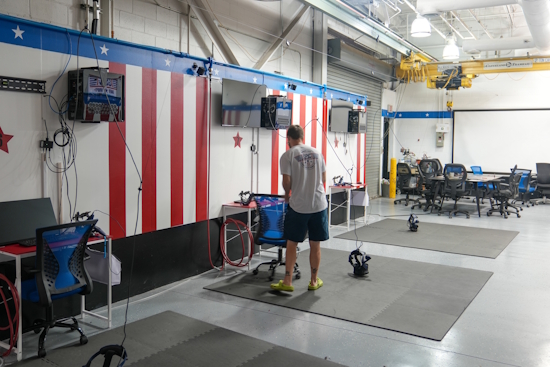
[Image: Wyatt Strickland, 402nd Aircraft Maintenance Group Virtual Reality paint instructor, organizes the equipment in the virtual reality lab at Robins Air Force Base, Georgia, Sept. 10, 2026. The bays were designed as exact replicas of the paint hangars used within the Warner Robins Air Logistics Complex. Credit: U.S. Air Force photo by Jasmine Braswell]
Virtual reality paint training keeps aging warbirds flight ready
By Jasmine Braswell, 78th Air Base Wing Public Affairs
October 29, 2026
ROBINS AIR FORCE BASE, Ga. — When an aircraft sits grounded on a flight line or depot floor, every passing hour is counted against mission capability. In depot maintenance, these delays are measured in “flow days” – the critical downtime required to strip, inspect, repair and paint vital components.
One of the most critical front lines of aircraft survivability and operational readiness is only fractions of a millimeter thick: the paint.
At Robins Air Force Base, Georgia, maintaining airframes, to include some that have flown for 60 or 70 years such as C-130s, demand rigorous corrosion prevention. Even minor defects during paint application can snowball into severe operational liabilities. To eliminate deficiencies, standardize techniques and accelerate turnaround times, maintainers across the 402nd Aircraft Maintenance Group and 402nd Commodities Maintenance Group with the Warner Robins Air Logistics Complex are utilizing virtual reality headsets before picking up physical spray guns.
“Paint plays a big role in aircraft maintenance and corrosion prevention,” said Wyatt Strickland, virtual reality paint instructor. “We’ve got airframes that are 60 to 70 years old. As these parts and components corrode and wear down, it causes delays in mission readiness. Aircraft are grounded, unable to fly missions while pilots wait on them.”
The Virtual Reality Paint Training program represents a high-tech evolution in craft preservation, blending decades of hands-on technical tradecraft with real-time digital simulation.
Aircraft coatings are sophisticated protective barriers, not cosmetic finishes. When applied improperly, the consequences extend far beyond uneven color.
If a flight control surface begins to delaminate, the aircraft is immediately pulled from operational status for emergency composite repair or component replacement. In the worst-case scenario, delamination can manifest mid-flight jeopardizing aircrew safety. VRPT directly addresses these vulnerabilities by establishing rigorous quality standards before technicians ever set foot in production hangars.
The VRPT lab offers an expansive dedicated space equipped to simulate real-world flight line and depot conditions. The simulation does not rely on generic sanitized training rooms. Instead, developers built exact digital twins of the installation’s maintenance bays. Everything from fire extinguisher placements and wall distinctions down to safety harness tethers and paint cart staging is accurately mapped.
The hardware in the student’s hand is identical to shop-floor equipment, replicating the exact spray guns, pressure pots and nozzle configurations used during active depot operations.
The VRPT program follows a progression designed to accommodate apprentice painters as well as seasoned technicians expanding their certificate.
Technicians begin on flat test panels and broad, uniform surfaces on aircraft such as the C-5 and the RQ-4 Global Hawk.
“If you can’t paint a straight paint stroke and coat a flat test panel like a wall, you’re not going to be able to paint an F-15 or an F-16,” said Strickland.
Some fundamentals of this baseline phase drill muscle memory for speed, steady trigger squeeze, overlap percentages and gun attitude. Once fundamentals are proven, students tackle complex component geometries. Technicians must continually adapt their angle of attack, adjusting movement across compound curves without allowing paint to thin out over leading edges.
The program runs an intensive, five-day syllabus structured around a cohesive team-teaching approach. Veteran maintenance instructors, who bring more than 30 years of tradecraft experience, guide students through technical orders, hazardous material safety regulations, environmental compliance standards and paint mixing chemistry. Students transition directly to the VR simulator bays to apply classroom concepts into muscle memory.
Hundreds of military and civilian personnel in AMXG and CMXG have already been training using the VRPT program, covering almost the entire depot painting workforce across different facilities.
“We’re keeping more aircraft in the air,” said Strickland. “We’re keeping things flowing more consistently and providing aircrews a safe piece of equipment that’s going to last longer because of what we’re doing out here.”
Leave a Reply