[Some context for today’s pre-Halloween post: In Lombard and Jones (2015) we identified types of presence referenced in published works, including one we labelled “parapresence,” in which “the aspect of the phenomenon that is of primary interest is related to social entities (human, electronic and otherwise), specifically their perceived physical presence in one’s environment when they are not, and could not logically be, present.” Here are some sample definitions:
- “Widows’ ongoing attachments to their deceased husbands and a sense of their presence” (Conant, 1993, 1996)
- “The sense of ‘a presence’ or of a sentient being” as “during partial sensory deprivation and exposure to very weak, complex magnetic fields across the cerebral hemispheres” (Persinger, 2003)
- “The sense of a presence, which may be the common phenomenological base from which experiences of gods, spirits, angels, and other entities are derived, is a right hemispheric homologue of the left hemispheric sense of self.” (Cook & Persinger, 1997)
- “The phantom double which is only felt, but not seen, is the autoscopic phenomenon most similar to the phantom limb (which is also only represented in the somesthetic modality). As a phantom limb, also the “felt” being can be localized very precisely in near extrapersonal space. The phenomenon is commonly labelled “feeling of a presence” (Brugger et al., 1996), but is also known as “Anwesenheit” (Thompson, 1982), “concrete awareness” (“leibhafte Bewusstheit”, Jaspers, 1913) and “false proximate awareness” (Koehler and Sauer, 1984). … [E]xhausted mountaineers frequently overcome hopeless situations by caring for ‘the other’ who climbs with them, and whose presence is felt compellingly enough to be offered food (e.g., Smythe, 1934). These observations suggest that the feeling of a presence rests on postural and kinesthetic representations of one’s own body that are falsely localized in extrapersonal space.” (The somesthetic phantom double) (Burgger, n/d)
The story below from IFL Science describes what might be another example of parapresence. See the original version for some related videos. For a related story, see “I See Dead People” from Psychology Today. Happy Halloween… –Matthew]
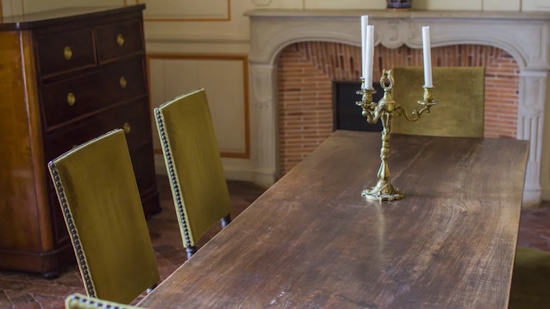
[Image: Credit: Mihai Surdu / Shutterstock.com]
The 1970s Philip Experiment: What Happened When A Group Of Scientists Made Up A Ghost And Tried To Talk To It? It Talked Back
Things got surprisingly weird for a seance that should have been doomed to fail.
By Rachael Funnell, Senior Science Writer
Edited by Katy Evans
October 21, 2026
In the 1970s, a group of scientists set out to investigate if the spooky events reported in seances were caused by nothing more than the people conducting them. To do so, they decided to hold a very different seance of their own – one that tried to communicate with a ghost they had made up.
They named the spirit Philip and spent several years trying to talk to him. Weird thing is, Philip the imaginary ghost turned out to be surprisingly interactive.
In science, we refer to spooky events as anomalistic phenomena. The study of anomalistic psychology searches for non-paranormal explanations for the seemingly paranormal.
Things moving around when they ought not to be is known as psychokinetic phenomena, and it was this sort of activity the Toronto Society for Psychical Research was most interested in. Before they could go looking for it, they had to make up their ghost.
How to build a ghost
It was decided it would be a man known as Philip Aylseford, Lord of Diddington Manor, which was a real place one of the scientists had previously visited. Like all good ghosts, Philip needed a backstory rich in traumatic events.
They decided he’d had an unhappy and politically motivated marriage. One he betrayed when he fell in love with another woman, only for his cruel wife to accuse her of witchcraft and have her executed.
Philip, bereft, ended his own life by throwing himself off a high wall. A story ripe for a haunting filled with tragedy, betrayal, and unfinished business. One that was, of course, also entirely made up.
Once his story was fleshed out, it was time for the seances to begin. Unlike those you see in the movies, these meetings were conducted in a well-lit room and were not led by an allegedly gifted medium.
At first they attempted to communicate with Philip through quiet meditation. Nothing much happened in the first year, so they opted for techniques mirroring those used in 19th century seances, which often included singing hymns, making jokes, and having casual conversations. After that, things got much more interesting.
Is there anybody there? Knock once for yes
A few sessions in, the table started vibrating and sliding around the room. Nobody sat around it appeared to be responsible, and when someone asked if it could be Philip, they heard a knock.
Philip started to scratch and knock on the table, often in time with the songs they were singing. The table itself tilted and even almost levitated, seemingly of its own accord. The electric lighting also appeared to be disturbed by Philip’s “presence”.
They started to ask questions, with one knock for “yes” and two for “no”, to see if Philip could answer them. Notably, pretty much everything he “said” could be attributed to the knowledge of the people sitting around the table.
In time, the scientists said Philip started to feel like an additional member of the group. A remarkable turnaround considering they were all still aware of the fact that he was entirely fictional.
All in the mind?
A leading argument for the sceptics of “paranormal activity” is that spooky things are more likely to happen to people who believe in them. This was the conclusion of a “haunted room” experiment that created its own “ghosts” by manipulating electromagnetic fields and found none of this tinkering was as significant as a person’s suggestibility.
The Philip experiment might seem like a slam dunk, then, except the people involved were all primed in a different way. They might not have thought they were interacting with spirits, but they did share the belief that the human mind was all you needed to experience paranormal activity.
As for that bizarre psychokinetic phenomena, sceptics likely have that covered, too, with what’s known as the ideomotor effect. It describes how a person’s thoughts can result in tiny unconscious movements, like the sort of stuff you see when someone gets a Ouija board out.
Interestingly, that wasn’t how some of the original experimenters saw it. In a 1977 publication of The Journal of Borderland Research, lead experimenter George Owen, a professor of genetics and mathematics at Cambridge University, said:
“Although members of the group speak directly to Philip and more or less treat him as a real person, he’s actually just an imaginary device for focusing the group’s mental energy. This focused energy generates what we believe are legitimate and repeatable examples of psychokinesis – or moving matter with the mind.”
It was Owen’s belief that the study demonstrated psychokinesis could be taught to anyone, and that the group intended to train more people both in Canada and the US. Makes you wonder, if they were right, where’s this psychokinetic army now?
However, as Filip Andjelkovic of the University of Toronto makes the case for in his 2023 paper on the Philip Experiment, it could be argued that whether or not the group’s minds were moving matter is beside the point. Its significance, he argues, instead rests in how the group’s “dreamy state” allowed them to have a shared experience of seemingly inexplicable phenomena, and collectively encode them as transformative events.
“Such experiences instead afford us insight into the interrelatedness between matter and minds – inner and outer experience,” he explains. “It is highly likely that the individuals of the Philip group would not have been able to produce the same experiences alone, or under less intersubjectively amenable conditions, because their experiences were entangled with a shared, dreamy state of altered consciousness.”
So, if you’re looking for something different to do this Halloween, why not grab a few friends and see if you can come up with your own ghost? You might be surprised by what happens.
Leave a Reply