[An assistant professor of gaming at Kennesaw State University in Georgia (US) has a National Science Foundation (NSF) grant to investigate how we can use personalized, AI agent guided, multisensory VR experiences in STEM (chemistry and computer science) courses to “help learners maintain attention, improve motor skill, and enhance learning in immersive virtual laboratories.” See the project’s NSF page and Professor Jung’s LinkedIn page for more details. –Matthew]
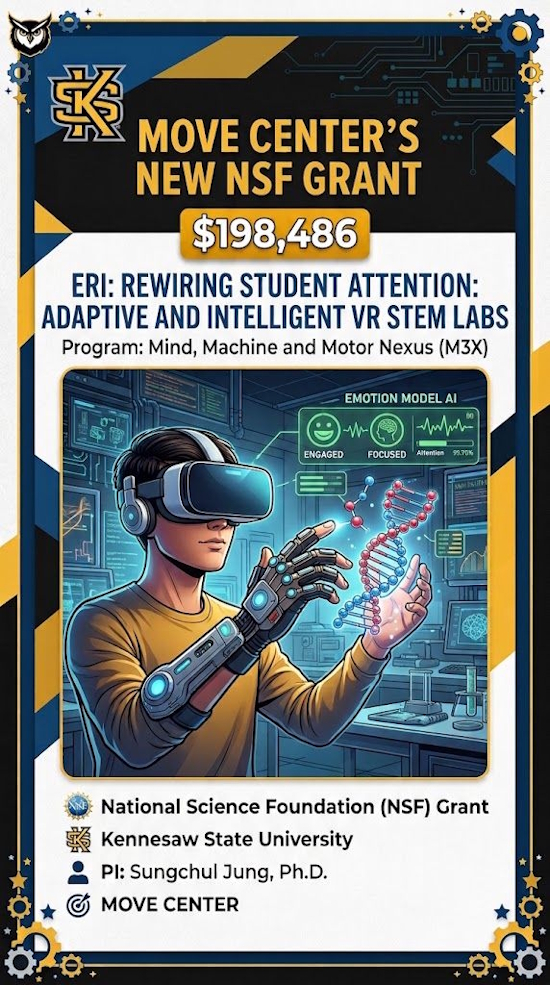
[Source: LinkedIn]
Kennesaw State researcher explores virtual reality to improve student engagement in STEM
By Raynard Churchwell
October 26, 2026
KENNESAW, Ga. – A Kennesaw State University researcher is exploring how virtual reality can help students stay focused and engaged during science and engineering laboratory activities. Supported by a $198,486 grant from the National Science Foundation (NSF), the research aims to help learners maintain attention, improve motor skill, and enhance learning in immersive virtual laboratories.
Sungchul Jung, an assistant professor of gaming in KSU’s College of Computing and Software Engineering, is leading the two-year project. The research will develop an adaptive intervention framework designed to help learners sustain and reorient attention without disrupting the learning flow during the virtual STEM laboratories. The project builds on Jung’s previous research on immersive learning and empathic computing in virtual reality.
Scheduled to begin in January 2027, the research could provide a more interactive alternative to traditional online learning.
“The main goal of this project is to help students maintain their attention throughout their learning experiences,” Jung said. “When attentional lapses begin, we want to find ways to bring them back into the learning experience through empathic and personalized interventions.”
The project will combine multisensory tactile gloves with a VR headset to simulate the sensation of touching and handling objects. Students could conduct virtual chemistry experiments or assemble electronic components, gaining hands-on experience without being physically present in a laboratory.
The system will monitor physiological signals such as eye movements, muscle activity, and task performance to identify changes in attention. When a student’s attention lapses, an empathic agent will dynamically adapt its verbal and nonverbal behaviors to help redirect attention toward the learning task without interrupting the learning experience.
Jung will conduct studies in virtual chemistry and computer science laboratories to determine whether these personalized interventions are more effective than traditional alerts. The research will also examine whether skills developed in virtual environments can transfer to real-world laboratory activities.
His long-term vision includes immersive virtual schools and universities where students can interact with instructors, classmates, and virtual tutors, that replicate key aspects of in-person instruction while retaining the flexibility and accessibility of online education. The research could make STEM laboratory experiences more accessible while giving educators new ways to support student engagement.
This research is supported by the National Science Foundation under Award No. 2552861.
Leave a Reply