[This story from National Defense Magazine describes an omnidirectional treadmill that allows virtual reality users to wear regular footwear and move naturally without a harness. It’s being developed by a startup company for use in military training but has obvious application in other contexts. For more information including a demo video, see the OmniTrek website. –Matthew]
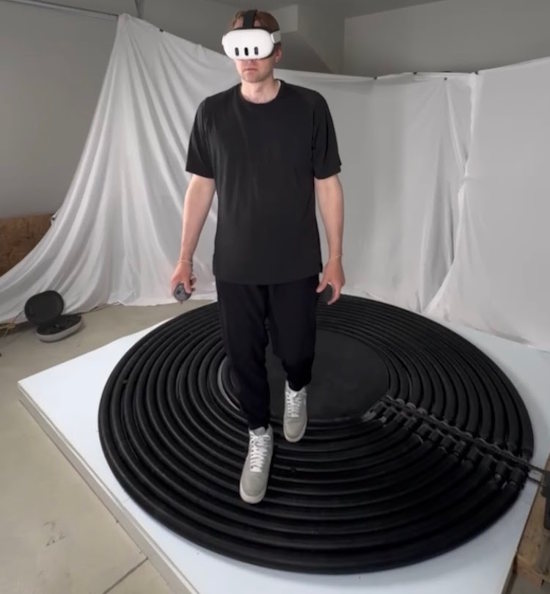
[Image: Source: OmniTrek]
Virtual Reality Treadmill Simulates Military Training Scenarios
By Colby Lamb
July 21, 2026
ARLINGTON, Virginia — A Utah-based startup is developing an omnidirectional treadmill to simulate military training scenarios inside a virtual reality environment.
OmniTrek’s proof-of-concept prototype for the omnidirectional treadmill uses virtual reality to simulate real-world battlefield experiences. The idea originated when the company’s founder, Bennett Mortensen, was a student at Brigham Young University, but it became a “serious project” over a year ago, Mortensen said in an interview.
The treadmill is a circular track with one motor that powers eight feet in diameter of compliant rollers that move in response to the operator. Other omnidirectional treadmills require special shoes and a harness, but the OmniTrek utilizes high-fidelity movement in regular shoes and no harness, Mortensen said.
Eventually, the treadmill will likely grow in size to allow for increased speed, “because we would like you to be able to actually run pretty close to a sprint on the full device,” Mortensen said.
Applications for OmniTrek include situational awareness for military teams and scenario training, he said. The device allows a unit to virtually go through real battlefield experiences and train and adapt to different scenarios that may arise.
Defense use cases include dismounted movement, patrols, room clearing, situational awareness and mission rehearsals that depend on how warfighters physically move through space, the company’s website said.
Mortensen is also developing a virtual reality headset with embedded software that synchronizes with the track. The company would like to work with other augmented reality companies to utilize features like outward-facing cameras that would be easily accessible to users when starting in the middle of the track, he said.
“The lack of ability to move in the VR space organically just really breaks the immersion,” Mortensen said. “The second you bump into a chair or your hand hits a wall, you’re thrown back into reality. This is one of the last missing pieces to have that high-fidelity movement in VR at a price point that the average consumer can afford.”
OmniTrek is currently seeking strategic partners and funding support to move from proof of concept toward a pilot-ready system, and the company would “love to have a champion inside of the military who understands how impactful this could be and could help us,” Mortensen said.
Leave a Reply