[High-end technologies designed to evoke spatial and social presence have come a long way in the last few decades, as can be seen in this story from AV Magazine about the latest products from the company Noro. See the original version of the story for two more pictures, follow the links at the end for videos of the latest tech, and for more details visit the Noro website. –Matthew]
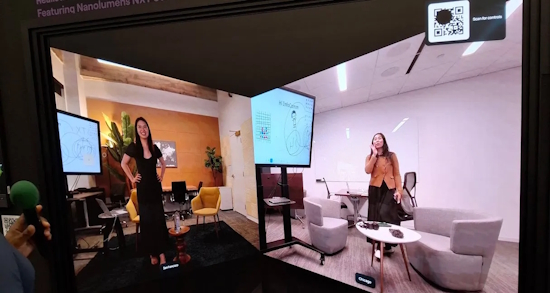
Is Tommaso Trionfi taking the next turn in telepresence?
The CEO of Noro and his team are combining an LED wall with an embedded central camera, companion touchscreen, collaboration tools and AI meeting agent.
By Guy Campos
June 24, 2026
“Seventy per cent of communication is non-verbal,” says Tommaso Trionfi, cofounder and CEO of next-generation telepresence company Noro.
“And maybe for an Italian like me, it’s eighty-five per cent,” he adds.
He makes this remark twice when I am around. The first time is at the Nanolumens stand at InfoComm 2026 where I am looking at the first formal trade show demo of the Noro Portal telepresence system with a Nanolumens NXT COB LED Series video wall.
The second time is later on, at an InfoComm panel discussion he is moderating on designing for presence in enterprise collaboration spaces where he is joined by speakers from Meta, Steelcase and AVI-SPL XTG. At the panel, he thanks one of the speakers, Julian Phillips, SVP and MD of AVI-SPL XTG, who had given him advice on market positioning and next steps for the product.
The observation he repeatedly makes about non-verbal communication is designed to explain the appeal of telepresence and draw attention to the limitations of conventional videoconferencing which cuts people’s bodies off from the waist or neck upwards and often cramps them into a small space on screen.
Trionfi has a somewhat unusual background for someone at an AV trade show, having started his career in merchant banking in London, before switching to entrepreneurship after an MBA. He went on to be the founding-team CEO of Wimba, a virtual classroom solution which grew to have 800 customers and was acquired by Blackboard. He was also founding-team CEO of a virtual event solution and went on to work as a CEO in private equity.
It was the experience at Wimba which gave him an insight into the benefits of connecting people at a distance in education. “You could see people really learning a lot,” he says. “Our motto was ‘people teach people’. It wasn’t about technology.”
After his latest exit from a private-equity firm, he decided to go back to what he loved, he says, and fix videoconferencing. But the challenge is different now from the one he faced with Wimba 20 years ago, before Webex was even bought by Cisco.
In making his pitch, and in talking about all that is lost when you can’t easily see people’s body language, I expected him to make reference to the pandemic, or to Zoom and the spread of cloud-based videoconferencing platforms on laptops.
Instead, he talks about AI. “AI is going to flatten intelligence,” he says. “Your AI is not going to be a lot better than mine. So how are teams going to win? By being together and strategising more.”
You need to move fast, “because AI is super fast”, but you cannot be in Chicago, New York or Atlanta for five hours at a time, to see customers, prospects, teams and a friend without a lot of travelling. It might make sense to go for a few days at a time to each location, but one-day travel is something telepresence can eliminate.
The lifesize Portal telepresence solution Noro is showing on a big LED screen at the Nanolumens booth at InfoComm has three layers to it, Trionfi says. There are infrastructure, collaboration and intelligence layers. At the level of infrastructure, it is showing lifesize images of people in offices in Chicago and San Francisco connected through their own Portals.
At the level of collaboration, there are tools such as shared whiteboarding screens that can be used. At InfoComm, there is a companion touchscreen to the right of the Portal. The content you create on it appears automatically on connected whiteboards in both of the two remote offices you can see through your Noro Portal. But other collaboration software and devices can be connected in this way, too. You can, for example, cast from your phone.
Then, at the level of intelligence, there is an AI agent that runs alongside meetings. This is used to ensure that all participants have to do is bring their things to the room and act naturally, and it can also provide all the usual AI meeting features such as summaries and action points.
From a hardware point of view, the most interesting thing about the Noro Portal demonstrated at InfoComm is the presence of a camera embedded in the centre of the Nanolumens LED screen at the approximate eye level of a user. This is something that wouldn’t have surprised me in the case of a projection screen but it feels advanced for LED. Trionfi says the Noro Portal usually has three cameras and they will be available with LED soon with image stitching.
Noro Portal is being developed at a time when other companies are also looking at bringing more presence to meetings, and there are also HP Dimension for Google Beam demos at InfoComm 2026. Google Beam is a partner, Trionfi says, even attending the same dinner with industry experts, but it has a different positioning, aiming to offer 3D videoconferencing at a more affordable price to a very large number of users in offices and homes. “We are orthogonal to that,” Trionfi says, aiming solely at the office. He says the companies are both launching a category of immersive telepresence.
Asked about other solutions in the market, Trionfi says that they use a flat screen against a wall. If you want to whiteboard, you would have to use the same screen, unlike Noro Portal which can use a companion touchscreen. “When I whiteboard, I want to see you,” Trionfi says. With Noro Portal, he can add a post-it note to his whiteboard and see it appear on the whiteboard at the remote location.
Another comparison you could make is with Cisco Webex Room Panorama, which Trionfi views as having limitations. This sold for a low-to-mid six figure price but the Noro Portal, with the Nanolumens NXT series, comes in lower than that with an MSRP of $132,000.
When looking for customers for Noro Portal, Trionfi started in education, where he had his prior experience, and the company has around 15 or 16 customers there. These customers originally had a projector-screen based solution but are now beginning to switch to LED. Customers include Boston College, Chaminade High School, Dartmouth College and the University of Melbourne.
In the corporate world, which Noro Portal is now launching into, customers include JLL (also an investor) and CX AI. A well-known Silicon Valley giant has had the product clear security review and is deciding between leasing and purchase, and there are conversations ongoing with other tech, property, investment and FMCG companies.
All of this has been achieved to date by word of mouth. “We are just a bunch of engineers with no sales force,” Trionfi says.
The company now has investment for the next stage which will see whether the next turn in telepresence belongs to the Noro Portal.
The Noro Portal has been filmed at InfoComm 2026 in two videos, available here:
Leave a Reply