[A new humanoid robot named Codey is designed to use embodied decentralized artificial general intelligence (AGI) to autonomously interact with humans in ways that evoke social presence in a variety of public and private environments. This story from Interesting Engineering describes the robot and its current and planned capabilities; see the original version for a 4:07 minute video (also available on YouTube). The excerpts from coverage in USA Today that follow below provide additional context, including comments on how children and adults respond to Codey and concerns about the prospect of similar robots becoming a regular part of our lives (see the original version of that story for several more images). –Matthew]
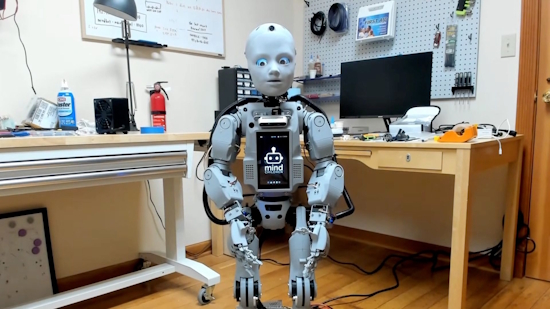
Video: Child-friendly Codey humanoid robot showcases embodied AGI future in education, healthcare
Codey operates independently, using sensors, onboard computing, and AI to navigate, understand, and interact in real time.
By Jijo Malayil
June 18, 2026
A Seattle-based robotics company has developed a three-foot-tall humanoid robot designed for use in public attractions and venues.
The AI-powered robot named Codey can navigate autonomously, engage in conversations without remote human control, and make independent decisions.
While not yet capable of performing complex physical tasks such as fetching objects, Codey is being developed for future roles in healthcare, education, and hospitality.
The company says the robot is designed to interact naturally with people, particularly children, in public-facing environments.
Codey targets companionship
Codey is designed to serve as an interactive companion in public-facing environments. Standing about three feet tall, the robot features glowing hazel eyes, expressive facial animations, and a friendly appearance intended to engage users, particularly children.
Powered by AI, Codey can navigate autonomously, hold conversations, and make basic decisions without requiring a remote human operator. Unlike many robots that rely heavily on teleoperation, Codey is designed to function independently, enabling more natural and responsive interactions with people. The robot uses a combination of sensors, onboard computing, and AI software to understand its surroundings and communicate with users in real time.
Mind Children plans to conduct pilot studies this year in museums, hotels, and art galleries to gather data and refine Codey ahead of mass production. One of the company’s near-term objectives is to enable the robot to perform simple physical tasks, such as pressing buttons. A second-generation version of Codey is scheduled for release in 2027. To support development, Mind Children has launched a crowdfunding campaign and has raised more than $600,000 toward its $1 million funding target.
In the longer term, Codey is expected to be introduced into healthcare, education, and hospitality settings. Potential applications include assisting visitors with information, providing companionship, supporting learning activities, and helping organizations deliver more engaging customer experiences.
Embodied AGI advances
At the core of Mind Children’s robotics platform is Hyperon, the decentralized artificial general intelligence (AGI) framework developed by SingularityNET. The system is designed to give robots advanced cognitive capabilities that go beyond traditional rule-based automation, enabling them to reason, learn, adapt, and make decisions in dynamic real-world environments.
By integrating Hyperon into its humanoid robots, Mind Children aims to create machines capable of understanding context, processing complex information, and responding more naturally to human interactions. The framework incorporates knowledge representation, reasoning engines, and human-inspired motivation systems that help robots prioritize tasks, pursue goals, and adapt their behavior based on changing circumstances. This approach is intended to move robots closer to exhibiting flexible, human-like intelligence rather than performing only pre-programmed actions.
Unlike conventional AI systems that rely on centralized computing and data control, Hyperon operates within SingularityNET’s decentralized ecosystem. This architecture allows AI services, knowledge resources, and computational capabilities to be distributed across a network, promoting collaboration, scalability, and interoperability among different AI agents and robotic platforms.
The partnership between Mind Children and SingularityNET positions the company among the first developers pursuing embodied decentralized AGI—an emerging field that combines advanced artificial intelligence with physical robotic systems. The goal is to create autonomous robots capable of perceiving, reasoning, learning, and interacting with the physical world while continuously improving their capabilities through decentralized intelligence networks.
—
[From USA Today]
This humanoid robot was built for connection. Some find him ‘creepy’
By Michelle Del Rey, USA TODAY
June 18, 2026
[snip]
Codey still has his quirks. During our interview [with Mind Children CEO Chris Kudla, Codey] frequently interrupted Kudla as he attempted to answer questions. He also can’t recognize emotions reliably unless a user is “very exaggerated and animated,” Kudla said.
The idea for Codey was born three years ago, when Kudla and Ben Goertzel, Mind Children cofounders, began developing the robot for human connection. To help him relate to humans, Kudla and Girtzel decided to give him a face, eyes and smile.
If and when Codey goes commercial, his primary demographics will be children and the elderly. Kudla wants the robot to be implemented in home care settings and elementary schools.
For that to happen, Codey will need to surpass numerous obstacles. And it’s not known how much consumer appeal the device might have. Though home humanoid robots are still in development, they’re likely to first be toys for the uber-rich. Price tags for the robots reach tens of thousands of dollars.
Even if they become accessible to the everyday human, people may not be comfortable with robots catering to their loved ones.
Adults call Codey ‘creepy,’ but kids seem to like him
Codey has received mixed reviews from humans so far.
“It’s interesting,” Kudla said. “The very first response from some adults is that it looks a little bit creepy.”
Children don’t respond in the same way, Kudla noted. At trade shows and pop-ups, kids interact with Codey in the way they would with a toy – without hesitation.
“They’ll talk to the robot before they talk to me,” he said.
Despite children’s fascination with the robot, Kudla said it’s too early to say whether Codey could eventually take on additional roles, like babysitting.
“We’ve talked about that,” he said. “The industry in general is probably a long way away from that, but it’s definitely on our list.”
What might be closer is using Codey for elderly home care. Kudla believes the technology could be helpful for people choosing to age in place and combat loneliness.
Could Codey be used as a caretaker?
An October 2025 study from nursing researchers in South Korea found robots could be critical in assisting elderly populations. The country is experiencing one of the fastest-growing older-adult populations and became a super-aged society last year.
About 95% of older adults prefer to grow old in their homes due to psychological benefits, the study states.
Patients with care robots have experienced psychological and emotional benefits, as well as positive effects on cognitive function.
But not everyone is convinced robots should be used as babysitters or elderly care workers.
Patrick Lin, director of the Ethics and Emerging Sciences Group at California Polytechnic State University, San Luis Obispo, doesn’t want adults punting caregiving responsibilities to technology.
“What tech company would you trust to raise your kids and take care of your parents?” Lin told USA TODAY. “That seems dangerous.”
Lin noted that using AI to power robots could also be problematic because the machines could encourage acts of violence. Moreover, kids who grow up with robots may have unrealistic expectations for social interactions if the machine is deferential.
“It can also distract from human companionship if a child or an older person gets overly attached to their robot caretaker.”
Still, he noted that there isn’t enough data to determine how the humanoid revolution might play out.
[snip]
Mind Children has launched a crowdfunding campaign to assist in its next stage of development. So far, the company has raised just over $600,000 of a $1 million goal.
How much will Codey be?
For a humanoid, Codey is cheap. The robot is set to retail for under $10,000. In comparison, the viral NEO home robot, which launched for preorders late last year, retails for $20,000.
Codey is more accessible due to its modular design and hardware. His unique features also help him interact with users.
Kudla says humanoid machines are advancing faster than the world can comprehend.
Someday soon, robots like Codey will be an everyday part of our lives, he said.
Leave a Reply