[A robot developed over several years by a diverse team of relevant stakeholders including engineers, clinicians and patients, and now capable of both telepresence and semi-autonomous or autonomous operation, is being tested in a clinical trial. The story below from the University of Pisa provides details and context (see the original version for two more images). For more information visit these websites: clinicaltrials.gov, SoftBots Lab of the Italian Institute of Technology, and the Natural Machine Motion Initiative; a 4:22 minute video of the robot from Liguria Notizie is available on YouTube. –Matthew]
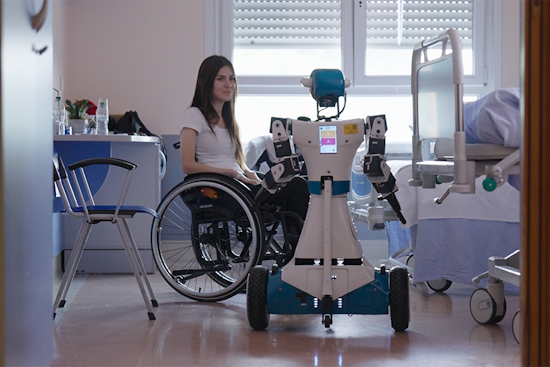
Maugeri, the Italian Institute of Technology and the University of Pisa bring robotics into hospital wards
ALTER-EGO is the first humanoid robot designed to support clinical staff in caring for patients with ALS
May 20, 2026
Humanoid robotics is taking a concrete step towards integration into everyday clinical practice thanks to ALTER-EGO, the robotic platform developed by the Italian Institute of Technology (IIT) and the University of Pisa, now at the centre of a pilot clinical study at IRCCS Maugeri Milan.
The initiative is part of the Fit4MedRob project, funded through the complementary programme to Italy’s National Recovery and Resilience Plan (PNC), with the aim of evaluating the integration of assistive humanoid robots into care pathways for patients with neurodegenerative diseases, particularly Amyotrophic Lateral Sclerosis (ALS), in both hospital and home-care settings.
ALTER-EGO is a humanoid robot approximately 120 centimetres tall that moves on two wheels and can operate via remote control, as well as in autonomous and semi-autonomous modes. It is equipped with two arms composed of compliant variable-stiffness modules that function as artificial muscles, enabling adaptive and safe movements.
To interact with the surrounding environment, ALTER-EGO uses the multi-articulated robotic hands SoftHand, capable, for example, of grasping and handing over objects or opening handles through the application of soft robotics principles.
These features allow ALTER-EGO to interact safely and gently with vulnerable patients and within complex environments such as hospital wards. The robot is therefore suitable for supporting clinical staff in care activities and assisting patients with everyday tasks.
The intuitive interface facilitates natural interaction and enables healthcare professionals to delegate repetitive and time-consuming tasks to ALTER-EGO, freeing up resources for activities requiring specialist or relational skills that robots cannot replicate. The platform aims to optimise clinical workflows and improve the quality of care for neurodegenerative diseases such as ALS. Areas of application were defined in direct collaboration with healthcare staff.
In telepresence mode, ALTER-EGO acts as an avatar for clinicians who, through immersive control devices such as a headset and joystick, can see through the robot’s camera-eyes and use its hands and voice to carry out, for example, remote follow-up visits. These are typical activities in home-care contexts, where the direct presence of healthcare professionals is more difficult to ensure.
In semi-autonomous or autonomous mode, ALTER-EGO can instead carry out repetitive daily tasks, including welcoming and guiding patients within hospital facilities, providing basic information and services, administering simple assessment scales (such as the Visual Analogue Scale for pain), and accompanying patients during different activities throughout the day.
“The ALTER-EGO project — (A)ssistive (L)iving and (T)reatment (E)nvironments for (R)obotic (E)quipment and (G)uided (O)perations — was conceived several years ago with the aim of using humanoid robotics at a particularly delicate moment in the patient journey: returning home after a period of hospitalisation, a phase we know to be critical both clinically and emotionally,” says Dr Rachele Piras, neurologist at IRCCS Maugeri Milan. “This led to the idea of using ALTER-EGO as a tool for continuity of care between hospital and community settings: not only as the ‘presence’ of the physician, but as an extension of the entire multidisciplinary team — physiotherapists, nurses and psychologists — initially in teleoperated mode (as an avatar) and later as autonomous support through videos, reminders and monitoring. The home-care simulations currently under way at IRCCS Maugeri Milan represent the first concrete step towards this future perspective.”
The project’s uniqueness lies not only in its technological dimension, but also in its methodology. From the earliest stages, the study adopted a multidisciplinary and participatory approach involving doctors, therapists, nurses, researchers, patients and caregivers. Through focus groups, field observations, feasibility analyses and usability studies involving non-expert users, researchers identified realistic usage scenarios and assessed their limitations, benefits and ethical implications.
“The goal of the collaboration between Maugeri, the Italian Institute of Technology and the University of Pisa is to create genuine dialogue between clinicians and engineers, enabling technology to respond to real clinical needs and clinicians to fully understand the potential of technology,” says Dr Christian Lunetta, Director of the Maugeri Neuromotor Rehabilitation Department.
“Focus groups involving all end users are one of the distinctive aspects of this project and made it possible to identify the specific tasks genuinely considered useful by both staff and patients for implementation on the robot,” explains Manuel Catalano, researcher and head of the NuBots Unit at the Italian Institute of Technology (IIT). “In particular, ALTER-EGO was perceived as a tool capable of reducing the workload of healthcare professionals, allowing them to dedicate more time to activities requiring clinical and relational expertise. Moreover, the results show a positive attitude towards the robot among all stakeholders involved and a high level of usability even among non-expert users.”
Six main application areas were identified: telepresence and teleassistance, support for daily living activities, delivery services, monitoring and safety, reception and orientation, and rehabilitation support. Among the most promising application scenarios are remote home assistance — in which the robot allows clinicians to support patients and caregivers in their homes — and its use for remote consultations, basic monitoring and facilitating communication with family members.
“The project is also looking to the future: solutions are currently being developed that will allow patients to directly control the robot through their residual movements, transforming ALTER-EGO from a clinician’s avatar into a true personal assistive device,” says Professor Antonio Bicchi, Professor of Robotics at the University of Pisa and researcher at the Italian Institute of Technology. “Overall, the study proposes a replicable model for the responsible introduction of advanced robotics into care settings, helping to bridge the gap between experimental research and real-world application. It is an important step towards a more innovative, sustainable healthcare system that is attentive to people’s needs, particularly in the field of neurodegenerative diseases.”
Leave a Reply