[In this essay from HackerNoon, neuropsychologist Nargiza Noimann-Zander argues that content, hardware comfort and time spent engaging with a user interface are less important in the success of virtual social worlds, and especially clinical applications, of immersive media technologies than presence. For more about the author, see a biography in CIO Times, the Noimann Academy website, and her ORCID profile. –Matthew]
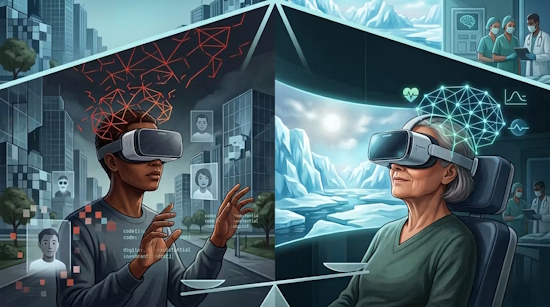
Why Clinical VR Is Succeeding Where the Metaverse Failed
By Nargiza Noimann-Zander, Neuropsychologist, VR therapy innovator, and founder of X-Technology. Focused on AI/VR solutions for cancer & Alzheimer’s.
April 28th, 2026
When Meta spent billions building a virtual social world and watched it fail, the autopsy focused on content, avatars, hardware comfort and whether people actually wanted to spend time together inside a headset. Those were reasonable questions. But they missed the more fundamental one: did the brain believe it was really there?
That question is not philosophical. It is neurological. And the answer explains both why the consumer metaverse collapsed and why clinical immersive technology is becoming one of the most significant therapeutic tools in medicine.
I have spent 25 years studying how the human nervous system responds to sustained stress, trauma and serious illness. For the last several years I have been building and deploying structured VR programs for patients recovering from cancer, dementia and burnout. What I have learned in clinical settings is something the consumer tech industry largely ignored: the brain does not evaluate virtual environments the way it evaluates content. It evaluates them the way it evaluates physical reality. And when the conditions are right, it responds accordingly.
Presence Is a Neurological State, Not a Feature
The concept of presence in immersive environments refers to the subjective sense of actually being somewhere. Researchers measure it, designers try to optimize for it and marketing teams use it loosely. What it actually describes is a specific state of the nervous system where the brain has downgraded its uncertainty about the reality of the environment and begun responding to it as if it were physical.
This matters enormously because the brain’s response to a perceived real environment is categorically different from its response to observed content. When you watch a film, your nervous system maintains a layer of protective distance. You know it is not real. When presence is achieved in an immersive environment, that protective layer thins. Physiological responses activate. Heart rate changes. Stress hormones respond. The autonomic nervous system adjusts. And critically, the mechanisms that govern emotional learning and memory consolidation engage.
This is why clinical VR works for pain management. When a burn patient is immersed in a cold virtual environment during wound care, the brain’s processing of incoming sensory signals is reorganised in a way that changes the subjective experience of pain at the neurological level. Not distracted. Reorganised. I have seen a similar dynamic in patients recovering from cancer treatment, where the nervous system has become so habituated to threat signals that ordinary sensory input is processed through a filter of fear. A well-designed immersive environment can interrupt that pattern in ways that conversation and medication cannot, because it bypasses the analytical mind and speaks directly to the physiological state.
Consumer metaverse builders optimized for the wrong thing. They built increasingly detailed social spaces and waited for people to find reasons to inhabit them. Clinical immersive designers ask a different question: what neurological state does this patient need to access, and what conditions will produce it?
Why Consumer Design Logic Is Dangerous in Clinical Settings
Companies now moving into clinical immersive technology from consumer backgrounds are bringing a product philosophy built for engagement. Time in headset. Return sessions. User retention. These metrics made sense for social platforms and games. They are a poor fit for clinical interventions and in some cases actively harmful.
Engagement is not the same as therapeutic effect. A patient can complete every session of a poorly designed VR protocol and receive no clinical benefit. A patient can also be harmed by an immersive environment that produces the wrong neurological state for their specific condition. Cybersickness is the obvious example. Less obvious are dissociation, heightened arousal in patients who need down-regulation and the blurring of internal and external reality in populations with certain psychological histories. These are documented risks that consumer design frameworks have no language for.
Clinical immersive design requires asking different questions. What is the target neurological state? What session duration is appropriate before diminishing returns appear? What screening criteria should exclude specific patients? What adverse response profile should trigger early termination? These are dosage questions, not engagement questions, and they require a clinical framework that most companies entering this space have not built.
What Actually Makes Clinical VR Work
The immersive environments that produce reliable clinical outcomes share characteristics that have nothing to do with production quality or content richness.
They are protocol-driven. The therapeutic sequence is defined in advance, tied to a specific clinical outcome and delivered consistently rather than varied for novelty. The brain learns through repetition and predictability.
They target the autonomic nervous system deliberately. The most effective clinical VR programs are designed to guide patients between specific states of arousal and regulation. The environment is not background. It is the instrument. Every visual element, soundscape and interaction pattern is calibrated to support the physiological transition the patient’s nervous system needs to make.
They treat sensory design as clinical design. The specific qualities of ambient sound, the degree of visual complexity and the demands placed on the user’s attention all have measurable effects on physiological state. In one patient I worked with who had completed chemotherapy, fifteen minutes inside a carefully designed low-stimulation immersive environment produced a measurable shift in reported pain perception and a reduction in the resting muscle tension that had persisted throughout her treatment. No new drug. No additional procedure. The environment did the work because the brain accepted it as real.
Where the Real Value Is
The consumer metaverse tried to replicate the experience of being somewhere. Clinical immersive technology is doing something more interesting. It is creating environments to which the nervous system responds with the same intensity as it does to physical reality, and using that to access psychological and physiological processes that other interventions cannot reliably reach.
This is not a niche application. The same principle that makes VR effective for burn pain applies to anxiety, cognitive rehabilitation, stress regulation and the recovery of bodily self-awareness after serious illness. The conditions that need to be met are neurological, not technological.
The companies that will matter in this space over the next decade are the ones that understand they are not building content. They are building conditions for the brain to change.
That is a different engineering problem. Almost nobody is treating it that way yet.
Leave a Reply