[Utrecht University researchers have used a cleverly designed presence experience to teach game players about the important but often confusing and controversial topic of evolution. There are more images in the original version of this story and more details in the researchers’ article in the European Journal of STEM Education. In the article they explain how their choice to have players take the role of fungi in the Zombie Ants VR game was in part because of the popularity of the HBO series and video game The Last of Us. They write that they used virtual reality because it ”provides an unparalleled sense of immersive presence and a strong association with virtual objects that promotes learning,” “allows players to experience an environment on limitless scales,” and because “using an immersive virtual environment assisted in our goal of dissociating the player from their personal perspectives to facilitate a more open mindset for the educational experience.” Table 1 in the (open access) article also includes the full wording of the questions and response options used in the study. –Matthew]
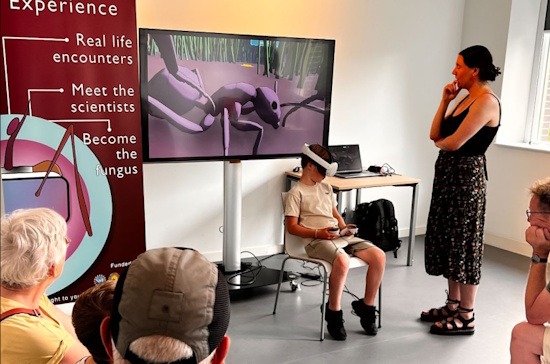
[Image: A visitor to the UMU plays the game under the supervision of Maite Goebbels]
Virtual reality game about zombie ants increases players’ understanding of evolution
Players take on the role of a zombie fungus
By Niels Kerstes, Press Officer
May 11, 2026
Playing a virtual reality game in which the player takes on the role of the zombie fungus Ophiocordyceps increases the players’ understanding of how evolution works. Last summer, Utrecht University zombie ant researchers William Beckerson, Maite Goebbels and Charissa de Bekker spent several weekends in UMU, the University Museum Utrecht, where they invited visitors to play the virtual reality game Zombie Ants VR: Definitive Edition. Comparisons between questionnaires completed before and after the game suggest that playing the game made the players more aware of how natural selection operates. The results were recently published in the European Journal of STEM Education.
Evolution is a process that is constantly happening all around us. For example, multi-drug-resistant micro-organisms are evolving as a result of the misuse and overuse of antibiotics.
“Understanding how evolution works is important for making informed decisions about the use of antibiotics and vaccinations,” says Beckerson. “Yet some people may not accept evolution based on religious or political beliefs. And even when people do accept evolution, they may misunderstand how it works.”
Moreover, teaching evolution can be challenging, as it might provoke emotional responses. That is why the team of researchers wanted to explore whether a game about zombie fungi infecting ants could be used to teach the principles of evolution intuitively, without explicitly using potential trigger words such as evolution and natural selection.
[Sidebar] Darwinian evolution by natural selection: how does it work again?
Within any group of living organisms (a population), there is variation: individuals differ from one another in various traits. These traits can often be inherited, meaning they are passed from parents to offspring through DNA. If certain inherited traits help individuals reproduce more successfully than others, those traits tend to become more common within the population over successive generations.
Game play
The game mirrors how the fungus Ophiocordyceps infects and manipulates its ant hosts in real life. Players begin as a fungal spore. Their mission is to successfully infect an ant and manipulate its behaviour: the infected ant is supposed to leave its nestmates so they do not detect the infection, climb up a nearby plant and bite down irreversibly into it. Then the fungus emerges from the ant as a mushroom-like, spore-dispersing structure. This way, the fungus can spread new infectious spores from a high location, so that it is better able to use the wind to infect new ant hosts.
Trial-and-error
The game has a trial-and-error gameplay: when the player fails a mission, they get a new chance to succeed. “It is explicitly stated in the game that each time you fail, you start over as a new spore,” explains De Bekker. “Apparently, that is enough to make players more aware of the process of natural selection.’’
Increased understanding
The team of researchers asked participants to fill in a questionnaire before and after playing the game. One multiple-choice question in each questionnaire was used to test their understanding of disease evolution.
The results show that before playing the VR-game, only eight out of the 28 individuals that were included in the study gave the correct Darwinian answer. But after playing the game, 17 of the 28 individuals gave the correct answer. What is more, six of the seven players that chose a creationist answer prior to the game, gave the correct Darwinian answer after playing the game. “This suggest that the game might be able to teach evolutionary principles to people with creationists views,” Beckerson says.
[Sidebar] The questions asked
In the pre-game questionnaire, the evolution-related question was “Which of the following best described how bacteria, fungi, and viruses change to infect new hosts?”, while the post-game version asked “How does Ophiocordyceps infect new ants over time?
Each time, participants had to choose from four answers. Two of them reflected non-scientific responses: one for creationism, the belief that life was created, and one for essentialism, the view that things have always been the way they are.
The other two options reflected scientific responses: one for a Lamarkian view, the idea that organisms pass characteristics on to their offspring that were acquired by the parent during their lifetime, and one for Darwinian evolution by natural selection acting at the population level, which is the single correct view.
Valuable experience
Beckerson, Goebbels, and De Bekker spent several weekends in the University Museum Utrecht to perform the tests. “Many more people than the 28 included in the analyses played the game,” says De Bekker. “But we had decided to only include people aged 12 and older, and unfortunately not many teenagers accompany their parents to the museum. I think it is quite remarkable that we see such interesting trends with so few datapoints.”
Moreover, the experience at the museum was valuable beyond just testing the game. “We ended up speaking with many children and parents. The game was a good starting point for people to ask questions about parasites and evolution,” says De Bekker.
Interdisciplinary collaboration
Prior to this project, Beckerson had experience conducting education-related research in biology, in a subfield of pedagogical research referred to as Discipline-based Education Research. “But we did not have the expertise to create an educational VR-game,” says De Bekker. “So we collaborated with John Murray, who is Assistant Professor of Digital Media at the University of Central Florida. The core of the game was developed by students during a bachelor course taught by Murray, and the game was further refined by other students who each focused on a particular aspect of the game. For instance, one student created the ant models, someone else made them move properly, and another student improved the gameplay based on earlier tests done with large numbers of people.”
Seed Fund
The game was originally developed in the United States, but was further refined in the Netherlands with help from Master’s student Brendan Miller of the Utrecht University’s Game & Media Technology program, the only game research Master’s in the Netherlands.
Beckerson was awarded a Public Engagement Seed Fund by Utrecht University to adapt the game to a Dutch audience and to test whether it could improve science literacy. “We are very grateful to have received funding from Utrecht University through their Public Engagement Seed Fund to make Zombie Ants VR more accessible to a Dutch audience and to explore the educational merit of our game. With the game being freely available to the public, we hope that other educators will explore the effects of the game with students across a wide range of different cultures and backgrounds in classrooms around the world.”
—
The game:
The game can be downloaded for free under the title Zombie Ants VR: Definitive Edition on both the Steam VR and Meta Quest marketplaces.
Publication:
“Zombie ants VR: Using trial-and-error gameplay mechanics to intuitively teach players about natural selection”
William C. Beckerson, Maite Goebbels, Brendan J. Miller, Neri St. Charles, John Murray, Charissa de Bekker
European Journal of STEM Education, 23 April 2026. DOI: https://doi.org/10.20897/ejsteme/18457
Leave a Reply