[A growing network of hospitals in Kenya are using the Proximie telepresence system to improve obstetric surgical care, as reported in this story from Health Business (the original version includes a second picture). For more information and context, see an April 2021 ISPR Presence News post and the Proximie website (and specifically the August 2022 blog post “The Obstetric Safe Surgery (OSS) Program in Kenya: Co-designing surgical training and mentoring programmes with local teams”). –Matthew]
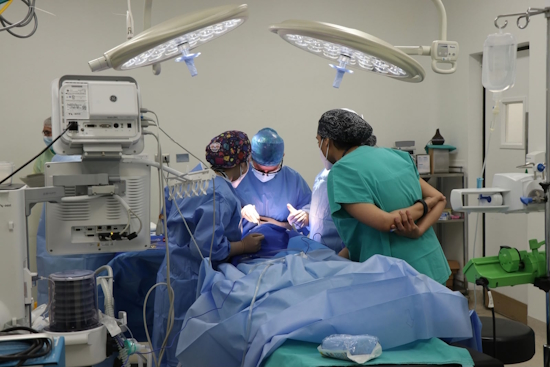
Inside Proximie: How telepresence is transforming surgery and maternal care in Kenya
By Pauline Achieng Tom
June 3, 2026
In Kibwezi Makueni County, a mother suffers a uterine rupture during delivery, an obstetric emergency that requires urgent surgery, usually this would mean a transfer to Makueni referral hospital where specialized surgeons are based. In her critical condition this journey that takes hours could turn fatal.
This is where Proximie- a telepresence technology changes the outcome. The digital platform connects operating theatres across the country using multiple camera feeds which then allows a specialist to connect in real time, offering their expertise without being in the room.
It is using Proximie that the attending Doctor in Kibwezi activated the system and proceeded to connect with a specialist in Makueni Referral Hospital, who with the aid of the telepresence that involves a real time feed, talked his colleague through a step-by-step subtotal hysterectomy, a procedure he has never done before, saving the mother and child.
According to Dr Ben Njihia, Surgeon and PHD fellow in maternal health, every mother deserves a safe delivery this is however a challenge in a health system with limited specialized doctors. The telepresence is meant to bridge this gap.
Data from the World Bank shows that Kenya has a significant doctor shortage, with 1 doctor per 5,263 people this way below the World Health Organization’s (WHO) recommendation of 1 per every 1000 people. The ratio is even worse when it comes to specialists.
“Pregnancy is not a disease,” Dr Njihia says “Every mother has the dream of holding their baby. Once the pregnancy is done to have a healthy outcome.”
“We have had challenges in trying to get access to appropriate healthcare for many mothers.”
This is where technology comes in, the system which was first established in the United Kingdom and now operates in over 50 countries, allows for specialists to be ‘present’ in the room without physically being there while still seeing what the surgical team sees and guiding them step by step during a procedure.
Dr Njihia who is involved in implementing Proximie telepresence technology says that the telepresence can plug the gap in healthcare access.
“Why are we still losing mothers?” he asked “we believe that similar to how mobile money transformed economies. Now is the time for digital technology to actually transform healthcare.”
“We have advanced in technology; it is time to consider how these technologies can now go down to the grassroots and impact these mothers and ensure that they go home with a healthy baby; that is what we are doing at Proximie.”
The system is already in use across a growing network of hospitals, including Kenyatta National Hospital which has it in 8 theatres, Makueni County and its sub county hospitals , Coast General Teaching and Referral Hospital, Homa Bay County Teaching and Referral Hospital , and international partner sites such as King Faisal Hospital in Rwanda, Kamuzu Central Hospital in Malawi, and hospitals in Uganda and Beirut among others.
Makueni County which is one of the earliest adopters of the system, uses a hub and spoke model where consultants are at the higher-level facilities and all the subcounty hospitals have access and are connected to the Proximie platform.
“In a country such as Kenya, where we have a shortage in terms of the specialists and the care that they’re able to offer, especially in our counties this technology enables us to move the expertise not the expert thus saving lives.” Dr Njihia said.
How it works
Cameras are set up to capture from different angles of the theatre, from the operating field, to the anesthesia machine, these cameras run a live feed. When needed a specialist can be dialed remotely and they can log in using their phone or tablet and speak directly to the surgical team through a headset.
“You have several cameras,” Dr. Njihia explains. “One can be linked to the theatre monitor, another to the anesthesia machine. We like having one camera facing the resuscitator so we can assess adequacy of resuscitation.”
The result is a fully interactive operating room where distance no longer limits expertise.
In procedures that require a camera feed internally like laparoscopy which is where a lighted camera (laparoscope) and long surgical tools are inserted through small incisions an expert can monitor the feed remotely.
“If someone is doing hysteroscopy or laparoscopic surgery, that field can be visible to a colleague who can advise in real time,” he explains.
These videos can then be used for training purposes to build skill capacity among Medics. According to Dr Njihia Makueni alone has built a substantial digital surgical archive with 756 recorded procedures, forming one of the largest telepresence learning repositories in the region.
“Instead of relying only on memory or notes, surgical teams can review recorded cases to study technique, communication, and decision-making.”
Dr. Njihia describes this as a shift toward continuous reflection in medicine.
“Now you can go back and look at the surgery, not just the outcome, but the process,” he says.
In a healthcare system where specialist shortages can determine survival, especially in cases where every second matters, telepresence offers a way to extend expertise without physically relocating doctors.
“Even if the expert is not in the room, their presence is,” he says.
Leave a Reply