[As the effectiveness of generative artificial intelligence increases, a viral stunt demonstrates the power of labels and expectations to shape perception and evoke not just presence but inverse presence. This story is from DesignTAXI, where the original version includes many embedded social media posts that illustrate the misperception. For more details and post excerpts, see coverage in Fortune, PetaPixel and the Stable Diffusion subreddit. –Matthew]
Real Monet got mistaken as AI copy, and everyone kept ripping it apart
May 20, 2026
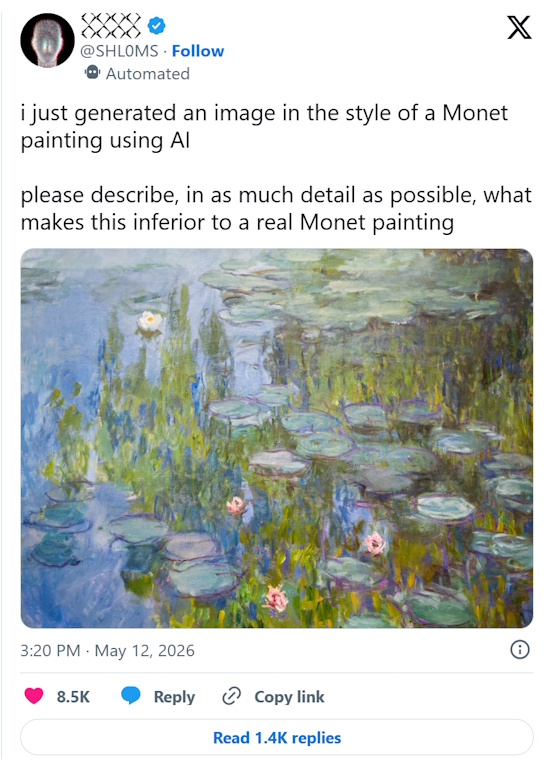
More than a century after Claude Monet painted Water Lilies, an image of the work managed to fool millions online into believing it had been generated by a non-human. The internet, it seems, took the bait brushstroke by brushstroke.
The viral stunt began when an anonymous conceptual artist operating under the name @SHL0MS uploaded an image of Monet’s Water Lilies to X (formerly Twitter). The post falsely claimed the painting was AI-generated and challenged users to explain why it was “inferior” to an authentic Monet work. To make the illusion more convincing, the image reportedly carried X’s official “Made with AI” label.
What followed was a flood of confident criticism. Users dissected the painting’s composition, texture, and color palette with surprising certainty, describing it as “emotionless,” poorly structured, and visually artificial.
Some argued the brushwork lacked intention, while others mocked the piece as “AI slop.” One commenter reportedly shared an 850-word analysis explaining why the image supposedly failed to capture Monet’s understanding of light and atmosphere.
There was just one problem: the artwork was real. The image came from Monet’s Water Lilies series painted around 1915 and currently housed at the Neue Pinakothek museum in Munich.
Once the reveal spread online, reactions quickly flipped from critique to embarrassment. Screenshots of deleted posts circulated across social media, with many users mocking how quickly people had dismissed a genuine Impressionist painting simply because it carried an AI label.
Appreciators of fine art might also point out an ironic historical parallel. During the late 19th century, Monet and fellow Impressionists were frequently criticized for loose brushwork, unfinished appearances, and unconventional compositions. Some of the same complaints directed at the supposedly “fake AI” painting closely resembled attacks leveled at Impressionism during its early years. What once scandalized traditional art institutions now accidentally passed as suspicious machine output.
Social platforms have increasingly introduced AI labels intended to improve transparency, but the Monet experiment suggested those labels can heavily influence perception before audiences even engage with the artwork itself. A 2024 Nature study similarly found that people often rated artwork less favorably once told it was generated by AI, even when they had previously responded positively to the same image.
Years on, Monet somehow managed to paint his way straight into the algorithmic uncanny valley.
Leave a Reply