[This story from Healio describes an ongoing project to develop and test a 45-60 minute “choose your own adventure” presence-evoking virtual reality experience to reduce the anxiety of cancer patients before they undergo surgery. For more details, the original version of the story includes a 5:06 minute video, and a 4:34 minute CBC News Manitoba report about the project is available on YouTube. Although they don’t focus on the role of presence, a quick online search reveals promising results when VR is used to reduce anxiety before cardiac surgery (e.g., these three studies), elective surgery, and for both children and their guardians. Positive results are also found in a 2023 meta analysis of 11 studies with 892 participants. –Matthew]
‘It could really help’: Virtual reality approach may reduce preoperative anxiety in cancer
By Josh Friedman; fact checked by Heather Biele
April 28, 2026
Researchers are exploring whether a virtual reality intervention could reduce preoperative anxiety among patients with cancer, according to information presented at Cedars-Sinai’s Virtual Medical Conference.
The virtual reality (VR) will include guided breathing, an educational platform about the operating room and more.
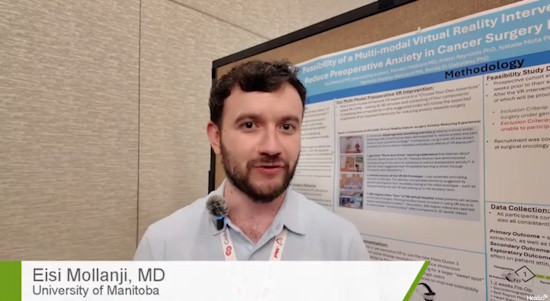
“The vision is being an intervention that is widely applicable to a lot of different surgeries,” Eisi Mollanji, MD, a third-year psychiatry resident at University of Manitoba, told Healio.
“Something as simple as saying, ‘You’re having surgery; here’s a headset.’ Here’s an intervention you could do at home or the clinical setting where you don’t need a lot of observation. It could really help reduce all these negative outcomes that we think are secondary to patient anxiety that’s untreated during the preoperative process.”
Prior studies have shown preoperative anxiety to be the “worst experience of surgery,” Mollanji explained.
“It’s also something that’s been shown in the literature to be associated with a lot of negative health care outcomes, [including] increased rates of postoperative pain, reliance on medications, length of stay in hospital and even mortality,” he said. “It seemed like a really interesting issue to tackle, especially because it’s not consistently addressed in our health care system.”
Operating room tours could help patients feel more at ease, but Mollanji described that intervention as unfeasible due to room availability and scarcity of staff. A VR tour could achieve the same result, though.
Researchers chose to investigate among patients with cancer.
“It’s a really big population where about 50% of them actually end up getting cancer surgery at some point, and a lot of those surgeries are going to be elective in nature, meaning we have a good time window to actually intervene,” Mollanji said.
“It’s been estimated that up to 75% of patients with cancer experience elevated preoperative anxiety,” he added.
Mollanji and colleagues previously evaluated a 10-minute VR intervention in a cohort of more than 20 patients with breast cancer.
Mollanji described it as “well tolerated” and “enjoyed,” but participants had suggestions, including showing patients closing their eyes in the operating room and opening them in recovery.
Based on that feedback, researchers expanded the intervention. It’s now a “choose your own adventure” called VR-CARE, which lasts between 45 and 60 minutes.
Components include a 15-minute breathing exercise; a point-and-click learning experience of the operating room; a refined VR experience of the OR, which includes being wheeled into surgery and waking up in recovery; and a 360-degree tour of the hospital itself.
The new study will include 20 adults with cancer scheduled for surgery. They will receive the VR intervention 1 to 2 weeks before their operation.
Researchers are currently recruiting patients, and engagement is expected to start this month.
Study feasibility, including acceptability, data extraction, engagement, recruitment and tolerability, will serve as the primary endpoint. Trends in preoperative anxiety will serve as the secondary endpoint.
“We’re really excited,” Mollanji said.
Source:
Mollanji E, et al. Poster 9. Presented at Cedars-Sinai’s Virtual Medical Conference; March 25-26, 2026; Los Angeles.
Leave a Reply