[A multi-year project in the EU is using presence-evoking virtual reality to help both the public and policy-makers better understand and address the challenges of controlling air pollution. Some of the details are in this news release from the European Climate, Infrastructure and Environment Executive Agency (the original version includes a second image); more details are available from Atmo Bourgogne-Franche-Comté (Atmo BFC). The Escape and Serious games are available from Meta. –Matthew]
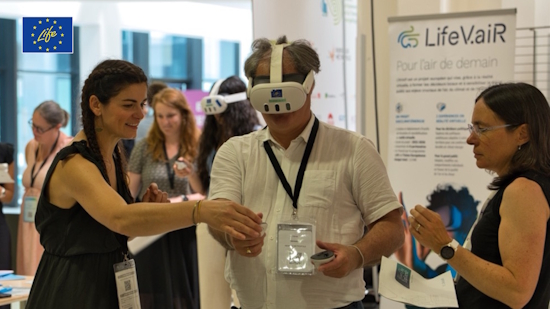
Clearing the air: LIFE project uses virtual reality to make invisible pollution visible
As air pollution remains a critical health and environmental challenge in Europe, the LIFE V-aiR project is leveraging immersive digital experiences to engage citizens and policymakers in building a healthier future.
By European Climate, Infrastructure and Environment Executive Agency
April 2, 2026
Air pollution is one of the leading causes of death in Europe, yet its causes and consequences often remain invisible or abstract to the public. The EU project LIFE V-aiR, launched in August 2022, was created to bridge this gap.
Coordinated by Atmo Grand Est and supported by the EU’s LIFE programme with a € 1.3 million total budget, the project brings together nine partners from France, Spain and Romania to turn complex scientific data into engaging virtual reality (VR) experiences.
“Our objective is to inform decision-makers on air-climate-energy issues in an innovative way through a serious game in virtual reality, using the air quality data collected in their territories,” said V-aiR’sAnna Manicot.
The project’s innovative approach centres on two distinct VR games designed to empower different audiences to take meaningful action against atmospheric pollution. The first, an escape game, is aimed at the general public. Players find themselves aboard the ‘Blue Sky Explorer’ station, where they must solve riddles in two specialised rooms: ‘The Lab’, which focuses on the health and environmental impacts of pollutants, and ‘The Monitor’, which identifies their sources. By participating in 20-minute sessions, citizens learn about air quality issues and leave informed about personal choices in their daily lives.
The second VR game targets urban planning and environmental policy. This simulation transports decision-makers to a dystopian 2070 devastated by inaction, then challenges them to return to the present to change the course of history. Played in pairs – where one person wears the VR headset while the other utilises a technical manual – participants solve puzzles across agriculture, energy, transportation, housing and industry. This collaborative format helps leaders visualise the long-term impacts of policy decisions and identify effective political levers that improve air quality.
“The LIFE V-aiR project will have a dual impact across Europe: by training decision-makers, it will support more informed and ambitious policies, while raising awareness among citizens will help them better understand and accept these changes,” said Anna.
The project aims to engage more than 12 000 citizens and 2 000 local decision-makers by 2028. Regional partners offer free VR headset loans and training for local events, while the games are available for free download on Meta Quest for anyone with a compatible headset. The games are also available in multiple languages, including English, French, German, Romanian and Spanish.
Together, these virtual reality experiences demonstrate how digital innovation transforms perceptions and responses to environmental threats. By making the invisible visible, LIFE V-aiR also provides the necessary capacity for European citizens and decision-makers to implement effective air quality plans to support the EU’s vision of zero pollution by 2050.
Leave a Reply