[As a vegetarian, this story from the Midwest Messenger wasn’t an easy read, but it describes an interesting and valuable new application of presence-evoking technologies in the meat processing industry. This is an abridged version of the original story; see that version for more details and three more images. –Matthew]
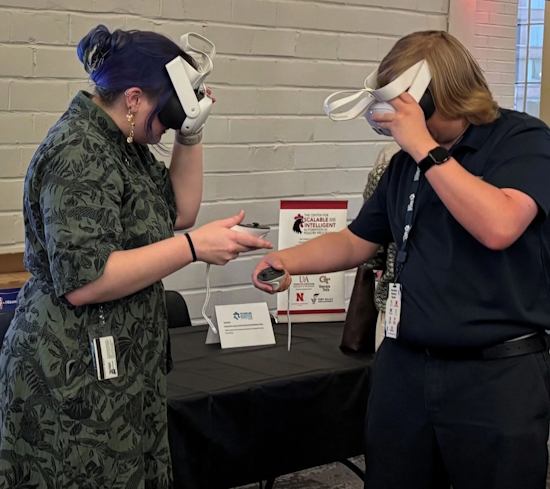
[Image: Konrad Ahlin, right, demonstrates how to use the controller and virtual reality headset at the Heartland for Robotics Conference in October 2025. Credit: Photo by Julia McQuillan]
Avatar meat processors? Virtual reality, automation future of meat industry
By Kristen Sindelar
March 6, 2026
Automation has become a normal part of our everyday lives. Avoiding late fees is effortless with automatic bill pay. Homes maintain a perfect temperature year-round with automated heating and cooling systems, while Roombas keep floors dirt-free without you even lifting a finger.
These modern-day conveniences extend into the agricultural realm, where fully automated implements are controlling weeds, spreading fertilizer, planting and harvesting. Manufacturing has also lost its human touch as robots increasingly overtake assembly lines.
As advanced as our society has become, technology in the meat processing industry has been limited. Human intellect and sensory perception are still necessary to effectively debone a chicken or carve out that perfect flat iron steak.
However, a team of visionaries from four institutions is combining robotic automation and artificial intelligence (AI) to forever change the food supply chain.
“We are revolutionizing the workforce,” said Jeyam Subbiah, associate vice chancellor for research development and professor at the University of Arkansas.
Subbiah is also part of the Arkansas Agricultural Experiment Station, the research arm of the University of Arkansas System Division of Agriculture (UADA). Previously, he had worked at the University of Nebraska-Lincoln (UNL) for 15 years.
Subbiah is the principal investigator overseeing the interdisciplinary team of food scientists, engineers, computer experts and a sociologist collaborating on a special project called the Center for Scalable and Intelligent Automation in Poultry Processing. The project is composed of faculty and staff from UADA, UNL, Georgia Institute of Technology, Fort Valley State University and the U.S. Department of Agriculture’s (USDA) Agricultural Research Service National Poultry Research Center. Their work is supported by key stakeholders from major poultry companies, food manufacturers and foundations.
A four-year, $5 million grant funded by USDA National Institute of Food and Agriculture, the project is diversified across four objectives:
- Address the meat industry’s immediate need to automate deboning of poultry
- Ease labor shortages through virtual reality
- Improve food quality and safety
- Determine social impacts of automation and robotics in the workforce
The overall premise for the project stemmed from the pandemic. Subbiah had ventured into Walmart to buy chicken, but much to his dismay, the shelf was empty.
“I was quite surprised that could happen in northwestern Arkansas,” said Subbiah, noting the irony.
The largest meat processing company—Tyson Foods—was only 8 miles away; the headquarters for the world’s largest retailer—Walmart—was within 20 miles; the world’s largest transportation company—J.B. Hunt—was within 14 miles. Moreover, the city was surrounded by poultry barns, and truckloads of broilers were waiting in the processing plant parking lot.
“So why couldn’t I buy chicken here?” he queried.
The missing link in the supply chain was the worker. This labor shortage pervades nearly six years later, especially in the meat industry. Subbiah shared startling statistics from a study published Jan. 29, 2025, by the Farrelly Mitchell food and agribusiness consulting firm. Approximately 58% of workers in packing plants quit within 90 days, and another [percent] leave by 180 days.
“The amount of turnaround is incredibly high in processing plants. They have to continuously train people,” Subbiah said.
Without a skilled workforce, a critical component of processing poultry—debonding the chicken—has become a bottleneck for the industry. Alleviating this pain point has become the center’s number one priority.
Objective One: Deboning meat
[snip]
Object Two: Virtual reality
While packing companies have taken measures to ensure the safety and health of their employees, a cool and humid environment is mandatory to preserve the meat. Loud equipment and people wielding knives only add to the stress of these working conditions. Moreover, tasks are physically and mentally straining, further exacerbating labor issues in the meat industry.
Yet only humans possess the dexterity and comprehension required for meat cutting.
“No machine right now can do this. No system can replace that worker,” said Konrad Ahlin, senior research engineer at the Georgia Tech Research Institute (GTRI).
Ahlin is forefront in the objective to transform the workforce through virtual reality. His team at GTRI is focused on the specific operation referred to as “cone loading.” Every plant is unique in its processing methods, but generally an eviscerated and cleaned chicken cavity is placed on a cone to be deboned. Loading cones often involves a person reaching into a large bin of carcasses, picking up one and placing it on the cone, which is a moving target on a conveyor belt.
“Plants move anywhere between 30 and 40 birds a minute, so you have to put a bird onto a cone every two seconds,” said Ahlin.
Albeit a challenge for machine vision, robots are capable of this action. The problem is accuracy. Ahlin rationalized that the system must be perfect, saying, “A poultry processing plant may process 400,000 birds a day. If you’re 99% effective, you’re still dropping 4,000 birds.”
The team has discovered that human-guided robots can complete the task with better acuity. But its idea surpasses teleoperation, where a robot’s every move is controlled by a person. Alternatively, their goal is to create a partnership between human and machine. Essentially, the worker is an avatar in a cyber meat processing world.
“In this human-robot collaboration, humans are making key decisions, but the robot is doing the repetitive work of lifting the cold chicken and loading it on the cone,” Subbiah said.
Such an alliance is possible through virtual reality. Similar to playing a videogame, the operator wears a virtual reality headset and holds a controller. The glasses “transport” the person to the robot’s environment through a digital representation of the processing line as perceived through the robot’s camera. The operator then moves the controller to select a point in space, indicating where the robot should grab. One click, and the robot automatically grabs the chicken and loads it onto a cone.
Ahlin compared the virtual reality space to an online forum, saying, “Not only could you be interacting with robots from different locations remotely, but you can also be operating with people on a task in a shared environment, wherever that person is located.”
Never before has working remotely been possible for those in the meat processing industry, but virtual reality and automation could drastically alter this workspace. Instead of being dependent upon the available regional workforce, labor could be diversified across the nation.
Furthermore, processing plants would no longer need to be built near big population centers.
“Plants could be put in rural America nearer where chickens are grown,” Subbiah said.
He acknowledged that the second objective of the project may seem futuristic, but advancements in these technologies are part of the team’s larger vision to fully automate poultry processing. The intelligent work of operators now serves as a database to train AI algorithms for the future.
“Long term, this project can transform the whole industry,” Subbiah postulates.
Objective Three: Food safety
[snip]
Objective Four: Social acceptance
Adding these new technologies to the meat industry is meant to ease labor requirements, as well as increase food quality and safety. Yet the ripple effects will incite major changes for the workers. What is the impact of automation on the workforce? How do they view these new technologies? What considerations are needed to avoid unintended consequences?
UNL professor of sociology Julia McQuillan is examining the sociological aspects of the project.
“The team realized that the social science dimension in food and food technology is quite central. If people don’t adapt and accept the innovations, it will not get anywhere,” McQuillan said.
McQuillan gauged preconceived notions about the technology before people tried the virtual reality work. She conducted tests at both a poultry processing plant in Arkansas with people who currently do the job, and at a resource center for people seeking jobs but who had not worked in poultry processing. Her surveys and interviews involved a series of questions to learn about what people think before, during and after working in virtual reality and collaborating in real time with a robot in another state. In addition, she and Ahlin had several people test the technology at the Heartland Robotics and Automation Conference at UNL’s Innovation Campus in October 2025.
“We learned from people who are currently working in poultry processing and then from people who had never worked in a packing plant, to tell their perceptions,” said McQuillan. She wanted to understand if operating an automated robot would be a desired job, what they thought it would be like to introduce robots into the industry and their comfort level interacting with virtual reality.
Participants were asked to enter a virtual reality environment. From their locations at Nebraska and Arkansas, they marked a location on a pixelated version of a chicken carcass to guide an automated robot in placing a silicone chicken onto a cone in Georgia. Afterwards, McQuillan gathered additional feedback from the two groups.
Most people were skeptical at first, said McQuillan, but almost all of them began giggling when they successfully loaded a chicken.
“As a sociologist, I did not anticipate that there would be a surprised delight,” said McQuillan. “People kept saying it was kind of fun.”
Ahlin added that most were also credulous about the fact that they were physically separated. “They kept saying ‘I’m in Nebraska—and that’s in Georgia.’ This is actually happening in real time,” he said.
Many uncertainties revolve around virtual reality and automation. “Once you introduce technology to either work alongside a human or do the operations for a traditional human worker, how does that change the mechanics of the poultry operation?” Ahlin wondered aloud.
The team raises additional questions. Would people spend part of their workday on the processing line and part in a virtual reality room? Or can this job be done from home? Is it a full-time or part-time position? How long can someone comfortably remain in a virtual reality environment? Will motion sickness be an issue, or will moving the controller lead to repetitive movement muscle strain?
These are all implications of creating a new job category.
“Our focus is the technology itself, but this technology is intended to be used by a person, so understanding how the person interplays with the technology is going to be critical,” said Ahlin.
Holistic assessment: reality of automation in meat processing
The Center for Scalable and Intelligent Automation and Poultry Processing is retrofitting these technologies for the poultry industry with the intent of applying the principles to other species. Subbiah said that a limited scope for the project was necessary if they were to make a tangible impact within the four-year timeframe of the grant.
“We started with poultry but are looking at this holistically to support the food industry,” said Subbiah.
Each animal is unique in how the carcass is broken down along the processing line, so the technologies will be adapted accordingly. In Georgia, the team at Fort Valley has begun evaluating these tools to process small ruminants, including lamb and goats.
The Center is preparing its prototype of the robotic cone loader; soon they will begin in-plant operations to benchmark performance, said Ahlin. He said that from a robotic perspective, the technology is “quite close” to becoming reality.
The real question is whether people are ready to adopt the technology.
“Getting workers comfortable with the idea of working in this shared environment with robots is further off from reality,” Ahlin admitted.
A fear people voiced to McQuillan is if they will still have a job. Workforce reduction is a justifiable concern given that automation and robots are meant to replace the need for a human being on the production line. She assures people that as for now, the team is trying to make better jobs and healthy industry for the workers.
“Right now, there is a shortage of workers in many plants. We do not necessarily want to take humans out of the loop but change how the tasks are done,” said McQuillan.
In the future, working in tangent with a robot may be as normal as driving an automatic vehicle. Many people are no longer capable of driving a stick-shift, yet this was the only option not long ago. What was once considered revolutionary has now become a necessity for mainstream society. Virtual reality and automation may similarly become integral in the 21st century food supply chain.
Leave a Reply