[Here are two stories about how the U.S. military is increasingly turning to presence-evoking technologies to replace in-person training. The first story is from Task & Purpose and the second is from Forbes; see the original versions of each story for an additional image. –Matthew]
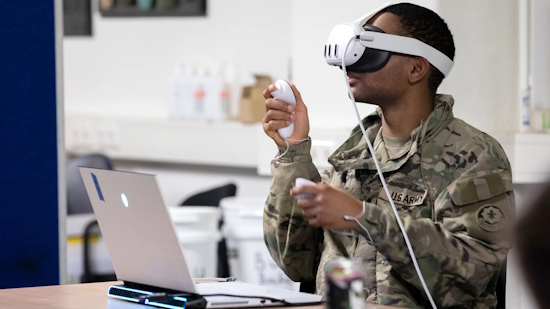
[Image: Army Spc. Elijah Sims uses a virtual reality headset at Rose Barracks, Army Garrison Bavaria, Vilseck, Germany. Credit: Army photo by Pfc. Jolene Cintron.]
The Army wants soldiers to travel less for training, do more in virtual reality
Army leaders said they are looking at more virtual reality and remote training inspired by civilian programs at universities.
By Patty Nieberg
January 13, 2026
Soldiers will travel less for training and do more virtually, Army leaders said Tuesday.
The Army is planning to have soldiers “train differently” with more remote learning and other more innovative courses that use augmented reality and virtual reality, called AR and VR, respectively. The programs would work in lieu of having soldiers travel to schoolhouses and training centers across the United States, Army Chief of Staff Gen. Randy George said at a virtual town hall at Fort Drum, New York.
The Army’s goal is to cut down on temporary duty assignments, TDY, or short-term moves where soldiers leave their permanent duty station for training that can last from several days to months. Instead, the Army wants them to do courses and trainings “at your local home station,” George said at the town hall, which covered topics affecting soldiers, from quality of life to training.
The Army is looking at revamping “everything from individual training when you first come in through your specialized technical training” for enlisted soldiers and junior officers, “all the way through the most senior courses that we have for our general officers,” David Dworak, provost of Army University, told Task & Purpose.
The Army is looking at a range of courses and lessons, like those available at civilian universities. At the same time, the service will not outsource skilled training on weapon systems or battlefield tactics, officials told Task & Purpose.
“What can be done in a virtual setting that really replicates the environment that you’re gonna be working in and what needs personal interaction?” Dworak asked. “I really have a hard time seeing the future where we get rid of all in-person interaction because there’s a professional element to it that requires human interaction. But that’s not to say that there isn’t a role for the online element.”
Beyond simple courses that soldiers can do by watching videos or learning in a remote classroom, the Army is also exploring VR and AR courses that universities already use, such as training in virtual medical cadaver labs, which could be useful for combat medics and those in similar fields.
The education overhaul comes as the service is trying to move faster and make its training system more flexible — a critique of military education that others have noted in reference to how fast the battlefield is evolving in places like Ukraine.
Dworak acknowledged criticisms that Army education has been “kind of stagnant” and “takes a long time to change,” but said that now the service is looking at new authorities that allow course directors and school commandants to make more timely decisions about the types of training that soldiers need.
“You really lose credibility with the students when something happens out there in the operating environment and the schools don’t react to it,” Dworak said. “Drones is a great example of that. Autonomous warfare, where is that going? What does it mean? We can’t have a system that takes one year or two years to get a curriculum approved and get it back out to the field and then you’re delivering it three years after you’ve realized that there’s a change that’s just not gonna work anymore.”
Leaders also said that the slashes to TDY and moves to remote training would also help reduce the stress put on soldiers to move frequently — a quality of life issue long flagged by troops and identified by the Pentagon last year as a major policy initiative for the military services.
[snip to end]
—
[From Forbes]
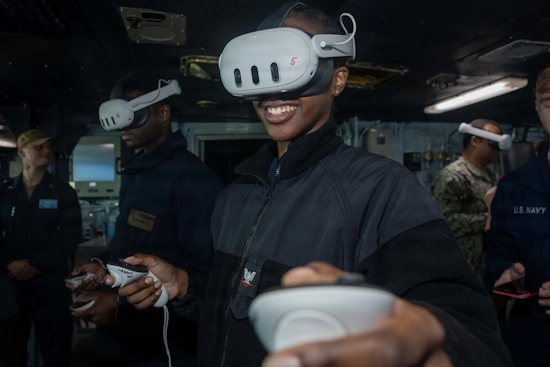
[Image: U.S. Navy Quartermaster 3rd Class Zinnia Bank participates in a virtual navigation demonstration using Virtual Bridge and Nautical Trainer (VIBRaNT) held in the pilot house of the Nimitz-class aircraft carrier USS Theodore Roosevelt (CVN 71), Jan. 8, 2026. Credit: U.S. Navy photo by Mass Communication Specialist Seaman Alexia Mezick]
U.S. Navy Tested Virtual Reality Trainer On USS Theodore Roosevelt
By Peter Suciu, who covers trends in the world of aerospace and defense
January 9, 2026
Virtual reality remains part of the new reality for training across the United States military. The technology could soon be integrated on the largest warships. Training with this new technology could help the United States Navy avoid incidents such as the collision between one of its aircraft carriers and a commercial vessel near the Suez Canal last year.
The Virtual Bridge Trainer
This week, the United States Navy announced that sailors onboard the Nimitz-class nuclear-powered supercarrier, USS Theodore Roosevelt (CVN-71), took part in a virtual training demonstration utilizing the “Virtual Bridge and Nautical Trainer,” also known as “VIBRaNT.”
It is one of several systems developed to provide realistic yet safe training in ship navigation, ship handling, and situational awareness. VIBRaNT enables crews to train in complex situations, including inclement weather and stormy seas, in high-traffic areas, and in force-protection exercises, without risking the real warship or endangering the crew. It is designed specifically for training bridge teams and can be used during lengthy maintenance periods, when the crew may have limited opportunities to practice on the navigation systems.
That in turn could maximize effectiveness during at-sea events.
The Training Day
This month, the Office of Naval Research Global TechSolutions and the Naval Information Warfare Center Pacific hosted the event aboard the fourth Nimitz-class supercarrier.
The event highlighted how the technology has the potential to enable bridge watch teams to practice the “rules of the road” and even rehearse missions aboard the actual warship rather than heading to a shore-based training center.
VIBRaNT was described as a “portable training system” that employs commercial-off-the-shelf extended reality hardware. It integrates with industry-developed commercial software and uses standard laptops, wireless routers, and headsets, yet delivers a realistic virtual bridge environment.
“We can bring this on board as a mechanism to have better access for training, increasing the availability to train, and providing better situational awareness,” said Amelia Kracinovich, Human Systems Integration scientist at NIWC Pacific.
Realistic Scenarios
VIBRaNT has the promise to immerse bridge watch teams in situations that could be difficult and even dangerous to replicate in the real world. It can also provide a way for crews to maintain their proficiency when the ship isn’t at sea or when they need to practice unfamiliar ship-handling scenarios.
“I can see this system being very useful to have onboard,” suggested Senior Chief Quartermaster Tom Salvatore. “Currently we rely on off-ship simulators in order to train our watch teams in foreign ports and waterways. This system will greatly increase our capacity for training in real-life scenarios that cannot be easily simulated otherwise.”
Collision Avoidance
Warships, especially the massive nuclear-powered supercarriers, could never be equipped with a collision avoidance system. Instead, it is up to the crew to ensure that such situations are avoided. Yet, it was just a year ago that another Nimitz-class supercarrier, the USS Harry S. Truman (CVN-75) collided with the Besiktas-M, a 53,000-ton Panamanian-flagged cargo ship, while operating in the Mediterranean Sea near Port Said, Egypt.
Naval experts have said it would be uncommon for a commercial ship to get that close to a carrier, as the carrier’s escorts in the Carrier Strike Group are there to prevent it. However, the issue is the Suez Canal’s narrowness: it is only 205 meters wide. It requires that vessels in the CSG travel single-file.
[snip]
Given that the United States Navy rotated multiple carriers to the Middle East from October 2023 to September 2025, and that traffic in the region has only steadily increased, this is a situation sailors may need to train to avoid.
VIBRaNT would seem well-suited to the role.
“This training will benefit our crew because it allows us to be in a scenario we may have never been in before. So, you are able to be hands-on and react instead of just listening and talking about potential steps and solutions,” said Quartermaster 3rd Class Zinnia Banks.
Leave a Reply