[Presence-evoking simulations are increasingly part of medical training, but a recent Nursing Simulation Day at Saint Mary’s College in Notre Dame, Indiana introduced an interesting new “body swapping” feature in which students could switch roles between caregiver and patient. Details are in this story from the student-run newspaper The Observer. –Matthew]
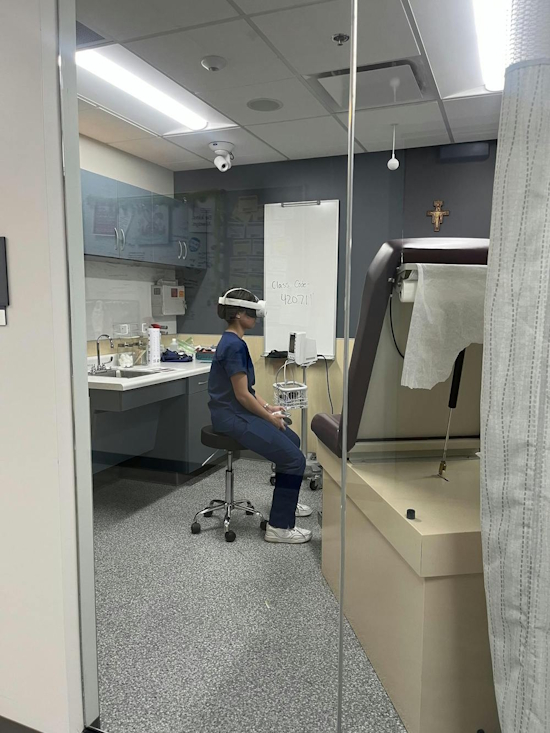
[Image: Nursing student gives clinical report to VR patient, utilizing the AI powered technology to receive real time feedback on procedures. Credit: Photo by Soledad Castellanos / The Observer]
Saint Mary’s nursing program debuts new VR and disaster simulation experience
The department featured its new VR simulators for students to experience various emergency scenarios
By Soledad Castellanos
April 22, 2026
The Saint Mary’s Department of Nursing Science welcomed over 130 participants to its second annual Senior Nursing Simulation Day Tuesday. From 7:30 a.m. to 5 p.m. in the basement of Regina Hall, students, volunteers and professors came together to simulate a campus disaster not experienced in everyday lectures or hospital rooms.
61 undergraduate nursing students and seven MSN students were responsible for the patients, and 40 volunteers acted as disaster victims. An additional alumnae panel of four registered nurses, faculty and staff was in charge of running the simulations.
The simulations ran every 90 minutes for six rounds. Nursing students were asked to respond and assess victims of a staged chemistry lab explosion. Classrooms, offices and simulation emergency rooms were utilized to recreate the process of real life emergency response and care, with the debut of new virtual technology to assist students.
Director of the Department of Nursing Science Trish Keresztes and professional specialist Jennifer Riggs, virtual reality program leader, walked through the process of both simulations for students.
According to Riggs’ abstract for Saint Mary’s annual research symposium on April 29, the VR and disaster day simulators aimed to “strengthen an array of interpersonal and professional skills including clinical judgment, teamwork, person-centered communication, empathy, and de-escalation.”
Powered by artificial intelligence, the new technology enables students to practice giving patients clinical reports in a hospital setting and receive real-time feedback based on their performances.
The highlight of the program is its body-swapping feature, which flips the perspective on students as it records audio and tracks facial expressions throughout the initial clinical report. The switch in places from nursing student to patient avatar explores how one can come across to patients in various situations.
The continuous practice and switch between roles create opportunities to learn and apply knowledge in an accommodating way.
“It’s different. It’s nice that it’s hands on, it feels really immersive. You feel like you can try stuff out without really hurting anybody,” Riggs said.
The immersive quality of the eight VR sets that are available to the program has translated well throughout the curriculum. As the field of nursing and healthcare increasingly aligns with technological advancement, providing students with the latest resources and skills for better workforce preparation is of the utmost importance to the program.
Riggs described the apprehension about the pivot toward newer simulation models, which has lessened since the transition.
“I think we were all a little bit afraid of AI at first because we didn’t know what it was capable of,” she said. “But then pretty quickly, we learned, ‘Oh my gosh, look at what it can do and all of these great opportunities for our students.’”
Also expressing this excitement for growth and opportunity for senior nursing students, was assistant professor of nursing science Kylee Rohatgi, who helped with leading and coordinating the day-long simulation. Her role included briefing students on simulation expectations and guidelines.
Rohatgi provided insight on how the course of the day proceeds and how the organization of it benefits students.
“For today, at least for the virtual reality, we designed two specific simulations for disaster response that can allow students to practice skills that they might not otherwise get in their other clinical experiences and just hopefully be thought provoking,” she said.
Some students said what drove them to the simulation was that the environment provided a safe space to make mistakes and equally be challenged.
Senior Jada Reitmeier has felt that the department has provided her the support needed to be successful throughout and in the aftermath of the program.
“I feel prepared to go into the real world. I’ll take a clinical any day over a lecture [as] I am very much a hands-on learner,” she explained. ” I do feel like that rotation in the community or even the simulations kind of help, as you put what you learn to the test. They really do help you prepare for thinking about things you might not think of or [what] the textbook might not necessarily be like.”
Leave a Reply