[This first-person report on the experience provided by a virtual reality installation about the Titanic and its sinking simultaneously captures some of the factors that enhance and degrade presence, and illustrates how a personal voice and vivid description and narrative in text can evoke a strong sense of presence as well. The story is from People, where the original includes five more images and a 52-second video trailer for Titan: Echoes From the Past (the trailer is also available on YouTube). –Matthew]
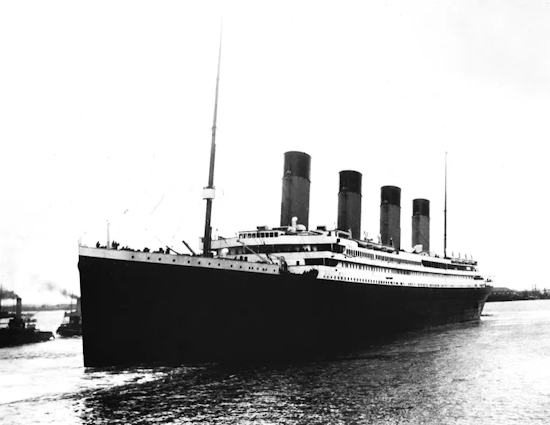
[Image: Credit: SSPL/Getty]
A Titanic Obsessive Reveals the Moment That Lingered While Visiting VR Recreation of the Lost Liner
PEOPLE’s resident ‘Titanic’ enthusiast steps inside a virtual reality recreation that brought him closer than ever to the ship he’s spent a lifetime studying
By Jordan Runtagh
April 20, 2026
Some kids want to walk with the dinosaurs. Others want to walk on the moon. I wanted to walk the decks of the Titanic — and I still do. I’ve had this dream since I was in kindergarten, long before James Cameron’s blockbuster made it slightly more comprehensible to the general public.
When I dressed up as the ship’s bearded captain for Halloween in elementary school, most people thought I was the man on the fish sticks box. And I can still picture my father’s confusion when he discovered that I’d transformed my bedroom into the Titanic‘s Edwardian Grand Staircase using construction paper.
Thirty years later, my enthusiasm for the lost liner hasn’t waned. I purchase every new book and documentary on the subject, attend every artifact exhibition and count authentic pieces of coal and deck wood from the wreck among my most prized possessions.
In short…I really like the Titanic, you guys.
Last year, I spent the anniversary of the sinking at Titanic: The Artifact Exhibition at the Luxor Hotel and Casino in Las Vegas, where I gazed through the portholes of a colossal slab of the ship’s hull, pretending I was one of the passengers inside. Now, in honor of the 114th anniversary, I attended a virtual reality recreation.
Titanic: Echoes From the Past was created by Eclipso, a company specializing in large-scale, location-based VR installations. Directed by Benjamin Auriche and Jean Dellac, the project was crafted from over two years of research.
Guests at the newly opened New York location are outfitted with VR headsets and let loose in a warehouse-sized room for an immersive 40-minute experience that allowed them to wander both the wreck and the ship as it would have looked in 1912.
The journey began on the top deck of a research vessel as a crew of Sims-like individuals busily prepared for the upcoming dive to the wreckage.
This is the exposition portion of the program, and one of the mission specialists came over to deliver a stern-yet-friendly briefing.
I’m ashamed to admit my attention wandered. Partially because this was not the boat I was here to see, but the nautical equivalent of an opening act I had no interest in watching. Aside from this, I was still adapting to the VR experience.
Even though the somewhat glitchy graphics leaned more towards Mario Kart 64 than photo-realism, I found it jarring how easily your brain can be tricked into accepting this as your new reality based purely on sight and sound input. I spent more time than I care to admit thrusting my arms out in front of me, expecting to be able to see my own hands and being slightly confused when I could not. (I pray that the security camera footage of my visit never leaks.)
In reality, the trek to Titanic requires a two-hour free fall in a submersible, plunging two and a half miles to the seafloor. However, the Echoes From the Past creators made the puzzling and terrifying artistic choice to have VR visitors ride outside the sub during the descent.
The experience grew more unsettling by the second as the water went from dark blue to pitch black, a visual signifier of both the depth and the increasingly oppressive water pressure bearing down.
The pressure on the seafloor exceeds 6,000 lbs. per square inch — more than 350 times what it is on the surface. (For visual learners, this is the equivalent of having an elephant standing on every square inch of your body.) This weight is enough to crush a person within 50 milliseconds, which is mercifully faster than the human brain can register pain.
For nearly 40 years, these stats were purely academic, but the Titan tragedy in June 2023 made them a horrifying reality — and it’s hard not to consider this as I drift virtually on the outside of this sub.
After more than enough time to contemplate my own mortality, I finally arrived at my destination.
At first, there wasn’t really much to see.
Rather than the wreck itself, I touched down in what’s known as the debris field, a 15-square-mile underwater scatter zone formed when the ship broke apart during its final descent. As the bow and stern sections tore free from one another, the ship’s contents were ejected and rained down across the ocean floor, dispersing everything from luggage and dinnerware to engine parts and personal belongings.
The adventure really began after coming across a bag in the debris field belonging to real-life passenger William Harbeck, a pioneering cinematographer who made his reputation filming the aftermath of the 1906 earthquake in San Francisco.
It’s believed that Harbeck was hired by the White Star Line, the company operating the Titanic, to document her maiden voyage, but Harbeck was lost during the sinking and never able to corroborate the story. His body was recovered in the days following the sinking with a “Moving Picture & Projecting Machine Operators Union” card in his pocket, but his bag of film reels went down with the ship.
Their recovery, assuming they weren’t corroded past the point of preservation, would be an invaluable resource for Titanic historians. Only 39 photographs of the ship’s interior are known to exist, and no film footage at all.
To date, Harbeck’s reels have never surfaced, but in the world of the VR experience, the newly recovered films offered a lifelike window into the past.
Rather than melodramatic views of the ship at sea, the first scenes captured intimate moments with a handful of passengers. Instead of reenacting the famous tales of the First Class elite, Echoes From the Past showcased little-known stories of everyday people — often overlooked even by Titanic lifers like me.
I met 17-year-old Wing Sun Fong (also known as Fang Lang), one of six Chinese survivors of the Titanic sinking. He clung to life on a floating door before being rescued by Lifeboat 14. The ordeal left him so traumatized that he never spoke of it with his children, and it wasn’t until after his death in 1986 that his son learned about this dramatic piece of family lore. His story has been cited as inspiration for James Cameron when writing the end of his film.
Then I found myself in the third-class cabin of Bridget Delia McDermott, a 31-year-old Irish immigrant from County Mayo. On her bed was a stylish new hat she’d splurged on just days earlier, a small indulgence for the life she hoped to begin in America. On the night of the sinking, she risked her life for it — abandoning her seat in a lifeboat and running back into her flooding cabin to retrieve it. Luckily, she made her way back to the deck and ultimately escaped, reportedly after a 15-foot jump from a rope ladder into a lifeboat.
While it’s easy to read her story as a foolish act of vanity, it underscores a harder truth: many third-class passengers were traveling with all their worldly possessions. Even if they escaped with their lives, it cost them everything else.
After the last of these vignettes faded away, I found myself back on the seafloor, where I got my first view of the wreck itself.
Most submersibles approach from the side, where the hull emerges from the darkness like a looming wall, with headlights catching the glass of the portholes so they flicker like ghostly eyes. But here in VR world, I was granted a full cinematic reveal, approaching head-on. The Titanic‘s prow stands upright — rusted, but still improbably regal — as if it were somehow still sailing more than a century later.
As imposing as it was, I was struck by how small she seems up close, roughly the size of a two-story building. Then it clicked: I was not seeing the whole ship. Nearly 60 feet of the bow remains buried in the mud, driven there when she slammed into the ocean floor at more than 30 miles an hour during the sinking.
As I moved toward the rear of the bow, the Titanic‘s full height finally came into view. The enormous scale is something that no wide-shot quite captures. It truly must be seen (at least through VR) to be believed.
Reaching the point where the ship broke in two, the severed hull drops away, with decks pancaked together like the floors of a collapsed building. In the darkness, my eyes landed on two towering vertical structures rising several stories out of the wreckage. These were the ship’s reciprocating engines, the mechanical heart of the Titanic, designed to convert steam into energy that drove the ship’s propellers. Even in ruin, they feel impossibly large, standing side by side like twin sphinxes revealed only after the ship was ripped apart. They’re a reminder of just how ambitious the vessel was: a floating city powered by some of the most advanced engineering of its time, now frozen mid-motion at the bottom of the Atlantic.
For the majority of VR visitors, the main event of Echoes From the Past is a stroll through the Grand Staircase. When most people picture the Titanic, they picture this room.
With its polished English oak paneling and ornate Louis XIV-style wrought-iron balustrades presided over by a torch-wielding bronze cherub, the opulent atrium is remembered by historians as both the main thoroughfare and architectural crown jewel of the legendary liner.
It’s familiar to moviegoers as the spot where a tuxedoed Leonardo DiCaprio invites Kate Winslet to a “real party.” It’s also familiar to me as the space I tried to recreate in my childhood bedroom using arts and crafts supplies.
I’m a salty old Titanic-loving seadog, and I’ve seen numerous real-life recreations of the Grand Staircase done in remarkable detail as part of the RMS Titanic, Inc artifact exhibitions. For me, it was the only part of the VR journey that didn’t quite land, if only because it’s the one thing I’ve come close to experiencing in real life.
The moment that lingered came later, when the (sadly fictitious) films of William Harbeck brought me out onto the open deck at dusk. Every few seconds, something new caught my attention: the horizon stretching endlessly ahead, the smokestacks rising above, and, of course, the wooden lifeboats that looked so tiny and fragile on board this seemingly indestructible ship.
For a brief moment, the illusion held completely — I was no longer a visitor in a headset, but a passenger on the Titanic, on a clear spring day in 1912.
Leave a Reply