[Supporting arguments about the benefits of presence, a new study by researchers in the College of Veterinary Medicine and Biomedical Sciences at Colorado State University demonstrates that students have a lower cognitive load when learning about complex anatomy structures using three-dimensional rather than flat, two-dimensional images in virtual reality. Follow the links in the story for more information. –Matthew]
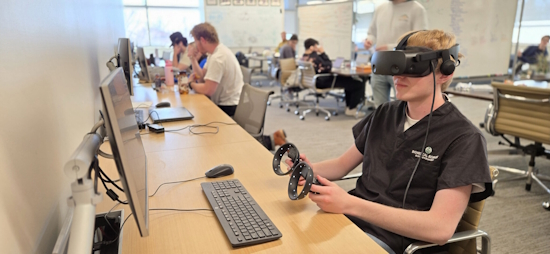
[Image: The HP Omnicept virtual reality headset, equipped with biometric sensors, was used to measure participants’ cognitive load while viewing instructional anatomy content. Credit: Photo courtesy of the Clapp lab.]
New study finds 3D virtual reality anatomy education lightens students’ cognitive load
By Rhea Maze
March 17, 2026
Virtual reality revolutionized how students learn spatially complex structures in anatomy education. CSU researchers have now shown that saving students from having to build out three-dimensional structures in their minds when learning anatomy reduces their cognitive load, a term used to encompass how demanding a task is on our mental resources. This pioneering research opens the door to a new phase of innovative virtual reality instructional design.
The study, led by researchers from the lab of Tod Clapp, associate professor in the Department of Biomedical Sciences and associate dean for academic and student affairs in the College of Veterinary Medicine and Biomedical Sciences, looked at biometric measurements of students’ cognitive load when learning anatomy in virtual reality. They found that when showing students two dimensions of a structure versus three dimensions, their cognitive load was lower when looking at the structures in three dimensions. Their results are published in Medical Science Educator.
“It seems intuitive that this would be the case given that we interact with the natural world this way, but it is exciting to actually show that it is more efficient to look at complicated structures in true 3D than in 2D,” said Clapp.
Before conducting the study, the research team knew anecdotally that anatomy students often struggled to create a picture of a 3D structure in their minds based off a 2D image.
“Anatomy is very spatial. When we show students pictures of flat images, they have to create a 3D image in their mind before they can start to understand it,” said co-first author and biomedical sciences master’s student Brandon Lowry. “And while the concept of cognitive load is complex and nuanced, we know it’s a real pain point that a lot of anatomy students struggle with.”
When the Clapp lab began the virtual reality program in 2017, they were provided with prototypes of a virtual reality headset that measured cognitive load through eye tracking and pupil constriction or dilation. For this study, the researchers used these headsets to put 70 undergraduate anatomy CSU students through two-and-a-half minute lessons on the larynx (voice box), an area of the body that is difficult to access and spatially challenging, in both 2D and 3D. The biometric data they collected was compared against an algorithm and provided a cognitive load score that allowed the team to infer how much mental effort the tasks were requiring. Students were also interviewed about their experience.
“The tool provided a unique, real-time assessment of the students’ learning effort,” said Lowry. “During the lessons, we could see if cognitive load spiked or dropped. There is a lot of research on the importance of learning environments, and our team’s research highlights a need to pay closer attention to this in virtual reality as well—building the right learning environment can greatly enhance the student experience.”
The study’s findings suggest that in virtual reality learning modules, 3D-based content significantly reduces the cognitive load compared to 2D-based content. Viewing 3D virtual reality content that allows students to see and work with anatomical structures in accurate depth and dimension not only lightens their cognitive load, it may also provide an effective way to improve their knowledge long-term.
“It was fascinating to see the body respond to different learning environments and to be able to track the learner’s gaze and see where and how their eyes focused on the content,” said co-first author Samantha McGrath, a recent graduate of the one-year biomedical sciences master’s program and current nursing student at the University of Colorado. “This is an understudied field, and our findings serve as an important building block for better designing future virtual reality experiences that are more conducive to learning and that best support students.”
The team plans to continue to investigate other physiological markers that provide information about cognitive load and to apply it to different aspects of learning, such as test taking. They hope to ultimately identify an ideal cognitive load zone that would help students to be the most successful. The cutting-edge work has also inspired current graduate students to make 3D teaching modules for incoming students, including one dedicated group who spent their entire winter break in the virtual reality lab creating fresh content for the next anatomy class.
“This study not only demonstrates that students have a lower cognitive load when in virtual reality, it also demonstrates why universities and educators should utilize this technology,” said Clapp. “It’s not just that it’s neat and cool, it allows students to run farther and faster when used in the right contexts—our virtual reality lab’s student-driven projects provide incredible educational opportunities for CSU students that nobody else has.”
Leave a Reply