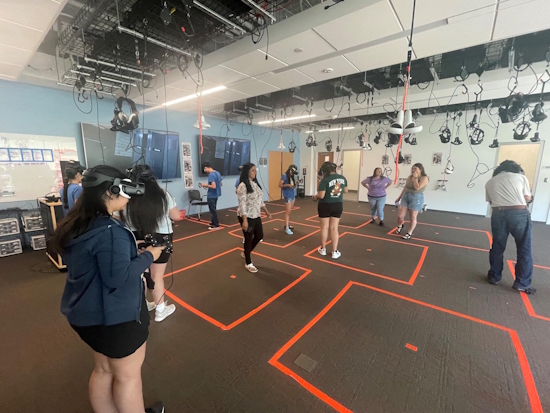
[Researchers at Colorado State University are using presence-evoking virtual reality to teach undergraduate students about veterinary care to help address the shortage of people going into careers as veterinarians. This story is from The Rocky Mountain Collegian, where the original version includes a second image. See also the related June 2025 ISPR Presence News post “Training your farm workforce: Virtual reality (and presence) as an aid in livestock care.” –Matthew]
[Image: Credit: Courtesy of Sangeeta Rao]
Researchers utilize virtual reality to address veterinary shortages, receive USDA NIFA grant
By Chloe Rios, Staff Reporter
February 4, 2026
In 2025, food animal veterinarians were at a critical low, making up only 3.1 % of clinical practice for veterinarians in the United States, according to the American Veterinary Medical Association. Two researchers at Colorado State University are seeking to alleviate this shortage.
From CSU’s Veterinary Teaching Hospital, Associate Professor Sangeeta Rao and Professor Pedro Boscan from the department of clinical sciences have worked to address this shortage through virtual reality livestock education, earning them a recent $250,000 grant from the United States Department of Agriculture and the National Institute of Food and Agriculture.
The grant, classified under education, extension and training, is a part of NIFA’s Veterinary Services Grant Program, which aims to address veterinary shortages and support their services.
The project began with one simple goal: enhancing education. At the start of the project, studies came out showing that the use of virtual reality in an educational setting led to increased satisfaction, performance and attention, making it an attractive tool to teach students with, Boscan said.
“We started considering, hey, maybe (virtual reality) is a way … that we can entice younger generations to learn and play and to have fun with what would be working on a dairy farm or on a production farm,” Boscan said. “Those are younger generations that are keen into using virtual reality or any computer technology base to try to see if we can start creating a little bit more of an appetite to go into that direction.”
The project has undergone a number of phases throughout the years and, in total, has received three grants. Each project creates an immersive experience for participants to experience a livestock care scenario. The first module, which received a grant from High Plains Intermountain Center for Agricultural Health and Safety at CSU, focused on dairy worker safety. A different model that received funding from the College Research Council explores safe and hygienic milk feeding to calves at a dairy farm.
Throughout the initial phases, the project was taken to dairy farms to test and work out iterations before finalizing the modules. Interactions like these have revealed gaps in dairy farm training, with different workers having different ideas about what protective equipment to wear.
The visits also led to feedback that has developed the project. For example, at one visit to a dairy farm, workers asked if the modules could be put in Spanish as well as English.
“We did that,” Rao said. “Now they can choose the language … (that) they’re comfortable with. … In the future, whatever programs that we develop we will make sure that we have at least those two languages to choose from.”
With the USDA grant, allocation plans have yet to be finalized. However, the professors are keeping requests like these in mind as they look to expand their project. They plan to add three to four more modules that look at different aspects of food animal veterinary work, such as poultry.
The development of these different modules has been an interdisciplinary collaboration. Beyond the veterinary hospital, Rao and Boscan have collaborated with Cyane Tornatzky, a professor of electronic art in the department of art and art history at CSU.
Tornatzky has worked to develop the visuals for the different modules. Marie Vans, an associate professor of systems engineering, has also been involved in the project throughout the past year by offering computer expertise.
Over the years, the different modules have traveled to various schools, county and state fairs, as well as making appearances at CSU’s Ag Day. Children along with middle and high school students have had the opportunity to interact with technology at events like these.
“Whoever comes to these fairs, … they don’t want to leave,” Rao said. “Some of the students are like, ‘ Oh wow, I love it.’ … They get so excited about it.”
With a goal of the project to foster interest in agriculture and livestock careers, participants can take a presurvey and postsurvey to evaluate their knowledge and interest in agriculture before and after using the technology. Middle and high school students are asked questions about the interactions they have with the modules, further enhancing the learning components.
The technology is present across CSU institutions, including the main campus in Fort Collins, the Veterinary Teaching Hospital, CSU Spur and the Sci on the Fly: Mobile Outreach Learning Lab.
Looking forward, the pair wants to provide people with access to the modules through an open source called Steam.
“We just want to help our community (and) help our society to get to that next level in terms of knowledge (about) where your food comes from (and) how does it work,” Boscan said.
Leave a Reply