[With a major winter storm in the forecast, it’s a good time to learn about how some of the professionals who work to restore electrical power after storms are using presence-evoking virtual reality to stay safe in hazardous conditions. This story is from South Carolina’s Post and Courier, where the original version includes five more images and a 1:14 minute video. For a related story, see the May 2025 ISPR News post “Digital twins and virtual reality transform electric utility workforce training at Virginia Tech.” –Matthew]
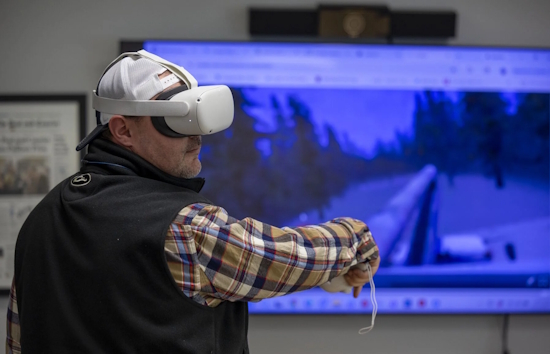
[Image: Travis Renwick, a lineman-turned-trainer, demonstrates a simulation using a virtual reality headset, Wednesday, Dec. 2, 2025, in the Post and Courier’s newsroom. Credit: Robert Scheer/Staff]
Electrical linemen across South Carolina are using VR to train for the job. Here’s how.
By Komlavi Adissem
January 22, 2026
Electrical line workers put their lives on the line when they go out to restore power after storms and when the wires get disconnected. As parts of South Carolina face the looming threat of snow and ice from an upcoming winter storm this weekend, crews are gearing up to respond to potential outages across the state.
Travis Renwick, a longtime lineman-turned-trainer, said he was once told by a colleague that line work is not any more dangerous than any other job, but it certainly is hazardous.
Training to be prepared for those hazards can come in various forms.
The Berkeley Electric Cooperative partners with Trident Technical College for a semester-long lineman training program. This and other training programs give line workers hands-on experience in a controlled setting. However, the Electric Cooperatives of South Carolina — the umbrella organization for 18 co-ops across the state — also employs a unique training tool: virtual reality.
Renwick travels around to different co-ops with his VR headset and three different training programs installed. Virtual reality is not a replacement for real-life, hands-on training, he said, but it supplements it. Virtual reality is a useful tool when bad weather prevents outdoor training, he said.
The first iteration of VR training programs for electric line workers was designed by Pike Corporation, a company that handles infrastructure for electric and gas utilities. It was created by strapping Go-Pros to linemen and recording their movements as they simulated repairing lines and operating bucket trucks, Renwick said. In 2023, the National Rural Electric Cooperative Association — the national counterpart of ECSC — rolled the VR programs into resources provided to member co-ops as part of the Commitment to Zero Contacts safety initiative.
Renwick said he first got his headset in December 2023 after ECSC leaders thought the software could be useful to train new linemen and to go over safety protocols when repairing downed lines. He spent about a week and a half in the headset at first, testing the limits of the software and exploring how it could be used for training.
Renwick said there are three VR programs he uses: Line Down, Coin Collector, and URD Experience, each with their own unique features. Coin Collector, he said, is great for training linemen on operating a bucket truck without jeopardizing a $300,000 vehicle. It also “scores” the users, he said, which can make it a fun way to learn and try to do the best you can. The URD Experience, meanwhile, provides training on how to operate on power cables buried underground.
Line Down offers the ability to walk through the process of preparing and putting on personal protective equipment, identifying a downed line, repairing it and restoring power. He said aspects of this particular program make it a versatile training tool.
“(You could say,) ‘Hey, we’re not worried about the line down part as far as actually fixing it, but … let’s train on our job briefing for it. Let’s train on PPE for it,” Renwick said. “You’re not handcuffed to just what it is, as long as you’re willing to think outside of the box.”
The training in VR can help reinforce safety protocols that save lives in the field. During a safety demonstration at Berkeley Electric Co-op in November, veteran linemen Kenny Infinger and Matt Gaskins demonstrated the threat that live lines can pose to workers.
Gaskins held a hot dog — an item commonly used in these kinds of demonstrations as a substitute for a human hand — up to a bare wire with an electric current coursing through it. The contact sparked flames and gave off smoke. The sausage, though seemingly unharmed on the outside, has a charred black streak coursing through the center. With another demonstration, Infinger explained how even something like a small hole in a rubber glove can turn into a fatal incident.
“That would be tragic for us as a company to have a lineman lose his life over a hole in a rubber glove,” Infinger said.
Checking for holes in gloves and other protective equipment is just one part of the process to ensure safety, Infinger said. Renwick told The Post and Courier that, with electric line work, “there’s a process for everything.”
“There’s a process, and there’s a reason why we do what we do,” he said. “And virtual reality helps supplement that in a way where we’re all together, we can all be on the same page, and we can all have the same understanding.”
Renwick said the VR software creates a space where trainees can make mistakes without the risk of injury, or worse. He noted that virtual reality isn’t for everyone — as it can cause motion sickness for some — but that it can offer a way to bridge the communication gap between the older generation of linemen and the younger trainees.
“Sometimes, just creating that conversation with this is now giving this younger guy a better understanding what this man has been trying to tell him all along,” he said. “He just doesn’t know how to relate. … Well, we just took visualizing it in your mind that we can put it on the screen, show it, talk about it, discuss it and walk through it.”
Leave a Reply