[This story and interview from the Kyiv Post describes how Russia’s war on Ukraine motivated a Ukrainian startup company to develop a rehabilitation device that uses presence-evoking virtual reality to treat the many patients suffering with phantom limb pain after amputations. See the original story for four more pictures, and the VRNOW Lab website for more information. –Matthew]
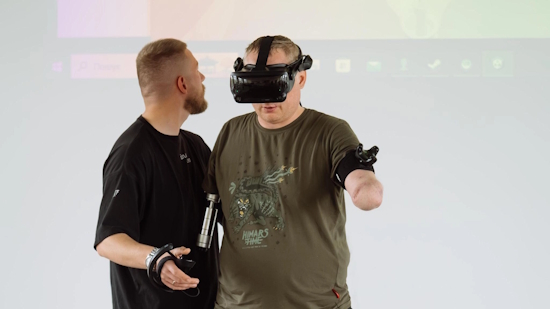
[Image: A patient undergoes virtual reality-based rehabilitation using VRNOW Lab’s system to treat phantom limb pain following amputation. Credit: Photo by VRNOW Lab]
Ukrainian MedTech Startup Deploys VR System to Treat Phantom Limb Pain
Kyiv Post interviews founder of Ukrainian startup VRNOW, which has so far enrolled 1,000 amputee patients in new patented virtual reality-based treatment for phantom limb pain.
By Olena Hrazhdan
December 31, 2025
Ukrainian startup VRNOW Lab has begun treating post-amputation phantom limb pain using virtual reality (VR), and its rehabilitation device has already been used by more than 1,000 patients.
In an interview with Kyiv Post, the founder of the idea, Artem Chyhyrynskyi, said VRNOW Lab developed the method while working to restore mobility in patients with complex war-related injuries, including veterans.
In cases of phantom limb pain following amputation, the brain continues to send signals to patients that the limb still exists and is in pain. Previously, phantom pain was treated using mirror therapy, in which patients were seated in front of a mirror so the brain could perceive the absence of the limb. However, VRNOW Lab developed a VR-based treatment, arguing that the mirror method is ineffective and outdated.
Developed by MedTech company VRNOW Lab in collaboration with Ukrainian physical therapists, occupational therapists, and neuropsychologists, the system combines immersive virtual environments with structured rehabilitation exercises.
It is already being used in more than 10 medical institutions, including the UNBROKEN rehabilitation center, military hospitals, and the Okhmatdyt Children’s Hospital. Despite the device’s relatively high price of nearly Hr. 2 million ($48,800), the company has already generated Hr. 20 million ($487,800) in revenue over the past year of sales.
At the core of the system is Virtual Limb Mode, a tool designed to address phantom pain. Patients can see and control a virtual representation of the lost limb, with the technology aiming to retrain the brain’s perception of the body and reduce persistent pain.
Kyiv Post spoke with Artem Chyhyrynskyi, founder of VRNOW Lab, about how the technology works, what doctors are seeing in practice, and whether Ukraine’s wartime experience could turn the country into a global testing ground for next-generation rehabilitation solutions.
Chyhyrynskyi is also the founder and CEO of Advin Global, a B2B augmented and VR company whose portfolio includes 250 completed projects for the Office of the President of Ukraine, Lenovo, Tefal, Coca-Cola, Toyota, and other companies, according to the company’s website. He said VRNOW was launched using investments from Advin Global.
The following interview has been edited for clarity.
Kyiv Post (KP): How did the idea for the startup originate? What circumstances led you to begin implementing rehabilitation using VR?
Artem Chyhyrynskyi (AC): The idea for VRNOW emerged in response to a very specific demand at the time. Starting in 2022, we saw how acute the shortage of modern rehabilitation tools in Ukraine had become for people who had lost limbs during the war. The longer the full-scale invasion continues, the more such patients there will be.
As of the end of 2024, according to various estimates, up to 120,000 people with amputations were living in Ukraine, with the overwhelming majority of these injuries caused by combat. Today, the number is higher still.
We began researching the problem of phantom pain, which affects around 85% of patients following amputations. At the same time, we studied international research, including pilot projects in the US, which showed that VR can be effective in treating phantom pain.
That was the moment when we decided not to wait, but to create our own solution in Ukraine. We assembled a team of more than 30 specialists – engineers, VR developers, 3D modelers, and, of course, doctors who helped shape the therapeutic scenarios. This is how VRNOW was created – as a response to a real and urgent need.
KP: Why did you specifically choose rehabilitation for veterans who have lost limbs and suffer from phantom pain?
AC: This is where we saw the biggest gap between the scale of the problem and the available solutions. Phantom pain is not just about physical discomfort. It is a condition that can exhaust a person for years, interfere with prosthetics, rehabilitation, and a return to full life.
At the same time, patients do not have tools that address this problem in a systematic and effective way. This led to the creation of our dedicated Virtual Limb Mode for working with patients with amputations.
We also realized that the technology has much broader potential – it can be used in post-stroke rehabilitation and for other musculoskeletal and neurological disorders.
We began testing at the end of 2022 in cooperation with rehabilitation centers and have documented clinical cases that demonstrate its effectiveness. The results show a consistent reduction in phantom pain, which for us is the key indicator that we chose the right path.
KP: Why are existing forms of treatment for phantom pain in Ukraine considered outdated today, and why is there a need for new treatment methods?
AC: An alternative method for treating phantom pain is mirror therapy, which has been used since the 1990s. It is based on the illusion of reflecting the missing limb in a mirror. However, its effectiveness today is increasingly questioned by both doctors and patients.
VR allows patients to immerse themselves much more deeply in the rehabilitation process. With VR, a patient does not just see a limb – they actively interact with it in a gamified environment, performing exercises, movements, and tasks, including working with a limb that no longer physically exists.
Thanks to trackers and sensors, movements are reproduced with high precision, and the system creates a personalized 3D avatar of the patient’s body. This significantly increases engagement in therapy and the overall effectiveness of rehabilitation.
KP: What was the initial capital required to develop the technology, and what sources did you use to finance the idea?
AC: We received our initial funding from the IT company Advin Global, which has been operating on the Ukrainian market since 2017 and specializes in augmented reality and VR technologies.
The initial investment amounted to around Hr.16 million ($400,000) at the time of investment. These funds allowed us to assemble the team, begin development, and bring the technology to the level of a medical product.
This product became the starting point for the creation of a new MedTech company, VRNOW Lab, which is now focused on the further development of virtual rehabilitation technologies.
KP: Your technology already has a patent. Not many teams choose to patent their technology at an early stage. How did this process work, and what did you need to do in order to obtain the patent?
AC: Yes, we deliberately chose to pursue patent protection at an early stage. For us, it was important not only to create a working product, but also to legally secure its technological novelty and protect the core solution underlying VRNOW.
We have a defined intellectual property strategy within the company. We worked with patent attorneys and prepared a patent application that clearly described the technical aspects, the operating logic of the technology, and how it differs from existing solutions. As a result, we obtained Ukrainian patent No. 158352.
A patent is an important element of asset verification and a foundation for future investment and partnerships. In parallel, we are working on international intellectual property protection and have already launched the patenting process in the EU, including obtaining a patent in Germany.
KP: How did you find your first patients?
AC: The first patients to test VRNOW were based at the Dnipro-based rehabilitation center Shliakh do Zdorovia (“Path to Health”) – primarily veterans with amputations. We worked closely with the doctors at this center during the development of the VR environments and therapeutic scenarios. Our first clinical cases were formed and documented on their clinical base, confirming the effectiveness of the technology.
KP: You say that “hundreds” of patients have already undergone rehabilitation using VRNOW. Can you provide a more precise number? Who are these patients and what types of injuries do they have?
AC: As of today, more than 1,200 patients have undergone rehabilitation using VRNOW in medical institutions across Ukraine. It is impossible to provide an exact figure, as the technology is also used in closed medical facilities – military hospitals – from which we cannot collect data for understandable reasons. Most patients are people with amputations, both military personnel and civilians.
KP: Under what conditions is this type of rehabilitation recommended or not recommended?
AC: VRNOW is always used as a complement to conventional physical therapy and only under the supervision of doctors or physical therapists. There are clear contraindications, including acute psychiatric conditions or epilepsy, so the decision to use VR rehabilitation is always made on an individual basis.
Our experience shows that properly selected VR scenarios help reduce phantom pain, increase patient motivation, and restore a sense of control over the body – which is critically important for recovery.
KP: You collect feedback from doctors who prescribe your solution. What do they say about the product?
AC: Yes, we continuously collect feedback from doctors and therapists at all medical facilities where VRNOW is used. For us, this is not a formality but a core part of product development. We maintain close, ongoing communication with rehabilitation specialists, physical and occupational therapists – discussing clinical outcomes, patient behavior, exercise difficulty, engagement levels, and changes in pain dynamics.
Based on this feedback, we constantly improve the VR environments, refine scenarios, and adapt exercises to real patient needs. Doctors often emphasize that VRNOW increases patient motivation and helps keep them engaged in the rehabilitation process – and for us, this is one of the most important indicators of effectiveness.
KP: Could you clarify whether this is ultimately a social project or a commercial product?
AC: VRNOW is an impact-driven project with a clear commercial model. We have a fixed price for the VR rehabilitation system – Hr.1,800,000 (~$43,000) – and sell it to both private and state medical institutions. This approach allows us to scale the technology, ensure its sustainability, and at the same time create measurable social impact.
KP: What do the financial results look like?
AC: VRNOW is a commercial product, and the technology is already generating revenue. Active sales began in Q4 2024, and since then 12 VR rehabilitation devices have been installed in medical institutions across Ukraine.
A key role was played by investment from Advin Global, which made it possible to finance product development, team formation, and pilot deployments, alongside investments from the company’s owners. After sales launched, the company transitioned to a self-sustaining commercial operating model.
Legally, VRNOW Lab was registered in 2025, although the technology itself had been developed and tested since 2022. That period laid the foundation for the product’s market entry and further scaling.
Cumulative revenue by the end of Q4 2025 is expected to reach Hr. 19-20 million (~$470,000).
Given the initial investments and ongoing quarterly R&D spending (estimated at 15–20% of revenue and covering updates to existing VRNOW functionality, development of new devices, including in ophthalmology, and pilot studies) the company does not expect to report net profit by the end of Q4 2025, as it remains in an active phase of continuous reinvestment.
KP: Who do you consider to be your competitors? More broadly, how would you describe the startup market for phantom pain rehabilitation in Ukraine and globally?
AC: In Ukraine, we have no direct competitors – there are currently no similar medical VR solutions specifically designed to work with phantom pain. We are the only company in the country with patented technology in this niche. Globally, there are very few such companies – by our estimates, fewer than 10 worldwide.
At the same time, we often encounter what we call “terminology confusion.” Under the label of VR, some hospitals receive VR headsets with 360-degree videos or relaxation content. This may have a psychological or calming effect, but it has nothing to do with physical rehabilitation or phantom pain treatment.
VRNOW is a medical tool with motion tracking, clinical scenarios, and measurable outcomes – not just a visual experience.
That is why we are not only talking about the VR market, but about the formation of a separate niche of medical VR rehabilitation, which in Ukraine is only just beginning to develop.
KP: Imagine an ideal scenario in which you have all the resources needed for growth and favorable market conditions on both the demand and supply sides. What does that picture look like for your startup? Where do you see the company in three to five years if everything goes according to plan?
AC: In an ideal scenario for us, VRNOW goes beyond being a standalone product and becomes part of a systemic shift in how rehabilitation is approached in Ukraine. In three to five years, we see the development of a full-fledged Ukrainian MedTech R&D center that not only implements ready-made solutions, but creates its own technologies at the intersection of medicine, neuroscience, and VR.
Ukraine has a unique, and unfortunately tragic, experience of working with a large number of patients with complex injuries, and it is precisely here that new clinical standards can be formed, which will later be in demand globally.
For the product itself, this means scaling VRNOW as a platform: more therapeutic scenarios, a broader range of indications, deeper analytics for doctors, and personalized programs for patients. Already today, our pipeline includes a second VR-based medical product in the field of ophthalmology.
From this perspective, we see Ukraine not only as a country that adopts innovations, but as an exporter of its own medical technologies – with VRNOW as an example of how a local response to a complex challenge can evolve into a global MedTech solution.
Leave a Reply