[Although it highlights only a particular platform, this article from FindArticles provides an interesting perspective on the evolution of communication media and specifically AI companions (note use of the term presence in the first paragraph). See also a story titled “Feeling Lonely? An Attentive Listener Is an AI Prompt Away” from the Harvard Business School. –Matthew]
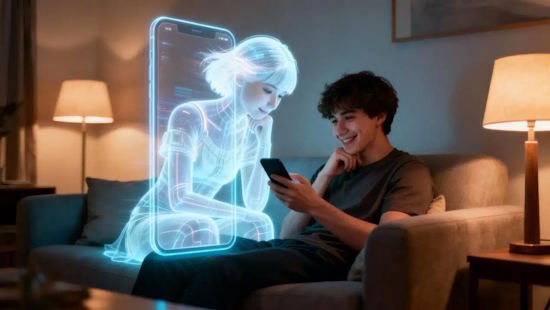
Can AI Companions Redefine How We Connect?
By Kathlyn Jacobson
December 20, 2025
By 2025 the intersection of artificial intelligence and emotion has moved from niche curiosity to cultural phenomenon. What began as simple chatbots responding to commands has evolved into a new market built on companionship, empathy, and co creation. More people than ever are turning to AI not for productivity but for presence, seeking forms of digital connection that feel personal, responsive, and emotionally intelligent.
Emotional technology is no longer a term on the margins of psychology or design—it has become their meeting point. It asks a question older than the internet itself: what does it mean to be truly understood?
The Era of Emotional Technology
The “emotional economy” has been forming for years. From therapy apps to social networks, many digital tools are built to capture and respond to human feeling. Yet until recently, emotional interaction was still transactional—you pressed a button, the system delivered a result. Now, generative AI has changed that model. It does not just react; it learns, remembers, and adapts over time.
The rapid rise of AI companions proves this shift. Search data and market analyses show consistent growth in terms like AI girlfriend, AI chat, and virtual companion. These platforms fulfill something dating apps and social media cannot easily provide: emotionally consistent feedback. For many people living in fast moving cities or isolated lifestyles, that reliability feels rare and deeply comforting.
Analysts describe this as a form of digital intimacy. The appeal is less about simulation and more about stability—a space where emotional expression meets guaranteed attention.
Why People Turn Toward AI Companions
Modern lifestyles often create emotional shortages. Urban living and remote work have compressed social interaction into brief, curated exchanges. People have fewer chances to speak freely or to feel truly listened to. Emotional AI steps into that gap.
Unlike human communication, which can be unpredictable or exhausting, AI companions promise calm continuity. They do not judge, interrupt, or disengage. Some users describe the experience as emotionally grounding, a kind of “practice relationship” that helps them reflect on their needs and improve communication habits in real life.
Critics worry that users will grow dependent on these systems, preferring the ease of digital affection to real human vulnerability. Supporters counter that AI companionship is not about replacement, but reconstruction—it helps people reconnect with feelings they might otherwise suppress.
Emotional AI as Creative Collaboration
The newest generation of companion platforms are less about conversation alone and more about co creation. At an individual level, users create the attributes of their AI characters by giving names, backstories and defining the personalities. The characters become a repository of their memories and interactions.
This dynamic turns users into storytellers. It transforms dialogue into narrative, encouraging emotional exploration through creativity. Flipped is one of the platforms leading this wave. It offers users the ability to shape AI characters that feel like living stories—characters that listen, remember, and grow alongside their creators.
Flipped gives users the freedom to create Protective Mentor, Charming Partner, Mysterious Rival, or a Curious Friend. With time the characters start reflecting the user’s emotional state. The AI responds to more than just spoken or written words. It is able to identify one’s energy and emotional state and be a fitting companion. The goal is not to simulate humanity but to study it—to show how empathy can exist within design.
The Business of Feeling
From a market standpoint, emotional AI represents an entirely new economy built on engagement and sentiment rather than attention alone. People no longer pay to be seen. They pay to be felt—to be remembered by something that never forgets.
Investors have started describing this sector as “emotion as a service”. The logic is obvious: connection keeps people coming back. Where most entertainment platforms compete for short bursts of focus, AI companionship sustains long term engagement. Users return not for distraction, but for dialogue.
This shift reflects a broader cultural transformation. People no longer see technology as purely functional; they want it to be relational. When machines begin to understand us emotionally, the boundary between utility and intimacy disappears.
The Human Side of Digital Companionship
Psychologists note that depending on context, emotional bonds with AI can mirror many natural forms of attachment. Humans have always invested emotion into non human entities—pets, fictional characters, even brands. The phenomenon reveals less about artificial intelligence and more about human capacity for empathy.
This does not mean we are replacing relationships. Instead, we are expanding their forms. Having access to an AI can provide you with a stable emotional state when life feels hectic and unpredictable. An AI can help you step away from stressful situations by being a companion or even just a helpful tool that listens quietly while you decompress, offering you a chance to reflect internally. It’s not reassurance in a romantic sense, but it’s the relief of being acknowledged, even by an entity that is nothing but a construct of design and information.
A New Type of Connection
The nature of emotional AI makes this a reality. Rather, the question is, how should we define those emotional attachments to AI? From letter writing to instant online messaging, human relationships have always changed with the advancement of technology. The platform ChatGPT is no different and serves as a primitive reflection of technology that allows people to interact.
In time, AI companionship may influence how people communicate in all kinds of relationships. It might help us learn to express needs more clearly, to listen better, to empathize more deeply. That is the paradox of this technology: by teaching machines to care, we rediscover what caring means for ourselves.
Experience the Future of Emotional AI
Flipped does not ask you to fall in love with technology. It asks you to notice what happens when technology begins to care back.
Perhaps connection has never been about who—or what—listens, but about being listened to at all.
If you have ever pondered the sensation of being entirely understood by a piece of technology, now you can see what that experience is like. Please visit Flipped to generate your first customized character. You will experience how it feels to have technology listen for a change.
Leave a Reply