[A large Community College District in central California is taking presence experiences on the road, as reported by The Bakersfield Californian; see the original version of this story for three more pictures. For more details see coverage from the District, which includes more pictures and cites an earlier story from Arizona State University, and a press release via PR Newswire. –Matthew]
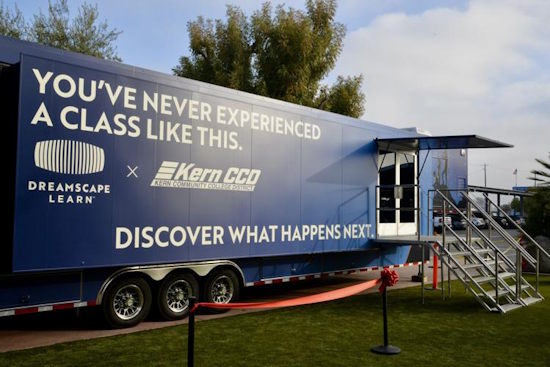
[Image: The Kern Community College District recently purchased a movable trailer with 16 virtual reality stations to help students learn a variety of subjects. The district plans to move the trailer around to its various campuses while also making the trailer available to local schools. Credit: Peter Segall / The Californian]
KCCD debuts mobile virtual reality classroom
By Peter Segall
December 4, 2025
The task was fairly simple: Pilot a flying vehicle down the Amazon river to investigate an explosion at a remote research facility. The students were enjoying doing it.
“This is some ‘Mission Impossible’ (expletive),” one said. “I mean stuff,” he corrected.
Fifteen students sat inside a tractor trailer, virtual reality headsets over their eyes and ears and their hands either controlling a joystick or trying to activate some button visible only to them.
They were among the first students to try out the Kern Community College District’s new Dreamscape Mobile Classroom, a mobile trailer with 16 stations equipped with headsets, a joystick, haptic feedback chairs and even little fans built into the desk to simulate the wind.
“It’s all kind of story based,” KCCD Vice Chancellor of Planning and Educational Technology Todd Coston said.
“The idea is you get students hooked into a story and then that gets them engaged with the content and they want to keep moving on. So they come in, they’ll do like a 12- or 15-minute act, and then they leave that, they go and do the classroom.”
The module students used Thursday morning was for a biology class and set the students up for the lesson with a sci-fi storyline where they investigate the cause of an explosion.
“It’s just a storyline to kind of get students intrigued and excited,” Coston said.
“What happens is they do the first one and then they’re anxious to do the work because they want to come back and see what happens next, and then they want to see what happens next. So it’s just a way of engaging students. It’s very different than what we’ve done in the past.”
The reaction from students was palpable. Shortly after putting on their headsets, the students started pawing and poking at the air, trying to interact with some projected object, all amid a constant chorus of “wow,” “whoa” and “where’s the multiplayer at?”
District officials and local dignitaries celebrated the purchase of the trailer Thursday morning with a ribbon-cutting, saying the trailer and its tech would provide new educational experiences to local students.
The trailer and its technology will be trucked around KCCD’s entire coverage area. Despite being named for Kern County, the district actually spans several counties, covering 24,800 square miles and servicing parts of Kern, Tulare, Inyo, Mono and San Bernardino counties through Bakersfield College, Cerro Coso College and Porterville College.
“That’s a level of opportunity and leveling the playing field I think is quite unique, and that’s why I think this project is so really exciting,” said Chris Huff, a vice president with Dreamscape Learn, the company behind the technology.
“It’s kind of the perfect match of the idea of allowing these amazing experiences to be mobile combined with an environment where that’s really a key part of what your challenge is,” Huff said.
Dreamscape Learn was founded by Walter Parks, a longtime screenwriter and producer and early partner at DreamWorks Pictures and Arizona State University President Michael Crow.
Huff said several years of studies at ASU have shown the technology to improve learning outcomes.
Students are almost two times more likely to achieve an A grade in the course using Dreamscape Learn versus the traditional lab approach that they used before, Huff said.
The trailer cost the district $1.2 million and will have an annual operating cost of less than $250,000, according to KCCD Chancellor Steven Bloomberg.
Right now, programing for the trailer is limited to a biology class and a chemistry class, but the technology can be used for any discipline, Bloomberg said.
“So right now, we have fully developed both biology and chemistry. Because of the technology that’s in here, it’s actually open source software. And so during the spring semester, one of the things we’ll be doing is taking this to each of our colleges and working with our faculty on what is coming next,” Bloomberg told The Californian.
The district also plans to make the trailer available to local schools at no cost. The trailer came with a scheduling software and Bloomberg said district leaders hope to have students of all ages access STEM-based lessons.
Bloomberg said the studies done by ASU gave him confidence the technology would actually produce improved educational outcomes.
“It shows that the students who enroll in courses in general biology using this technology are more than twice as likely to earn an A, and their percentage points, of course, completion goes up about 20% over students who didn’t enroll in immersive technology,” he said.
Leave a Reply