[A professor at the University of Illinois Urbana-Champaign has created a virtual reality game that teaches players about Loïe Fuller, an extremely popular and influential dancer who was one of the first to integrate technology (including presence-evoking technology) into her performances; game players also learn and practice basic dance principles. See the original version of the story for a second image (of Loïe Fuller), and follow the Master Dancer link for videos and more information. –Matthew]
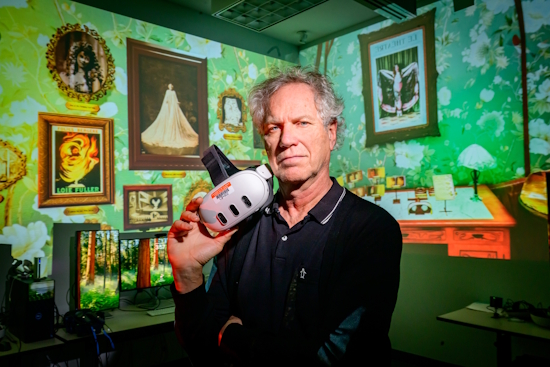
[Image: Professor John Tenjes is surrounded by a projection of a scene from “Master Dancer” in a National Center for Supercomputing Applications lab. Credit: Photo by Fred Zwicky]
Illinois dance professor creates virtual reality dance game about modern dance pioneer Loïe Fuller
By Jodi Heckel, Arts and Humanities Editor
March 23, 2026
CHAMPAIGN, Ill. — Modern dancer Loïe Fuller became famous in early 20th century Paris for her “Serpentine Dance,” which she performed while enveloped in a long, flowing skirt that she twirled around herself.
Fuller’s dance comes to life again through an avatar in a virtual reality game called “Master Dancer,” developed by John Toenjes, a University of Illinois Urbana-Champaign dance professor, composer and the music director for the dance department. The game teaches basic dance movements as well as the history of Fuller’s influence in dance.
“Fuller had her own theater at the Paris World’s Fair in 1900. She was hugely influential at the time. She was the Beyoncé or Taylor Swift of the early 20th century in terms of her popularity and influence,” Toenjes said.
“She really was quite a groundbreaking performer,” he said. “She transformed herself into all these organic shapes. She used very inventive lighting techniques. The combination of that and the costume transformed her into a moving, glowing shape.”
Toenjes said he was inspired to create “Master Dancer” by the popularity of gaming and the immersive quality of virtual reality and to consider how their potential might create a deeper appreciation for and more interaction with dance. His research focus is integrating technology into live dance and theater performances, and he founded the Laboratory for Audience Interactive Technologies at Illinois.
Toenjes said Fuller was one of the first dancers to integrate technology into her performances. She used a magic lantern to project images onto her costume while she danced and chemical compounds to create color gels and luminescent lighting.
The game’s players meet Fuller in a room decorated with photos of her and a virtual sculpture created from a scan of a sculpture of Fuller in the Minneapolis Institute of Art. Fuller directs the players to explore exhibits located throughout the lobby of a theater. The room has a stereoscope and cards to insert that were scanned from a collection in a British museum. The players use them to move between the exhibits and the dance games.
The exhibits examine Fuller’s lighting innovations and her friendships and collaborations with scientists, including Thomas Edison and Marie Curie; artists such as sculptor Auguste Rodin and lithographer Jules Chéret, who created work featuring Fuller; composers Florent Schmitt and Claude Debussy, whose music Fuller used in her performances; and dancers Sada Yacco and Isadora Duncan, whom Fuller supported in their careers. As players visit each museum exhibit, they collect the signatures of the featured characters in a playbill.
The players also play two games designed to teach a particular movement principle. In the Star Maker game, players strike stars that are flying toward them into a specified region in the sky to form constellations. The game teaches a forceful, direct movement of the arms.
The Music Roundabout game requires players to twist their bodies toward orbs resembling bubbles that are floating around them. They must lightly touch the orbs to create a melody.
After players have viewed all the exhibits and completed the games, Fuller reappears to them and demonstrates a dance using the movements they have just learned. The players then compose their own dance, creating a colorful digital sculpture around them as they do so.
“The idea is, if you just learn some basic principles, you can feel like you can be a dancer and your dance can relate to the world around you,” Toenjes said.
He has been developing “Master Dancer” for several years and has built several versions of the game. It is in its final version now. Much of the technical work to create the game has been done by The stu/dio, a student-staffed game development company on campus that works on game development projects to support education and research.
“It’s unique for a university program to have an actual game development studio. Faculty can contract with them to develop a game or immersive experience,” Toenjes said. “Before working with The stu/dio, in the first year (of the game’s development), I had a group of students who got (the project) on its feet. They all moved on, and I got a new group that had to spend time figuring out what the other students did and build on that, then they moved on. It’s project death by graduation. The stu/dio really solves that problem.”
The students worked on game design, programming, sound effects, music and many of the graphics. Toenjes created many of the two-dimensional graphics, and students at the New York School for Visual Arts did much of the three-dimensional modeling.
Toenjes is working with Illinois business students on a marketing plan for the game. He said he’d like to see the game used in middle school and high school libraries and in museums to help teach history and movement. The filmmakers of a 2023 documentary about Fuller, “Obsessed with Light,” want to take the game to film festivals that are screening the documentary, Toenjes said.
—
To contact John Toenjes, email jtoenjes@illinois.edu.
This project is supported by the Illinois Campus Research Board, the Center for Innovation in Teaching & Learning, the Grainger Engineering Library IDEA Lab and the Siebel Center for Design.
Leave a Reply