[This story from the Canada Media Fund uses examples and comments from a panel discussion at the Montreal International Documentary Festival to explore the potential positive and negative psychological impacts of documentaries that utilize presence-evoking extended reality technologies. For more on Traces: The Grief Processor, see a March 2025 ISPR Presence News post. –Matthew]
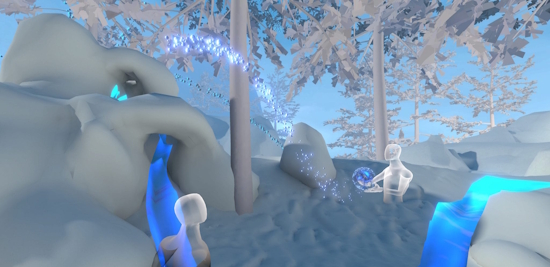
[Image: Traces: The Grief Processor. Credit: Couzin Films.]
The risks and rewards of XR documentary
For several years, extended reality (XR) documentaries have been offering immersive experiences by dropping audiences directly into stories via virtual or augmented reality. How is the genre faring today?
By Philippe Jean Poirier
March 5, 2026
Traces: The Grief Processor, presented at the SXSW festival in Austin, Texas, last March and the Montreal International Documentary Festival (RIDM, based on its French acronym) in November, is an interactive documentary experience that uses location-based virtual reality (LBVR) to explore grief.
Before donning the virtual-reality headset, visitors are asked to contribute a written, visual or auditory memory connected to the loss of someone important to them. They then enter a virtual dreamlike forest in a small group, guided by director Vali Fugulin and actor Stéphane Crête, who also specializes in funeral rites. During the experience they can interact with the subject of their grief, then share a statement that is archived in the Traces universe.
“The frustration I’ve often felt [with immersive experiences] is that I’m dropped into something that’s happening right then and there, but it was conceived by someone else,” Fugulin explained at RIDM, where XR documentary filmmakers discussed the virtues and dangers of their field during a talk titled Memory in the Age of Digital Storytelling.
“As a documentary filmmaker, my personal obsession has become integrating reality into an experience that’s happening in real time. When creating Traces, I wanted people to be able to bring their own stories into my story,” she continued.
French filmmaker Emeline Courcier places her personal story at the heart of her work. In her video installation Burn From Absence, recently on display at Montreal’s Place des Arts and the PHI Studio, Courcier uses artificial intelligence to recreate memories of her deceased family after a relative in Vietnam burned all their family photos back in 1975.
Users hear real audio accounts while seeing AI-generated visual recreations of those memories. “Each person has their own perception of their experience; some memories contradict each other. In the end, it’s up to the viewer to decide if they are watching a work that is true or false,” Courcier said during the RIDM talk.
Accessing the Inaccessible
Ugo Arsac, a documentarian from Marseille, France, uses digital storytelling in a different way. He sees the medium as a way to let people access experiences that would generally be inaccessible to them.
One of his projects, IN-URBE, explores Paris’s labyrinth of underground sewers, crypts, tunnels and subways. Another, Girlfriend Experience, takes its audience into the brothels of Marseille. His project ENERGEIA, which was presented at RIDM, takes place in a virtual post-apocalyptic setting comprised of real French nuclear power plants.
“It’s a sort of experimental video game,” Arsac explained. “You walk around the interior of this 3D documentary. There’s no beginning, there’s no end. You enter when you want, you leave when you want.”
ENERGEIA participants meet experts who contradict each other on energy issues. “In all of my projects, I try not to give my view of things,” Arsac said. “I prefer to present people who offer varying positions. That gives the audience the opportunity to form their own opinion.”
The Risks of XR Documentary
Although he has decided to embrace the medium, Arsac recognizes that digital storytelling comes with risks. “Virtual reality has a different power than [traditional] documentary,” he explained. “A documentary remains in a cerebral place; we remember it in our minds. Virtual reality also creates a physical memory in the inner ear. The memory is located in a different place.”
Extended reality experiences can also provoke strong, sometimes unexpected, emotional reactions. “There’s a risk that the experience itself creates trauma,” Arsac said.
That’s why Courcier chose to abandon an immersive project on incest. “An immersive experience allows you to include the viewer by putting them in a position to confront a difficult experience. That said, who would want to be dropped into such a nightmarish experience?”
She wonders if that pursuit is even worthwhile. “What is a work of art if there’s no one to witness it, if there’s no one to share it with and create a dialogue? I find this type of physical and mental engagement a little risky [in the context of a story about incest].”
With Traces, Fugulin has seen the emotional power of the medium firsthand. “Even if we try to prepare people beforehand, we can’t completely control the emotional charge. There are people who have very strong reactions, even if we’ve done everything we can to mitigate them. It’s true that it can get away from us.”
[This story from the Canada Media Fund uses examples and comments from a panel discussion at the Montreal International Documentary Festival to explore the potential positive and negative psychological impacts of documentaries that utilize presence-evoking extended reality technologies. –Matthew]
[Image: Traces: The Grief Processor. Credit: Couzin Films.]
The risks and rewards of XR documentary
For several years, extended reality (XR) documentaries have been offering immersive experiences by dropping audiences directly into stories via virtual or augmented reality. How is the genre faring today?
By Philippe Jean Poirier
March 5, 2026
Traces: The Grief Processor, presented at the SXSW festival in Austin, Texas, last March and the Montreal International Documentary Festival (RIDM, based on its French acronym) in November, is an interactive documentary experience that uses location-based virtual reality (LBVR) to explore grief.
Before donning the virtual-reality headset, visitors are asked to contribute a written, visual or auditory memory connected to the loss of someone important to them. They then enter a virtual dreamlike forest in a small group, guided by director Vali Fugulin and actor Stéphane Crête, who also specializes in funeral rites. During the experience they can interact with the subject of their grief, then share a statement that is archived in the Traces universe.
“The frustration I’ve often felt [with immersive experiences] is that I’m dropped into something that’s happening right then and there, but it was conceived by someone else,” Fugulin explained at RIDM, where XR documentary filmmakers discussed the virtues and dangers of their field during a talk titled Memory in the Age of Digital Storytelling.
“As a documentary filmmaker, my personal obsession has become integrating reality into an experience that’s happening in real time. When creating Traces, I wanted people to be able to bring their own stories into my story,” she continued.
French filmmaker Emeline Courcier places her personal story at the heart of her work. In her video installation Burn From Absence, recently on display at Montreal’s Place des Arts and the PHI Studio, Courcier uses artificial intelligence to recreate memories of her deceased family after a relative in Vietnam burned all their family photos back in 1975.
Users hear real audio accounts while seeing AI-generated visual recreations of those memories. “Each person has their own perception of their experience; some memories contradict each other. In the end, it’s up to the viewer to decide if they are watching a work that is true or false,” Courcier said during the RIDM talk.
Accessing the Inaccessible
Ugo Arsac, a documentarian from Marseille, France, uses digital storytelling in a different way. He sees the medium as a way to let people access experiences that would generally be inaccessible to them.
One of his projects, IN-URBE, explores Paris’s labyrinth of underground sewers, crypts, tunnels and subways. Another, Girlfriend Experience, takes its audience into the brothels of Marseille. His project ENERGEIA, which was presented at RIDM, takes place in a virtual post-apocalyptic setting comprised of real French nuclear power plants.
“It’s a sort of experimental video game,” Arsac explained. “You walk around the interior of this 3D documentary. There’s no beginning, there’s no end. You enter when you want, you leave when you want.”
ENERGEIA participants meet experts who contradict each other on energy issues. “In all of my projects, I try not to give my view of things,” Arsac said. “I prefer to present people who offer varying positions. That gives the audience the opportunity to form their own opinion.”
The Risks of XR Documentary
Although he has decided to embrace the medium, Arsac recognizes that digital storytelling comes with risks. “Virtual reality has a different power than [traditional] documentary,” he explained. “A documentary remains in a cerebral place; we remember it in our minds. Virtual reality also creates a physical memory in the inner ear. The memory is located in a different place.”
Extended reality experiences can also provoke strong, sometimes unexpected, emotional reactions. “There’s a risk that the experience itself creates trauma,” Arsac said.
That’s why Courcier chose to abandon an immersive project on incest. “An immersive experience allows you to include the viewer by putting them in a position to confront a difficult experience. That said, who would want to be dropped into such a nightmarish experience?”
She wonders if that pursuit is even worthwhile. “What is a work of art if there’s no one to witness it, if there’s no one to share it with and create a dialogue? I find this type of physical and mental engagement a little risky [in the context of a story about incest].”
With Traces, Fugulin has seen the emotional power of the medium firsthand. “Even if we try to prepare people beforehand, we can’t completely control the emotional charge. There are people who have very strong reactions, even if we’ve done everything we can to mitigate them. It’s true that it can get away from us.”
Leave a Reply