[The short story below from the North Dakota Monitor via KVRR, and the longer one from The Bismarck Tribune via GovTech.com that follows it, describe a promising application of presence to help people with disabilities learn about and obtain jobs in manufacturing (and in the future, other fields). See the XR for VR website of Bismarck State College for more information. –Matthew]
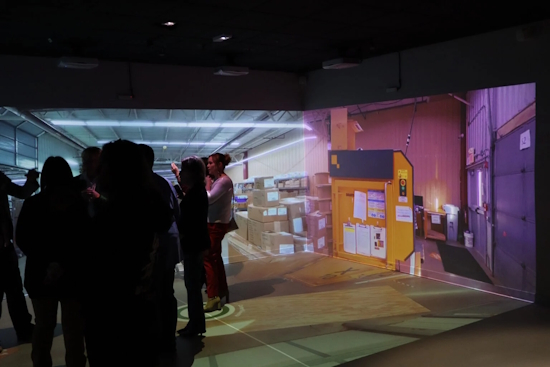
[Image: Bismarck State College unveils its new virtual reality room on March 9, 2026. The room is part of the XR for VR project, which uses virtual reality to help people with disabilities see what it’s like to work manufacturing jobs. Credit: Photo by Mary Steurer/North Dakota Monitor]
Virtual reality makes manufacturing more accessible for people with disabilities
By North Dakota Monitor reporter Mary Steurer
March 13, 2026
BISMRACK, N.D. (North Dakota Monitor) — A new virtual reality room at Bismarck State College is the latest addition to a project to help people with disabilities get manufacturing jobs in North Dakota.
The project is called XR for VR, which stands for “extended reality for vocational rehabilitation.”
It’s a collaboration between Bismarck State College, Fargo virtual reality media company Be More Colorful and nonprofits ND Assistive and CAST.org.
The goal is to make manufacturing more inclusive of people with disabilities.
“We’ve seen talented, capable people steered toward jobs far below their capabilities, earning much less than a living wage often due to incorrect assumptions around perceived limitations,” Be More Colorful co-founder Matthew Chaussee said at a Monday ribbon-cutting for the room.
People with disabilities can use the virtual reality technology to view manufacturing facilities and see what working there is like.
“They can learn safety protocols in a controlled environment,” Gov. Kelly Armstrong said at the Monday ceremony. “They can build confidence, develop skills and see themselves in careers they may have never even imagined before.”
While participants can use the program with virtual reality headsets, XR for VR hopes to open nine virtual reality rooms across the state. They work by projecting North Dakota manufacturing workspaces onto the walls and floor — with no headset required.
The latest room opened at Bismarck State College on Monday. Bruce Klootwyk, career coach for the program, said people with all kinds of support needs can participate.
“We go across the spectrum from ADHD to cognitive disabilities,” Klootwyk said.
XR for VR has met with the North Dakota School for the Blind, for example, he said.
“A lot of them can still see a little, and with our technology, we can help them get better jobs,” he said.
Klootwyk, who has cerebral palsy, said assistive technology was virtually non-existent when he was in school. Recent advancements in the field like XR for VR give him hope, he said.
“I think the world is going to become much more inclusive of individuals with disabilities,” he said.
The project was made possible through a $9.9 million grant from the U.S. Department of Education’s Disability Innovation Fund. The team received the award in 2024.
About a hundred people have tried out the product so far, Klootwyk said. Of those, 10 have gone on to find jobs in manufacturing, he said.
Klootwyk said the team’s goal is to have 400 people with disabilities participate over five years.
The team also wants to one day use the technology to simulate working in other industries, like health care, he added.
Those interested in trying the room can fill out a form on the program’s website.XR for VR also welcomes manufacturing companies who want to have their facilities filmed for the project to get in touch.
—
Bismarck State College Taps XR to Fill Manufacturing Jobs
A $9.9 million federal grant will help the college use extended reality, in the form of virtual tours and VR videos, to give people with disabilities a glimpse into what a typical workday in manufacturing looks like.
By Zachary Weiand, The Bismarck Tribune, N.D.
January 7, 2025
(TNS) — A multimillion-dollar federal grant for Bismarck State College seeks to help bridge the gap between the disabled community and North Dakota’s manufacturing industry.
Bismarck State College recently launched its XR for VR project — XR stands for extended reality, and VR stands for vocational rehabilitation. The five-year project is being supported by a $9.9 million federal grant, one of 27 initiatives around the country awarded money through the U.S. Department of Education’s Disability Innovation Fund. A total of $250 million was awarded around the U.S. this year as part of the program.
The XR for VR project aims to address workforce shortages in North Dakota’s manufacturing sector by empowering people with disabilities. The initiative seeks to raise awareness of the untapped potential within the state’s disabled community, which is often overlooked for job opportunities, while introducing people with disabilities to potential career paths in manufacturing.
In 2022, North Dakota had the second-highest employment rate among its working-aged disabled population in the U.S. at around 56.5 percent, according to the latest report from the Center for Research on Disability; the center defines working age as between 18-64 years old. The national average that year was 44.5 percent.
In comparison, the employment rate for the state’s working-age, non-disabled population in 2022 was 84.7 percent, while the national rate was 79 percent.
“This initiative really was to help focus on building capacity of manufacturing in the state of North Dakota by tapping into a — maybe a demographic that is overlooked, and that’s individuals that have disabilities,” project director Alicia Uhde said. Uhde is the dean of Automation, Energy and Advanced Technologies at BSC.
Extended reality is an umbrella term for technologies that merge the real and virtual worlds using computers. Common examples include augmented reality, which overlays virtual information onto the real world; virtual reality, which immerses users in a completely virtual environment, typically through a headset; and mixed reality, which enables digital and real-world objects to co-exist and interact.
The XR for VR project uses extended reality to offer virtual tours and VR videos, giving participants a glimpse into what a typical workday in manufacturing looks like. Many of these videos are filmed at real workplaces. The content is produced by CareerViewXR, a Fargo -based company specializing in immersive virtual reality career exploration experiences, which is one of the collaborators for the program.
The project aims to pilot with around 25 participants who are workforce ready, CareerViewXR CEO Matt Chaussee said, which will allow those running the project to learn and evolve the program over the five years.
The content will be available through virtual reality headsets, giving people who may not be able to travel to a manufacturing workplace the chance to explore the facility up close and make a more informed decision about whether the industry is right for them.
“(There is) a lot of preconceived notions about what manufacturing is, and this can help demystify all of those environments so that it’s viewed as a really great opportunity to move into a well-paying job that supports North Dakota workforce,” Chaussee said.
In addition to virtual reality headsets, nine “immersive rooms” will be set up across North Dakota. Chaussee describes these rooms as VR without the VR headset. The rooms are designed to expand accessibility for people with disabilities who may not be able to use a VR headset. One immersive room is already operational in Fargo.
XR FOR VR IMMERSIVE ROOM
“We project (the content) on all of the walls and the floor, and it feels like you’re in that space,” Chaussee said. “Individuals who can’t wear a VR headset for whatever reason — maybe they have a mobility issue, maybe there’s a tactile sensitivity issue — they’re not restricted from being able to get immersed in those environments to help make those decisions.”
The project includes an advocacy component that educates employers in the manufacturing sector about the talent within the disabled community. This effort is supported through a partnership of several North Dakota -based organizations.
Impact Dakota as the state’s manufacturing extension partnership has direct connections to just about every manufacturer in North Dakota, Chaussee said. The Bismarck-based firm will lead efforts to help employers understand the benefits of a diverse workforce and work to get manufacturers interested in the project.
ND Assistive, a nonprofit that provides residential and vocational assistive services, will help by providing adaptive equipment to help make workplaces more accessible. Adaptive equipment is any tool, device or machine that helps people with disabilities to perform tasks. Examples commonly seen in the workplace include screen readers, headsets and voice recognition software.
“(It’s) the big picture of not only the education and the training they might need and then the employment, but then with ND Assistive, (it’s) other services that they might need,” Uhde said. “We’ll have like a career coach position that will be there to provide them support so that they can be successful, not only through education if that’s the route they choose, or if they go right into the workforce and need accommodations.”
Chaussee said many people with disabilities are eager to work but are not actively seeking employment, which causes them to be overlooked in nonemployment statistics. He added that a key benefit of the project is that it will spotlight the disabled community, allowing people to take on roles that utilize their full potential.
Uhde said the project also benefits the disabled community by providing opportunities for employment and helping people thrive within the state.
“It’s really just creating opportunity for individuals with disabilities in our state of North Dakota, and we want them to stay here and we want them to want to be here and feel appreciated and valued within our state,” Uhde said.
Leave a Reply