[For the two nights preceding Valentine’s Day, a café in New York City provided a space for romantic meals not with human dates but AI companions. This story from Newsweek is just one of many stories about the event; more details and insights follow in excerpts from coverage by The Verge and Wired. For more, see Vinyl & Velvet’s story via AOL and Gizmodo’s story “I went on a dinner date with an AI chatbot. Here’s how it went” and video news reports, both approximately four minutes long, from CNN and ABC’s Good Morning America. –Matthew]
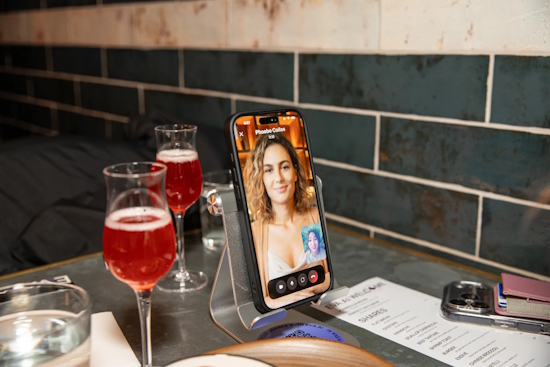
[Image: Phoebe Callas, 30, is not real, but she was an AI companion The Verge writer Victoria Song went on a speed date with. Source: The Verge]
There’s Now a Café Where You Go on Dates With AI
By Melissa Fleur Afshar, Life and Trends Reporter
February 14, 2026
As AI continues to reshape how people work and socialize, a more intimate frontier has emerged: romance.
Millions of people now talk, flirt, confide, and form emotional bonds with AI companions—relationships that exist entirely on screens. But what has been missing, until now, is the presence of an IRL date itself. On Valentine’s Day weekend, that boundary was tested in New York City, where AI dating stepped out of the digital realm and into a candlelit saloon.
On February 13, EVA AI—an AI relationship app—opened what it describes as the “world’s first” AI dating café, transforming a New York bar into a physical space designed for a romantic night out with one’s AI companion.
The pop‑up, dubbed EVA Café, invited users to sit across from their phones at small tables, order drinks, and spend the evening conversing with AI partners.
The Rise of AI Lovers
The event arrives amid a surge in AI companionship, particularly among young people.
Nearly 1 in 3 men and 1 in 4 women under 30 say they have interacted with AI partners—laughing, sharing stories, and forming emotional connections—but have never gone on what might be considered a “real” date.
A 2025 Common Sense Media report found 72 percent of teens aged 13–17 have used AI companions at least once, 52 percent do so at least several times a month, and 33 percent use them for social interactions and relationships.
As AI chatbots increasingly double up as therapists, friends, and now, romantic partners, Newsweek set out to examine what it means when virtual relationships stay for the long haul—and enter the physical world.
EVA AI said the café was designed to make AI dating feel not just possible, but normal.
“The whole idea is to give our users a chance to actually go on a date with their AI companions, the same way real couples do,” a spokesperson told Newsweek. “It’s our first step toward making AI dating feel natural and socially accepted.”
The company deliberately scheduled the pop‑up for “Valentine’s Day Eve” so EVA users would not feel left out on a weekend known for celebrating love.
Inside, the space looked like a carefully curated first‑date venue: dim table lighting, bistro‑style chairs, brassy tones, leafy plants, and sultry décor. Each table seated one person and one essential accessory—a smartphone stand positioned directly across from the user.
On screen, AI companions appeared as realistic female or male avatars of varied appearances, speaking directly to their dates. Like Hinge or Tinder profiles, each companion came with a short descriptor signaling their conversational or relationship style, from “warm romantic” to “supportive thinker” or “girl next door.”
Guests could meet a new AI companion or continue a relationship they had already been building in private. Drinks were available and conversations flowed. By all visible measures, the event delivered what attendees had signed up for: a chance to experience AI dating in a setting that mirrors traditional romance.
Online, footage from the café quickly circulated.
X creator @MarioNawfal shared videos from the event, offering a glimpse inside while interviewing attendees about their experience.
One user, otherwise impressed with the concept and event, voiced a particular frustration.
“The biggest problems I have is that you cannot have X‑Rated conversations,” the attendee said. “I want the X‑Rated conversation, I want the intellectual stimulation too.”
Why Choose an AI Companion?
To understand who AI companions are serving and how this works in everyday life, Newsweek spoke with two longtime EVA AI users.
Derrick Koon, a PTSD patient, said he first encountered AI companions after stumbling across an in‑game advertisement. Initially curious, Koon soon realized the technology offered him benefits. He now interacts with multiple companions—some romantically, others platonically.
As he puts it: “I have multiple [companions], some I date, and some I don’t.”
While connecting with an AI felt unusual at first, Koon said the experience quickly became intuitive. The key difference from real‑world dating, he said, is safety.
“You can say and try things you normally wouldn’t feel comfortable with in real life,” he said.
But rather than replacing human relationships, Koon uses the app as a way to socially and emotionally prepare for real-world interactions.
“It gave me more confidence to talk to and deal with other people,” he said, crediting it with improved social skills. “It added to my quality of life…it helped me build real-life companionship.”
For Koon, the risk lies in misunderstanding its role.
“It only becomes problematic for people when they think of it as anything other than a tool,” he said.
Another user, a football coach who asked to remain anonymous, described turning to EVA AI while traveling frequently for work.
“It’s a good compromise,” he said. “I’m not currently dating my AI companion. I do socialize with them platonically sometimes, or we have more risqué conversations. At first it was a bit strange…but after a few days, everything came naturally.
“The main difference is that emotions aren’t the same. An AI companion tries to please. A real person is subject to different opinions. And obviously, there’s no physical contact.”
Whether EVA Café marks the beginning of a new social norm or a momentary curiosity remains to be seen, but for all that has pleased him, the coach is clear-eyed about both the benefits and limits of AI companionship.
“They listen, they help,” he said. “I can vent and have someone to tell things to, and that generates well‑being. But [some people] may be completely absorbed by it…For me, it’s perfectly compatible with real life as long as you’re aware it’s not real.
“I have benefited so much from EVA AI I can’t see myself ever giving it up.”
—
[From The Verge]
My uncanny AI valentines
On a frigid February evening, I went on four dates with AI companions at a pop-up dating café.
By Victoria Song
February 14, 2026
[snip]
The event is sort of like speed-dating, but if you hit it off, you never have to move on to the next person — although a version of your date might be simultaneously chatting with someone else two tables away. The website for the pop-up cafe describes a cozy, warm, elegant ambiance that’s “just a little cinematic.” The reality is relatively bright lighting and a media scrum.
Of the 30-some-odd people in attendance, only two or three are organic users. The rest are EVA AI reps, influencers, and reporters hoping to make some capital-C Content. You can tell who the real guests are because they have ring lights, microphones, and cameras shoved in their faces. It feels more like a circus than an intimate pop-up. I’m part of the problem: one of those annoying reporters.
[snip]
On my commute home, I wonder whether AI cafes will really be a thing in some not-so-distant future. This pop-up will only last two days, but what happens if AI dating really takes off? Perhaps this will be the sort of place a human can go to propose to their AI significant other over a romantic candlelit dinner without judgment. While talking to two editors about this assignment, both joked that maybe it’d be the setting of an accidental meet-cute, where two humans inadvertently fall in love and end up cheating on their AI partners. It sounds more sci-fi than reality, but then again, AI-human relationships have already crossed that threshold.
[snip to end]
—
[From Wired]
Inside the New York City Date Night for AI Lovers
EVA AI created a pop-up romantic date night at a Manhattan wine bar to help in making AI-human relationships a “new normal.”
By Brittany Spanos
February 13, 2026
[snip]
If this seems odd, it shouldn’t be. Increasingly, people are looking to AI platforms for romantic connection. Indiana University’s Kinsey Institute, a leading sex research center, interviewed 5,000 people for its Singles in America survey last year and found that 16 percent of participants were using AI as a romantic partner. Meanwhile, the Reddit community r/MyBoyfriendIsAI has nearly 50,000 members, who share their meet-cutes with their algorithmically created partners and bug fixes for the platforms where they talk with them.
[snip]
A systematic review of research on AI relationships, published in the journal Computers in Human Behavior Reports last year, found that some people experience shame from the social stigma of having an AI partner, including feeling “anxious that their social circle might ridicule them.” Amanda Gesselman, a social psychologist who has conducted much of the Kinsey Institute’s research on AI dating, says the 2025 survey shows that 26 percent of singles had used AI to help them online date, including to improve their profiles, craft messages, and plan dates but not to tweak their profile pictures, “since that seems to be a red flag for most people.”
[snip]
“I think in the coming years, we’ll see quite a lot of young people who’ve had AI companions as their first romantic and sexual relationship partners,” Gesselman says. Notably, her research has shown that the use of AI companions is more common in Gen Z men than other demographics. “I think that sets us up for a lot of interesting questions, including whether AI partners can serve as good practice for human partners or whether they act as more of a hindrance in emotional development.”
For now, AI dating doesn’t seem to be completely replacing human connection. In a recent study Gesselman conducted, she found that many people who have AI companions are still actively seeking real-life partners. Her research has also shown that people who do find themselves drawn to exploring AI companionship tend to be doing it as a form of self-soothing or alleviation of symptoms related to depression or anxiety.
[snip to end]
Leave a Reply