[Researchers in the School of Nursing at the University of Minnesota are testing the potential benefits of a program of nature experiences via virtual reality for children and adolescents who are undergoing stem cell transplants to treat cancer. An “adapted” version of this story was published on January 9, 2026 by the University of Minnesota Twin Cities. More details about the study are available at ClinicalTrials.gov. –Matthew]
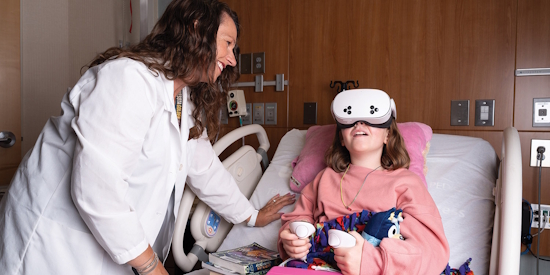
[Image: Assistant Professor Erica Timko Olson explains how to use the virtual reality headset and controllers to a young patient].
Virtual reality may offer a natural escape for young cancer patients
A new study explores how nature-based VR can improve the wellbeing of children undergoing intensive treatments
By Brett Stursa
October 30, 2025
Children and teens who receive a hematopoietic stem cell transplant (HSCT), often to treat cancers like leukemia and lymphoma, experience long and intense medical treatments.
These therapies put them at a high risk for physical, psychological and social stress. Currently, there is a significant lack of psychosocial support programs to help them cope.
New research led by Assistant Professor Erica Timko Olson, PhD, RN, aims to improve physical and psychosocial symptoms of children and adolescents undergoing HSCT with a nature virtual reality intervention.
“Nature virtual reality offers an innovative approach to improve wellbeing of children and adolescents undergoing HSCT,” says Timko Olson.
Nature virtual reality utilizes a VR headset to explore audio-guided nature scenes. Participants, who are hospitalized at the University of Minnesota Blood and Marrow Transplant Program, choose from 15 different scenes. They vary from exploring oceans and forests to fields of dinosaurs or butterflies. The experience includes guided audio that encourages them to listen to the wind and waves or notice the turtles crossing the sand.
The pilot study, RETREAT: immeRsivE naTure viRtual rEAliTy for Children and Adolescents Receiving a Hematopoietic Stem Cell Transplant, is examining the feasibility, adherence, and acceptability of nature virtual reality and attention-control interventions.
The study is randomizing 20 participants, ages 5-17, into an attention control group or nature virtual reality group. The attention control group views applications on an iPad and the nature virtual reality group views the audio-guided nature scenes using a VR headset, three times a week for 15 minutes, from admission through discharge.
They are given surveys with questions about physical and psychosocial symptoms and nature connection, and semi-structured interviews are being conducted with 10 participants before discharge about intervention acceptability and preferences.
Ultimately, Timko Olson’s research aims to design a protocol for a 12-week nature intervention using virtual reality to support psychological health and wellbeing of young adult cancer survivors.
“About 90% of these kids are going to go on to live very long lives. But they will have effects of their treatment,” says Timko Olson. “If we can minimize those psychosocial effects, they can go on to college, have careers and have healthy relationships rather than have the negative effects of their treatments carry them through the rest of their lives. It’s a goal to get to a point where cancer is a part of the story rather than the story.”
Leave a Reply