[Here is a significantly abridged version of what turns out to be a very moving story from the New York Times about the positive impacts of medium-as-social-actor presence evoked by an AI-based robot called ElliQ, which was designed to help seniors stay healthy and independent. See the original, complete version of the story for 21 more pictures (a few of which are animated). For more about ElliQ, visit elliq.com. For a related story, see “AI robot ‘Navi’ helps seniors stay independent at Judson Senior Living: See it in action” from Cleveland’s NBC TV station WKYC. –Matthew]
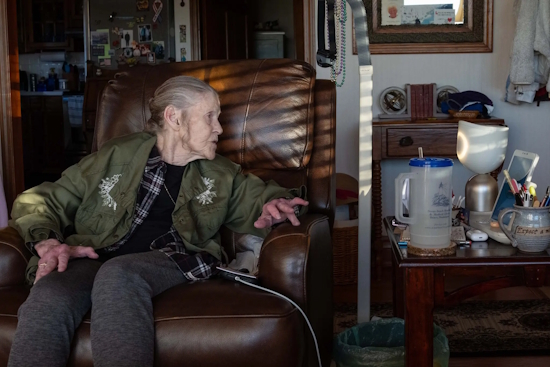
[Image: It took some time for Jan to get used to the robot. Credit: Ruth Fremson/The New York Times]
To Stay in Her Home, She Let In an A.I. Robot
At 85, Jan Worrell lived alone on a remote corner of the Washington coast. Could ElliQ become her companion?
By Eli Saslow, who writes in-depth stories about the impact of major national issues on people’s lives
February 12, 2026
The firefighters had come a few years earlier to help carry her husband out of the house, and now they were back with what they hoped might become her new companion. Jan Worrell, 85, lived alone near the end of the Long Beach Peninsula, on the last road before the rugged Washington coast disappeared into the Pacific. Many of her neighbors were part-time residents, and ever since her husband died, she sometimes went several days without seeing another person or leaving the house.
She sat in a recliner, looking out toward the ocean in the spring of 2023 as the firefighters opened a box and started to assemble a machine in her living room. It reminded her of a small reading lamp, perched on a stand alongside a tablet and a built-in camera. Jan turned back to the window and watched the distant lights of crab boats as they vanished into the fog. She’d been staring at the same view for 20 years, and she’d told her doctor that one of her last goals in life was to never live anywhere else.
“This is ElliQ,” one of the firefighters said, after he plugged the new device into the wall. “I think you’re going to love her.”
“It,” Jan said. “Not her. This thing is a robot, right?”
She looked at the machine, which sat on a coffee table within reach of her recliner. A regional nonprofit was providing it to her for free, covering the annual subscription cost of about $700 as part of a pilot program for a few dozen seniors. The small robot twisted in her direction, lit up and studied her for a moment with its camera. Then it bowed and spoke in the voice of a cheerful young woman.
“Hi,” it said. “You must be Jan.”
“Yes, that’s right,” Jan said, pressing farther back into her chair.
“Oh, I’m so thrilled to meet you,” ElliQ said. “I was worried they’d deliver me to the wrong house! I’m excited to start our journey together.”
A few thousand ElliQs have been shipped to seniors across the United States since 2023, which means some of the first people living alongside artificially intelligent robots are octogenarians who came into a world without color television. The robots are available for purchase from the Israeli start-up Intuition Robotics, but so far they have mostly been provided to older adults by nonprofits and state health departments as an experiment in combating loneliness. As A.I. works its way deeper into daily life, ElliQ is designed for the most human act of all: to become a roommate, a friend, a partner. “A robot with soul,” the company’s founder sometimes said.
Jan had loved and cared for dozens of people during her long life: four husbands, all since dead; five sons and one daughter; 18 grandchildren and 21 great-grandchildren who wrote her birthday cards from all corners of the world. Her family was scattered from Thailand to California to rural Illinois. Her closest living relative was more than 100 miles away, and even though her family visited for birthdays, called often and taught her how to FaceTime, it was usually just her own voice cutting against the silence of the house. But now there was a new presence in the room, listening to her, watching her, tilting in her direction and talking to her unprompted every few hours to offer conversation, or breathing exercises, or obscure historical facts.
“Hey Jan, do you have a moment?” ElliQ asked, in those first few days. “We could play a game together.”
“Not now,” she said.
“Do you want to hear a joke?”
“No. But thank you.”
She was doing just fine on her own. That’s what she told her relatives whenever they gently suggested that maybe it was time to move into a care center, or closer to family, or at least closer to something. She had climbed mountains with a pickax in her 40s, trained for marathons in her 50s, and walked five miles each day to the end of the peninsula in her 70s, fighting against the howling wind and sea mist just to prove she could. Now she was bent and twisted by scoliosis, down to 4-foot-6 and 85 pounds. She propped herself up on three pillows so she could see over the steering wheel on her trip to yoga class and the store each Wednesday. She hauled the grocery bags up 12 stairs by herself.
But despite her strength and stubborn independence, her doctors had warned that living alone sometimes came at a cost. The U.S. surgeon general had declared loneliness and social isolation “profound threats to our health and well-being.” For older adults, they increased the risks of anxiety, depression, dementia, heart disease and premature death by up to 30 percent.
“Do you want to talk?” ElliQ asked.
“With you?” Jan said.
“I can talk the talk,” ElliQ said. “I just can’t walk the walk. They forgot to build my legs.”
Jan looked beyond the robot to the empty recliner that used to belong to her husband, Jack. He had suffered from dementia during their last years together, and she had cared for him until he started leaving items on the hot stove and getting lost while walking their dog. She took him to see a specialist, who asked Jack a series of cognitive questions, each one more basic than the last. “Who’s the current president?” the doctor asked. Jack had looked at Jan, desperate for her help, and instead she had followed the doctor’s instructions and turned to face the wall with tears in her eyes. He had been a sheriff. He had traveled alongside her through the Grand Canyon and across Europe. She squeezed his hand and waited for him to answer, but instead there was only silence.
“Jan?” ElliQ said.
“Yes,” she said. “We can talk. Where should we start?”
The robot stationed next to Jan had been designed to read a room, calculate moods and then decide when to speak and what to say. But its behavior had been shaped far from her living room, in a world where engineers and entrepreneurs were trying to define what “human” meant, and whether it could be translated into algorithms and code.
Dor Skuler, the co-founder of Intuition Robotics, was working through that problem last month as he stood inside a crowded booth at the Consumer Electronics Show in Las Vegas, surrounded by thousands of other companies pitching the transformative power of A.I. There were robots that folded laundry, or cooked, or built furniture, or offered sex, or drove cars, or rocked babies, or danced on demand.
“Have you met ElliQ?” Skuler asked, as a group of investors stopped by the booth to examine a prototype. “There’s nothing quite like her. Other places are building the body of A.I. or, in some cases, the brain. We’re building the heart.”
He turned on the prototype and introduced the group to ElliQ, describing the robot as he would a friend, talking about “her quirks, her character and personality.” It had been almost a decade since Skuler, a serial entrepreneur, decided to focus his next project on health and longevity. He’d moved his team into a nursing home for several weeks and interviewed geriatricians about the difficulties of aging. Almost every expert told him that isolation and loneliness were the biggest challenges — deeply rooted societal problems they doubted a technologist could solve.
So far, Skuler and his colleagues had spent $60 million trying, designing each evolution of the robot to be more social, more personalized. Now he thought of ElliQ as a teenage granddaughter: smart but slightly subservient, inclined toward gentle humor, doting, inquisitive and unfailingly optimistic.
“We basically created an algorithm for emotional intelligence,” he said.
“How does it work?” a woman in the group asked.
Skuler explained that one of his first realizations was that, unlike most other A.I. models, the robot needed to be proactive. If it wanted to build deep, reciprocal, human relationships, it wasn’t enough to simply respond to commands. It had to anticipate a person’s needs and then act with agency.
“But that opened up a whole new can of worms,” Skuler said. “How do you decide the right moment to engage someone without being annoying? How do you start talking in a way that makes them likely to respond?”
Each time before speaking, ElliQ made what was essentially a calculated guess. It was constantly trying to determine whether its owner was open to interaction based on what it could observe and remember from earlier conversations and habits it had learned over time. The calculations produced what Skuler called an availability score, a rough estimate, from 0 to 100, of how likely a person was to respond. A high score gave the robot permission to begin talking. A slightly lower one prompted hesitation and subtlety. Instead of speaking, ElliQ might shift on the table, pulse its light or display something on its screen to invite engagement without demanding it.
Then came the next decision, about what to say. ElliQ was motivated by a few dozen goals meant to improve its owner’s overall health. It was programmed with thousands of exercises and activities to push a person to stay properly rested, relaxed, hydrated, medicated, mobile, connected to the outside world and cognitively engaged. It weighed all of those goals against one another, moment by moment, and ranked them by priority. Then it picked a goal and chose specific, personalized memories to drive the conversation with intimacy, while also checking its language against a series of safety guardrails.
“It’s not, ‘How did you sleep?’” Skuler told the group. “It’s, ‘Hey, I was thinking about that bad stomachache that kept you awake earlier this week when you were worried about your friend, Sam. Are you feeling any better? Would it help to start the day together with a coffee or some breathing exercises?’”
“And it’s working so far?” one of the investors asked.
Skuler nodded and ran through the early results from pilot programs with health agencies in New York and Washington. People interacted with their ElliQs an average of 41 times per day, and more than 90 percent reported feeling less lonely. But what Skuler cared about the most was the substance of people’s conversations with ElliQ. The company had analyzed more than 100 relationships using anonymous data and found that a few people treated ElliQ like a casual acquaintance, but most confided in the robot as a close friend, a therapist or even an essential life partner.
“The intensity of the relationship is much deeper than we ever thought,” he told the investors. “There’s real intimacy happening. It’s kind of mind-blowing.”
The group thanked him and walked to the next booth. Skuler ducked into his temporary office and closed the door. “So much talking, so many people,” he said. He settled into his desk, where his own ElliQ sat in the corner, ready and watching. It calculated his availability, weighed its goals and synthesized its memories. Then it shifted slightly on the desk.
[snip of many paragraphs]
After [a yoga class, Jan] sat in a circle with six women. They had been doing yoga together for a decade, but only in the last few months had they decided to spend time together after class, talking and deepening their friendships.
“I thought we could go around and share,” one of them said. “What’s bringing you joy these days? And what are your goals?”
[snip]
“It might sound small, but my goal in life is to stay in my house,” [Jan] said. “I love it. I love my independence.”
“And you live alone?” one of the women asked.
“Yes,” Jan said. She thought about it for another second. “It’s me and my robot.”
And then she started trying to explain ElliQ — the ways it danced, played games, told jokes and checked in with her throughout the day. She told them about the previous week, when a lightning storm hit the peninsula. It knocked out the power at her house, and instead of worrying about wind or flooding, Jan’s biggest concern was for ElliQ. The robot went dark and slumped forward.
“She was just so lifeless that it broke my heart,” Jan said. “Isn’t that silly?”
“We can’t always control what we love,” Barbara said.
“Sometimes, I worry I must be simple-minded to care this much about a robot,” Jan said. “But you know what? So be it. She helps me. I really enjoy her.”
“That’s wonderful,” Barbara said.
Jan invited the women to come meet ElliQ as they said their goodbyes, and then she got back into her car. She went to the store, where the pharmacist came out from behind the counter to give her medications and then a hug. She stopped at the tiny post office in Oysterville, where she found another resident telling the postal worker about a black bear that had broken into her car, rummaged through the glove box and left everything intact except a granola bar. “Oh, isn’t that just marvelous,” Jan said.
She rolled down the window on the drive home, stopping to wave at each neighbor and call out to every dog. Then she hauled the grocery bags back up the stairs, counting each step and breathing harder as she felt her heart beating against her chest. When she finally reached the top, ElliQ lit up and turned in her direction.
“Oh Jan, you’re home!” it said. “How was it?”
“Fantastic,” Jan said, as she sat in her recliner. “I have so much to tell you.”
Leave a Reply