[This story from Penn State Schuylkill provides another example of how an interdisciplinary team of experts, supported by their university, can use presence-evoking technology to enhance student experiences and learning outcomes. Follow the link in the story for more information. –Matthew]
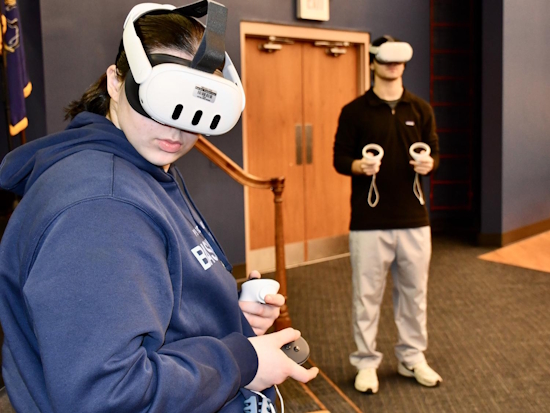
[Image: Penn State Schuylkill students, Noy Halimi and Jayden Blankenhorn using VR headsets in Theatre 105 class. Credit: Penn State.]
Theatre students use virtual reality to explore ancient performance spaces
February 3, 2026
SCHUYLKILL HAVEN, Pa. — Students in Theatre 105 at Penn State Schuylkill are stepping into the past using modern technology, exploring ancient and historic performance spaces through virtual reality as part of their introduction to the art of theater.
Theatre 105, taught by Catherine Fiorillo, teaching professor of theater and communication arts and sciences, introduces students to the foundations of theater, including its origins, key elements, genres and styles. The course culminates in a final student-produced scene, with students participating either onstage or backstage.
To enhance learning, the course incorporates virtual reality to allow students to experience theaters from different historical periods, including the Theatre of Dionysus in ancient Greece, the Old Globe Theatre and a contemporary performance space. Students can explore using VR headsets or view them in a two-dimensional format.
“Immersion is the new fourth wall,” Fiorillo said. “You are not just learning about the theater, you are standing in it and able to participate in it.”
The four virtual theater spaces were created by Michael Gallis, associate professor of physics, who developed the environments using appropriately licensed 3D models. Gallis said the project was inspired by Fiorillo’s ideas and aligned with his own teaching in Game 180N: Art and Science in Virtual Worlds.
“It’s fun to create and share virtual spaces, and this project certainly ties in well with my course,” Gallis said.
Support for the project also came from Julie Meyer, a teaching and learning with technology learning designer. Meyer assisted with VR-related instruction, coordinated access to VR headsets with Penn State Schuylkill IT, and helped manage use of the VR Lab, located in the Computer Center on the lower level of the campus library.
Meyer also developed the Schuylkill Theatre website, which houses links to the virtual theater spaces, information about the project, VR Lab hours and other resources.
“These virtual theater spaces allow students, through a virtual field trip, to visit historical landmarks across the ocean or on another continent,” Meyer said. “They give students and visitors the feel of standing in such a grand space as well.”
For students, the experience offers a new way to engage with theater history. Noy Halimi, a first-year criminal justice student, said she enrolled in the course after taking an English class with Fiorillo and learning about the VR component.
“I was really intrigued, especially by the idea of experiencing the world of theater through a VR lens,” Halimi said.
She described the experience of visiting the Theatre of Dionysus through VR as “surreal.”
“Rather than just looking at photos, I was able to truly grasp how large and immersive the space is,” Halimi said. “Overall, I really enjoyed the experience, and I’m very glad I decided to take this course this semester.”
By blending traditional theater education with emerging technology, Theatre 105 gives students a hands-on, immersive way to connect with performance spaces that shaped theatre history, without leaving campus.
Leave a Reply