[A team of researchers at the University of Florida studied audience reactions to different types of cultural experiences in presence-evoking virtual reality, with some interesting results. In addition to the link in the second paragraph below, you can read the research report at ResearchGate (at this writing at least). –Matthew]
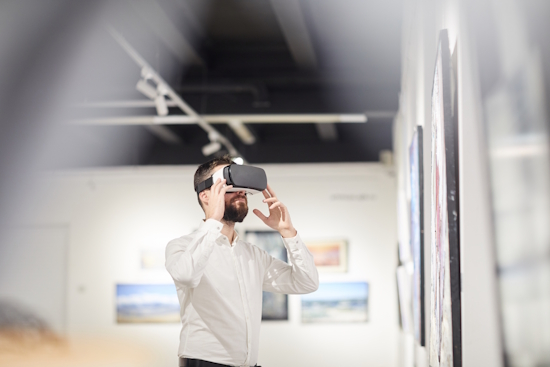
Bringing Van Gogh to life: How VR could redefine the way we experience art and culture
By Alisha Katz, APR
January 7, 2026
Tampa crowds are currently sailing underneath Vincent van Gogh’s twinkling “Starry Night” and drifting through his golden “Wheat Fields” in the 360-degree digital art exhibition, “Van Gogh: The Immersive Experience.” The ongoing popularity of this award-winning attraction begs the question: Is virtual cultural tourism the new frontier in arts enrichment?
“Our team wanted to see whether virtual reality, or VR, serves as a substitute for real tourism or if it is perceived more as entertainment,” said University of Florida researcher Svetlana Stepchenkova, Ph.D., who recently explored the intersection of VR and cultural tourism in an Information Technology and Tourism study.
A professor in the UF College of Health & Human Performance’s Department of Tourism, Hospitality & Event Management, Stepchenkova analyzed how audiences respond to VR when seeking authentic cultural experiences, especially those rooted in art, language and traditions. The study also investigated how attitudes toward authentic experiences, such as preferring a painting on a gallery wall over an alternative experience, shape perceptions of VR.
Gauging the VR appeal
Stepchenkova’s research compared two types of VR: traditional and hyperreality. Individuals wore Oculus Quest 2 headsets and experienced both simulations featuring Van Gogh’s artwork.
“In the traditional VR setting, you’re in a museum in Amsterdam, moving from one painting to another,” Stepchenkova said. “In the hyperreality VR setting, you enter a fantasy-like world.”
The headset application was limited to a 1,000-square-foot area for participants to walk and explore the simulations safely. Individuals also wore sensors to track physiological responses, such as heart rate, and completed an online questionnaire to capture emotional responses after the VR experience.
Findings showed that hyperreality VR elicited stronger emotional responses and higher heart rates than traditional VR, indicating excitement and thrill. In contrast, traditional VR felt more educational and reflective, producing calmer reactions similar to those experienced during a traditional museum visit.
Something for everyone
Stepchenkova determined that there are three types of people who travel: realists, or those who value the “real” and traditional experience; constructivists, or those who value interpretation and meaning; and postmodernists, or those who seek enjoyment above all.
“If you look at why people travel, an overwhelming majority want to see authentic things,” Stepchenkova said. “But authenticity means different things to different people. Some want the original, others accept restorations and some simply want to enjoy what’s available.”
Surprisingly, Stepchenkova’s analysis revealed that realists enjoyed hyperreality VR more than expected, alongside constructivists and postmodernists. Additionally, the thrill-inducing nature of hyperreality VR suggests that it may lean more toward entertainment than education.
“What our research team discovered is that people likely react in a more direct manner to traditional simulations, but hyperreality VR has some markings of entertainment,” Stepchenkova said.
While hyperreality VR leans more toward entertainment, that may not be a drawback, as it could actually enhance the value of tourism. If these digital experiences motivate more individuals to explore cultural destinations and take away something meaningful, the impact can still be profound.
Leave a Reply