[A U.S. professor of game development at Kennesaw State University (in Georgia) is drawing on his own experiences navigating grief after the loss of his young daughter to apply presence-evoking technology to help others in similar situations. This story is from KSU; though it’s behind a paywall, more coverage is available from the Atlanta Journal-Constitution. –Matthew]
[Image: Credit: Matt Yung]
KSU researcher draws on personal experience in creation of VR system designed to address grief
By Alyssa Ozment
September 24, 2025
Six years ago, Assistant Professor of Game Development Lei Zhang and his wife welcomed their first child into the world. However, at 8 months old, she was diagnosed with acute myeloid leukemia, a rapidly progressing cancer of the blood and bone marrow.
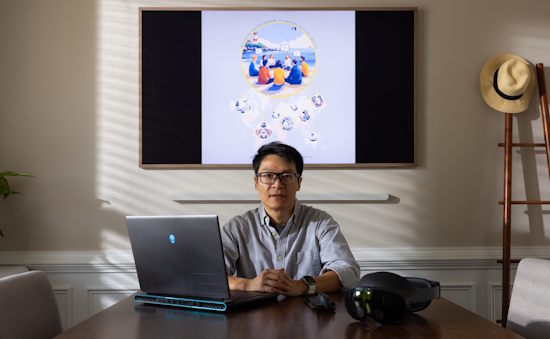
Now, using virtual reality, Zhang is developing an immersive virtual reality therapeutic system where bereaved parents can meet online and support one another.
“This project has been very useful because I feel have been able to find meaning in loss of my child,” Zhang said. “By doing this project, I’m helping build a legacy for her and helping other parents who need support.”
When Zhang’s daughter, Lexie, was diagnosed with acute myeloid leukemia, the family turned to St. Jude Children’s Research Hospital, hoping that an intensive care plan could give Lexie a chance. Zhang himself served as the blood marrow donor for his daughter’s transplants.
Despite a year of aggressive treatment, Lexie relapsed within two months of the procedure and succumbed to the cancer in April of 2020.
Following the loss of their daughter, Zhang and his wife were consumed by grief.
St. Jude provides grief and bereavement support to parents who have lost their child saying, “Once a St. Jude family, always a St. Jude family.”
A staff member contacted the Zhangs several months after Lexie’s passing and asked if they would be willing to share their story with parents who are currently dealing with similar situations, and they agreed thinking it could be healing in some small way.
Each year, St. Jude hosts annual events for parents who have lost their children. However, since Lexie died in 2020, most of the events were online through programs such as Zoom and Microsoft Teams.
Zhang realized that while the concept of this was incredible, the execution was not fulfilling because people would often join with their cameras off. This added to the isolation Zhang felt because he couldn’t see anyone’s faces while they were talking or see their reactions when he was talking.
“We did have some in-person events,” Zhang said, “One of them is called the Day of Remembrance. Every year this hospital brings the parents back to the hospital campus where we all met together and gives us all the chance to share our children’s stories.”
At this event, parents are given the opportunity to create a memory board where they can put pictures of the child and any of their things; it’s a chance for them to create some kind of art for and of their child.
Zhang described it as a great experience but thought about how he could improve it.
If telehealth is here to stay, how can technology be used to recreate the feeling of community and face-to-face support?
Virtual reality provides a unique opportunity to manipulate environments to suit specific needs and desires. In Zhang’s virtual world, parents will have avatars that are able to meet up and participate in various grief therapy activities together, with the goal being helping parents make sense of their loss and find meaning in it.
“This type of loss can cause some prolonged or complicated grief symptoms that will affect the person’s quality of life,” Zhang said. “They can’t work, they can’t sleep, they can’t eat, and they have to acclimate to a world without their loved one.”
Zhang’s proposed system will help these parents connect with each other, share their stories, and work through their grieving process in a communal way.
One example of a therapy activity is group discussion. And rather than sitting in a conference call, parents will be able to meet up in relaxing environments such as scenic beaches.
Utilizing advanced VR technology that allows for eye and facial tracking, the avatar will be able to capture and display mannerisms and facial expressions such as smiling or pointing at someone.
What began as a tragedy, then led to a struggle to connect has evolved into a research mission that could revolutionize the management of mental health. In the future, Zhang hopes that this project will expand to include other types of griefs and mental health struggles in general.
Leave a Reply