This is a gently edited version of the original book proposal submitted to and approved by De Gruyter.
Title:
De Gruyter Handbook of Immersive Media
Co-editors:
Matthew Lombard, Temple University
Cheryl Campanella Bracken, Bowling Green State University
Hocheol Yang, California Polytechnic State University
Kun Xu, University of Florida
Cindy Fang, Temple University
1. Rationale
As media have evolved from cave paintings and the written word; to radio, television and film; to video games and virtual and augmented reality; and to AI chatbots and embodied robots, they have not only entertained and educated, but enthralled and transported their users. Modern media technologies accomplish this more effectively than ever before because they immerse users in vivid and compelling experiences.
Whether in art, business, education, entertainment, medicine, science or any other field, these immersive technologies offer designers, creators, producers, owners, policy-makers and users with new benefits, dangers and responsibilities. To apply and use the technologies effectively and responsibly, we need to understand how they already do, and in the future could, affect individual users; in other words, we need to understand the psychology of immersive media experiences.
That is the goal of this Handbook. Beginning with a focused history of the characteristics and user responses to immersive media technologies, the Handbook will explore theories regarding the nature, causes, and cognitive, affective, physiological and behavioral impacts of their use. Theories regarding attention, involvement, absorption, flow, identification, interactivity, embodiment and particularly different forms of (tele)presence, will be used to clarify terminology and explain concepts and phenomena. State-of-the-art research methods and findings regarding each theory will be examined and assessed. Then to demonstrate how immersive media are being used across a wide spectrum of contexts, a series of literature reviews and first-person case study reports containing practical and specific advice regarding lessons learned, will follow. The book will conclude with a consideration of ethical issues regarding the design and use of immersive media, and a series of informed predictions and recommendations regarding the further evolution of both the technologies and their roles within and across societies around the world.
While immersive media technologies and experiences have been with us for centuries, the technologies have never been more sophisticated and the experiences they evoke have never been more compelling, ubiquitous, and likely to have both substantial positive and negative impacts. So the topic is both timely and important.
The chapters in the proposed Handbook will link design of media form and content, sensory perception, cognition, affect, and behavior to explain not only how immersive media appeal to and affect people but how they can be applied responsibly in homes, classrooms, workplaces and public spaces to improve every aspect of our lives. The emphasis is on evidence rather than hype: what works, why it works, and how to measure impact in real contexts.
This approach has many potential benefits to diverse readers, whether they’re already in the field or new to it. Academics gain shared frameworks, validated tools, and methods that scale from lab to field. Designers and developers gain practical principles and benchmarks for creating attentional engagement, presence, enjoyment, learning and social connection, with playbooks for rapid evaluation. Business leaders gain decision frameworks that tie psychological outcomes to value, cost, and risk, with metrics like performance gains, therapeutic effects, attitude change, and knowledge retention, along with guidance on ethical design and data acquisition and use. And media users gain experiences that improve learning, skill acquisition, and well being while protecting agency, privacy, and access.
The proposed Handbook represents a long-desired goal of the first editor to help create a collection of accessible, coordinated and contextualized summaries that together represent a comprehensive, “one-stop” resource that captures the diverse and fascinating range of theories, research findings, applications, impacts and implications related to immersive media.
The process for creating the Handbook, along with an online space for providing and discussing updates and new insights in the years following publication, is also designed to connect diverse experts across specialties and create community and synergy that advances the field.
2. Target market/expected readership
The term immersive media has become increasingly common within and beyond academia since 1990 (see the figure below), but there has been growing interest in concepts and phenomena related to media experiences that immerse and engage users for much longer. That interest can be seen today in the work of scholars and researchers, university curricula, corporate investment patterns, stories in the technology press, and in conversations and media use patterns among members of the general public.
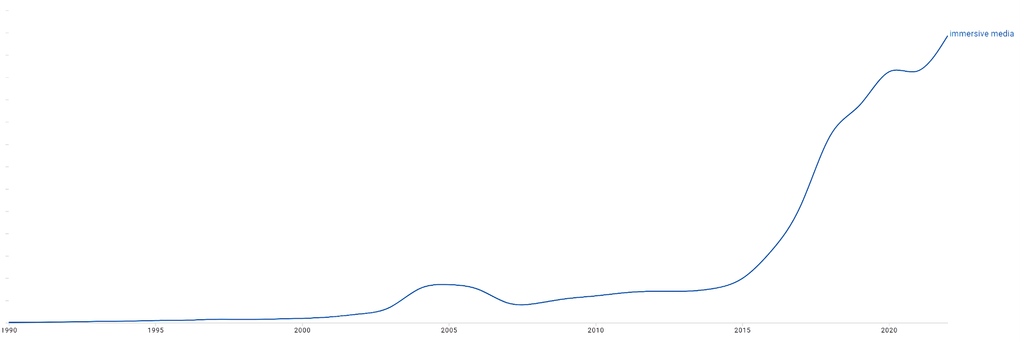
[Figure: A Google Books NGram representing the frequency of searches for “immersive media” between 1990 and 2020; chart ticks are at 5-year increments]
The Handbook is designed to be used by three sets of readers:
- Upper division undergraduate and graduate (master’s and doctoral) students in colleges and universities;
- Professional media designers, content creators, and product developers and managers for whom immersive media technologies represent a tool or potential tool; and
- Professionals in for-profit, not-for-profit and government organizations who are seeking ways to use immersive media to educate, entertain, persuade, influence, train, provide medical care, etc. in a wide variety of topic areas.
Courses for which the Handbook would be appropriately assigned
As immersive media technologies become both more sophisticated and less expensive, and as immersive media experiences become more common, the design and psychological and other impacts of these experiences are increasingly taught in undergraduate and graduate courses in the US and around the world. A long preliminary list of examples can be found in the appendix Courses and Degree Programs. We therefore envision a significant readership based even just on the first category of readers listed above.
3. Table of contents
Number and length of chapters and references:
The final number and length of chapters will obviously depend on many factors, but in consultation with the commissioning editor we envision a volume with 35 chapters, each approximately 6,000 words (i.e., 210,000 words), with a maximum of 75 references for each chapter.
Section introductions:
The editors will write brief introductions for each section to guide readers.
I. INTRODUCTION
Chapter 1: Setting the Stage
[By editors]
- Compelling examples
- Defining immersive media and related terms
- Why it matters
- Purpose and design of book
- Suggestions for how to use book
II. HISTORY
Chapter 2: History of Immersive Media
- History of immersive media related to psychology/presence
Chapter 3: History of Immersive Media Scholarship
- Interdisciplinary connections
- Timeline
- Important people and their contributions
III. THEORY AND RESEARCH
Chapter 4: Concepts and Theories
An overview of key concepts and theories regarding the psychology of immersive media, e.g.:
- Attention
- Involvement
- Absorption
- Flow
- Identification
- Narrative transportation
- Presence
- Embodied Cognition
- Proteus Effect
- Para-social interaction
- Homuncular Flexibility
- Relationships between and among concepts and theories
Chapter 5: Presence Theories
- The Pole Model (Biocca)
- Focus, Locus, Sensus (Waterworths)
- Layers of Presence (Riva & Waterworth)
- Measures, Effects, Conditions (MEC) (Wirth et al.)
- Capacity Limited, Cognitive Constructivist (CLCC) (Nunez)
- Attentional model of spatial presence (Draper, Kaber, and Usher)
- Social presence and media richness (Short, Williams and Christie; Daft and Lengel)
- Parasocial Interaction (Horton and Wohl)
- Media Equation (Reeves and Nass)
- Levels of social presence (Biocca and Harms)
- Computers/Media as Social Actors (CASA/MASA) (Nass; Lombard and Xu)
- Self-presence (Ratan)
- Embodied Presence / Novel Bodies (Won)
- Inverse presence (Timmins and Lombard)
- Relationships between and among types of presence and related concepts
Chapter 6: Immersive Media Research
What the research says (about the theories and concepts generally, across app areas)
- Methods used
- Measures used
- Notable results
- Summary of patterns of results – what we know
- Causes, characteristics and effects of (types of) presence
- Future research: what we don’t but need to know
NOTES RE: SECTIONS IV – VIII:
Content of section chapters:
Each chapter in these sections of the book will review academic and other literature in a specific application area and include examples (case studies) as well as specific advice based on research findings and personal experience regarding the design, use, and assessment of impact for immersive media in that area.
IV. IMMERIVE MEDIA AND SOCIETAL FUNCTIONS
A. Government and the press
Chapter N: Politics
Chapter N: Journalism, news and documentary
B. Security
Chapter N: Military and warfare
Chapter N: Law enforcement, security and surveillance
C. Business and Commerce
Chapter N: Organizational communication and information management
Chapter N: Construction and restoration
Chapter N: Transportation
Chapter N: Tourism
Chapter N: Advertising and public relations
Chapter N: Retail
Chapter N: Social media influencers
D. Education
Chapter N: Education and skills training
E. Health
Chapter N: Health and medicine
F. Science
Chapter N: Environment
Chapter N: Exploration
Chapter N: Scientific visualisation
V. IMMERSIVE MEDIA AND ARTS & CULTURE
Chapter N: Entertainment
Chapter N: Sports
Chapter N: Gaming
Chapter N: Theme parks
Chapter N: Art
Chapter N: Music
Chapter N: Food
Chapter N: Cultural heritage (GLAM – Galleries, Libraries, Archives, and Museums)
VI. PERSONAL USES AND IMPACTS
Chapter N: Relationships
Chapter N: Sexuality
Chapter N: Personal and social identity
Chapter N: Disability and Enhancement: Altered perception, cognition and mobility
Chapter N: Binge media use
Chapter N: ASMR: Autonomous Sensory Meridian Response
Chapter N: Beauty
Chapter N: Violence
Chapter N: Death and bereavement
VII. TRANSFORMATIVE TECHNOLOGY: ARTIFICIAL INTELLIGENCE
Chapter N: Generative AI: Sounds, images and video
Chapter N: Conversational AI: Chatbots, virtual assistants and digital humans
Chapter N: Natural Language Processing (NLP)
Chapter N: Computer vision and tracking
Chapter N: Embodied AI: Machines, robots, and androids
VIII. THE BIG PICTURE
Chapter N: Human-Machine Communication
Chapter N: User experience (UX) design
Chapter N: Philosophy and the meaning of life
Chapter N: Media literacy
IX. CREATING EFFECTIVE AND ETHICAL IMMERSIVE MEDIA
Chapter N: Voices of experience: Advice for optimizing immersive media
Synthesis of advice for creating effective immersive media experiences
Chapter N: Ethical challenges in immersive media
- Implications for and perspectives regarding individuals
- Implications for and perspectives regarding organizations
- Implications for and perspectives regarding society
X. THE FUTURE
Chapter N: Preparing for the future of immersive media
- Predictions for future
- Challenges and opportunities
XI. REFERENCES/INDEX/APPENDICES
4. A list of the main competing books
We’re not aware of any book that directly addresses immersive media experiences across media technologies, deeply addresses both theory and practice, and considers diverse application areas and user populations. We’ve identified seven books, including the last two below co-edited by editors of the proposed book, that are only somewhat similar, but three of the seven were published more than a decade ago. The seven books are listed below and a comprehensive list is available in the appendix Competing Books.
1.
Bender, S. M., & Broderick, M. (2021). Virtual Realities: Case Studies in Immersion and Phenomenology (1st ed. 2021.). Springer International Publishing. https://doi.org/10.1007/978-3-030-82547-8
This book “makes a compelling case for VR-phenomenology to be employed as a methodology by humanities scholars and also in cross-disciplinary applications of immersive media in fields such as psychology, human-computer interaction studies and the health sciences.” Compared to our proposed handbook, it has a more narrow scope regarding theory, research and applications as well as media technologies and responses to them. Rather than a collection, the seven chapters are written by the two authors.
2.
Champion, E. M. (2021). Rethinking Virtual Places (1st ed.). Indiana University Press. https://iupress.org/9780253058355/rethinking-virtual-places/
This book has a more narrow focus than the proposed handbook as well. It focuses on the humanities, theory and research more than applications, and perceptions of mediated places rather than people. Rather than an edited collection, the ten chapters (twelve including the introduction and conclusion) are written by the author.
3.
Langer, E. (2023). Media Innovations AR and VR: Success Factors For The Development Of Experiences (1st ed. 2023.). Springer Berlin Heidelberg. https://doi.org/10.1007/978-3-662-66280-9
The eight chapters of this book, which is translated from the original German with the help of AI, were written by the author specifically as a practical guide for those who produce content for augmented and virtual reality. So although based in part on “scientific evidence,” the focus is more narrow than in the proposed handbook.
4.
Waterworth, J., Riva, G., & Murray, D. (2014). Interacting with Presence: HCI and the Sense of Presence in Computer-mediated Environments (J. Waterworth, G. Riva, & D. Murray, Eds.; 1st ed.). De Gruyter. https://doi.org/10.2478/9783110409697
This edited collection designed for researchers and graduate students as well as technology professionals, considers a variety of applications of immersive media in the context of theories regarding presence. In addition to having been published twelve years ago in a fast-evolving topic area, the intended audience and theoretical scope of this book are somewhat more narrow than in the proposed handbook.
5.
Zakrzewski, P., & Tamés, D. (2025). Mediating Presence: Immersive Experience Design Workbook for UX Designers, Filmmakers, Artists, and Content Creators. Taylor & Francis. https://doi.org/10.4324/9781003442462
As the title makes clear, this book by two media designers is focused on practical advice for readers who design and create immersive media content. The proposed handbook will draw some similar advice from chapters containing extensive reviews of theories and research findings and reports on experiences of those who have applied them in diverse contexts.
Two older, and loosely connected, edited collections together cover some (though certainly not all) of the same topics as the proposed handbook (the first editors of each of the books are among the co-editors of the new Handbook). But in addition to now being very dated given the evolution of immersive media and their applications, these earlier books divide the material and intended readership across volumes, and in the case of the more recent book, the content was predetermined based on earlier projects funded by the EU rather than determined and written purposefully to best cover the relevant theories and methods:
6.
Bracken, C. C., & Skalski, P. (Eds.). (2010). Immersed in media: Telepresence in everyday life. Routledge. https://www.routledge.com/Immersed-in-Media-Telepresence-in-Everyday-Life/Bracken-Skalski/p/book/9780203892336
7.
Lombard, M., Biocca, F., Freeman, J., & IJsselsteijn, W. (Eds.). (2014). Immersed in media: Telepresence theory, measurement & technology. Springer. https://doi.org/10.1007/978-3-319-10190-3
5. Production details
Length:
As noted in section 3 above, we envision a volume with 35 chapters, each approximately 6,000 words (i.e., 210,000 words), with a maximum of 75 references for each chapter. We’d consult with the commissioning editor and contributing authors regarding the number of illustrations.
Tentative timeline:
- Submit proposal: February 2026
- Peer reviewing of the proposal: February-March 2026 (4-6 weeks)
- Book contract signed: March 2026
- Line up contributors: April – August 2026
- Online or hybrid meeting of authors: August/September 2026
- Contributors write and submit chapters: September 2026 – May 2027
- Review of chapter submissions, feedback and writing of final drafts: June – December 2027
- Final manuscript submitted: January 2028
- Publication: Q2/Q3 2028
Tentative process:
- Refine topic outline
- Write up guidelines/requirements for all authors
- Identify and recruit specific authors for specific chapters
- Establish Canvas site, Discord, etc. for contributors
- Hold online or hybrid (online and in person) meeting(s) for all authors (to address questions, build community, etc.)
- For important but unassigned chapters, write and distribute calls for specific chapters
- Hold an ISPR Workshop for just authors or a full ISPR PRESENCE conference with one or more sessions designed around the book with all available authors attending (in person or via Zoom), and other attendees given the opportunity to learn about and contribute ideas and possibly chapters. Either event could be hosted at Temple U. in Philadelphia in late 2026 or early 2027.
- Divide the provision of guidance for different sets of authors and reviews and final editing of their chapter drafts among different pairs of editors, with regular consultations among all editors to maintain consistency.
7. Co-editor details
Matthew Lombard
[email protected], [email protected]
Matthew Lombard (PhD, Stanford University) is a professor in, and the chair of, the Department of Media Studies and Production in the Lew Klein College of Media and Communication at Temple University in Philadelphia, Pennsylvania, USA. His research centers on individuals’ psychological and physiological processing of media experiences, with particular focus on the concept of (tele)presence. His work has appeared in academic journals including Behaviour & Information Technology, CyberPsychology and Behavior, Human Technology, Journal of Communication, Human Communication Research, Journal of Computer-Mediated Communication, and Presence: Teleoperators and Virtual Environments. He is a co-founder and president of the International Society for Presence Research (ISPR, http://ispr.info) and has been managing editor of ISPR Presence News (and its predecessor) since 1998. For more detailed information please visit http://matthewlombard.com. [Curriculum Vitae]
Cheryl Bracken
[email protected]
Cheryl Campanella Bracken (Ph.D., Temple University) is a Professor and Director of the School of Media and Communication, at Bowling Green State University. Her scholarship encompasses media psychology, communication research methodology, and the psychological processing of media content and form. The central theme of her research explores how individuals experience and respond to media, with particular emphasis on telepresence, media effects, binge-watching and new viewing behaviors. She has published in leading media and communication journals including Media Psychology, Journal of Broadcasting & Electronic Media, Journal of Media Psychology: Theories, Methods, and Applications, and Human Communication Research. She has also co-published and co-edited three books including Binge Watching: Motivations and Implications of our Changing Viewing Behaviors (with B. Rubenking), and Immersed in Media: Telepresence and Everyday Life (with P. Skalski). [Curriculum Vitae]
Hocheol Yang
[email protected]
Hocheol Yang is an Assistant Professor in the Graphic Communication Department at California Polytechnic State University, San Luis Obispo. He earned his Ph.D. in Media and Communication from Temple University’s Klein College in 2020. His scholarship sits at the intersection of media psychology, human computer interaction, user experience research, and immersive VR and AR systems. He investigates how presence, motivation, and emotion shape learning, and how inclusive design practices can translate research evidence into better experiences for diverse users. At Cal Poly GrC, he teaches studio courses that blend hands-on production with research driven critique, including digital photography and motion graphics, UX methods, mobile UX, and senior project mentoring. He uses project based assessment, tools such as eye tracking, and reflective writing to help students connect technical skills with communication outcomes.
His research examines immersive media and communication technologies, with particular attention to how telepresence shapes motivation, engagement, and related psychological processes. Grounded in media psychology and supported by rigorous experimental methods, his scholarship also draws on interdisciplinary perspectives across HCI, UX research, and learning science. His work has appeared in Mobile Media & Communication, Journal of Radio and Media, Telematics and Informatics, International Journal of Communication, Studies in Media and Communication, and The Social Science Journal. [Curriculum Vitae]
Kun Xu
[email protected]
Kun Xu is an Associate Professor of Emerging Technologies at the University of Florida College of Journalism and Communications. He also serves as Director of Media Effects & Technology Lab (METL) as well as the University of Florida College of Journalism and Communications Research Lab. His research focuses on human-robot interaction, human-agent interaction, computer-mediated communication, and psychological processing of emerging media. He uses social scientific approaches to investigate how people perceive, process, and respond to humanoid social robots, AI agents, and augmented characters. He is also interested in how people make sense of spaces and maintain social relationships in virtual and mixed reality environments. His lead-authored work has appeared in Journal of Computer-Mediated Communication, Communication Theory, New Media & Society, International Journal of Social Robotics, and so on. [Curriculum Vitae]
Cindy Fang
[email protected]
Cindy Fang is a Ph.D. candidate in media and communication at the Lew Klein College of Media and Communication at Temple University. Her primary research interests are the psychological processing of media, emerging communication technologies, and their effects on perception and behavioral change. She is also interested in interactive media and storytelling. Her dissertation examines the psychological processes and effects of immersive storytelling, comparing these processes across books and screen media (e.g., television). Cindy has presented her research at the SIETAR USA National Conference, the Association of Internet Researchers (AoIR), and the Association for Education in Journalism and Mass Communication (AEJMC). She also teaches visual communication and research writing courses at Temple. [Curriculum Vitae]
8. Appendices
These documents are available online: