ISPR Presence News

Monthly Archives: July 2011

Call: ATA 2012: American Telemedicine Association Meeting & Exposition

ATA 2012: American Telemedicine Association 2012 Meeting & Exposition

Call for Presentation Now Open
Participate in the biggest telehealth event of the year!

April 29 – May 1, 2012 / San Jose, CA
www.ATA2012.com

Abstracts accepted thru September 15, 2011

Recognized throughout the world as the primary forum for the telemedicine industry, the ATA 2012 program meets the changing needs of professionals who utilize telehealth technologies. Whether you are a novice or expert, the ATA 2012 offers a revitalized approach to presenting and learning about telemedicine.  Submit an abstract before September 15, 2011 to participate in the biggest telehealth event of the year!

Program Focus Areas

Abstracts that focus on the following five focus areas are of particular interest for the ATA 2012 program. However, high quality abstracts on any topic relating to telemedicine, telehealth, mHealth and remote medical technologies that do not fall into one of these high priority categories will also be considered. Read more on Call: ATA 2012: American Telemedicine Association Meeting & Exposition…

Posted in Calls | Leave a comment

Sonic Cradle, an experiment in embodied remix interfaces

[From

Sonic Cradle Lets You Mix Soundscapes With Your Breathing

By Stephen Fortune on July 13, 2011

One can rest easy about the fate of the remix, as artists are constantly seeking new ways to push remix culture into new territory. Oftentimes, they do so by reimagining the interface by which one can cut and mash up (like such novel projects as the VJacket and Karina Van Heck’s internal organ mixing desk), and the latest experiment in embodied remix interfaces is even more ambitious than previous forays. Jay Vidyarthi and Darwin Frost have designed the Sonic Cradle that enables users to mix a soundscape using their breath alone. Read more on Sonic Cradle, an experiment in embodied remix interfaces…

Posted in Presence in the News | Leave a comment

Call: Human-Computer Confluence (HCC) research community coordination project

[Note: PEACH = Presence Research in Action; http://hcsquared.eu/home).

This is, although broader in scope, a continuation of the work carried out in PEACH and we would like to ask you all to participate.

We shall be organising summer schools, workshops and other events and publications relevant for the Presence community and as before we shall be able to provide some financial support to those wishing to attend.

We shall also be working on the definition of educational curricula and the roadmap for future research in Europe on HCC and would value your contributions when the time comes.

Please visit our site and join our linkedin group where details of all events, calls for input and funding opportunities shall be announced. Read more on Call: Human-Computer Confluence (HCC) research community coordination project…

Posted in Calls | Leave a comment

New Tokyo club Nicofarre blurs reality and virtual reality

[From

[Image: Virtual venue: Takeshi Natsuno, managing director at Dwango, explains the features of Nico Nico Douga's new Nicofarre venue. ALEXIS WUILLAUME PHOTO]

Website Nico Nico Douga goes live … house

By MARK JARNES
Special to The Japan Times
Thursday, July 14, 2011

Online video-sharing website Nico Nico Douga has become a popular place for young Japanese to check out new music. Now imagine stepping inside the site to experience those tunes live.

That’s the feeling you get when you enter Tokyo’s newest live venue, Nicofarre.

“We wanted to create an interactive musical experience where reality and virtual reality become blurred,” says Takeshi Natsuno, managing director at Dwango, which runs Nico Nico Douga. With a decor consisting of the Internet, LEDs and augmented reality (AR), Natsuno has come pretty darn close. Read more on New Tokyo club Nicofarre blurs reality and virtual reality…

Posted in Presence in the News | Leave a comment

Job: Postdoc researcher in ICT-Mediated Social Interaction at Helsinki Institute for Information Technology

Helsinki Institute for Information Technology HIIT  (http://www.hiit.fi) is a joint research institute of Aalto University and the University of Helsinki for basic and applied research on information technology. A new research group in the Network Society research programme will focus on the social psychological aspects of information and communication technologies (ICT).

We are looking for a POSTDOC RESEARCHER in the area of ICT-MEDIATED SOCIAL INTERACTION for a three-year period.

The research of the group focuses, for example, on the emotional and cognitive processes during mediated social interaction. The research supports the creation of ICT that is optimal from the perspective of human emotional and cognitive processes and social interaction. Methodological approaches include also psychophysiological recordings (e.g., EEG, facial EMG). Read more on Job: Postdoc researcher in ICT-Mediated Social Interaction at Helsinki Institute for Information Technology…

Posted in Jobs | Leave a comment

Test presidential candidates with simulations, not debates

[From

War games, not debates, are what this race needs

July 17, 2011
Jim Geraghty

Brace yourself: Seven Republican presidential debates are scheduled in the next four months, and even more may be added.

After two or three, the questions and answers are going to sound depressingly similar and predictable. Ah, yes, you’ll cut taxes and spending. You’ll respond decisively to foreign threats. Yawn.

With primary debates including so little debate and so much rehearsed recitation of stale sound bites, it’s time to shake things up. What could give primary voters a clearer perspective of a candidate’s thinking and decision-making? What would best give a sense of how each would perform as president?

How about war-gaming? Read more on Test presidential candidates with simulations, not debates…

Posted in Presence in the News | Leave a comment

Call: Workshop on Human-Computer Interaction & Knowledge Discovery and Data Mining (HCI-KDD) at USAB 2011

Workshop on Human-Computer Interaction & Knowledge Discovery and Data Mining (HCI-KDD) @ USAB 2011

Conference Papers due to August, 8, 2011

http://www.hci4all.at/?page_id=334

Motto: “Human intelligence harnesses machine power” (Ben Shneiderman (2011))

In Biomedicine, Health Care, Clinical Medicine and the Life Sciences professional end users are confronted with increased masses of data. Research in Human-Computer Interaction (HCI) and Information Retrieval (IR) or Knowledge Discovery in Databases and Data Mining (KDD) respectively, has long been working to develop methods that help end users to identify, extract, visualize and understand useful information from these masses of high dimensional and mostly weakly structured data. HCI and IR/KDD, however, take very different perspectives in tackling this challenge; and historically, they have had little collaboration. Our goal is to support professional end users to interactively analyse information properties and to visualize the most relevant parts without getting overwhelmed. The challenge is to bring HCI & IR/KDD to work together and hence reap the benefits, so that Computer Science/Informatics can benefit the areas of Medicine, Health Care and the Life Sciences even more.

This special expert workshop is intended to establish a joint cooperation platform for interested experts who regard the extremely important application area of Biomedicine, Health and Life Sciences as important for their future research. The workshop is planned on Thursday, November, 24, 2011 within the context of USAB 2011 – Information Quality in e-Health, see main conference page: http://www.meduni-graz.at/imi/usab2011 Read more on Call: Workshop on Human-Computer Interaction & Knowledge Discovery and Data Mining (HCI-KDD) at USAB 2011…

Posted in Calls | Leave a comment

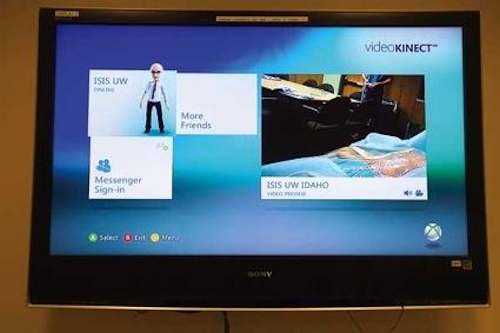
How Microsoft’s Xbox 360 and Kinect help surgeons in the OR

[From

[Image: The avatar for Dr. Brian Ross welcomes participants to an online training session using Xbox chat technology (Stephen Brashear photos/PSBJ)]

GAMING TECHNOLOGY

How Microsoft’s Xbox 360 and Kinect help surgeons in the OR

by Brad Broberg on Saturday, July 16, 2011

The sight of a surgeon playing “Grand Theft Auto” in the operating room might raise eyebrows, but it’s one example of how consumer technology is being repurposed to advance the practice of medicine.

Rising medical costs — bloated by expensive, complicated machines — are wrecking the nation’s economic health, while off-the-shelf consumer gadgets keep getting cheaper and more powerful. So the health care industry has discovered it can tap into the innovative wonders of an Xbox 360 or PlayStation 3 or an Android smartphone app.

Dr. Tom Lendvay, assistant professor of urology at the University of Washington, has studied whether warming up on a virtual reality simulator can improve a surgeon’s performance on the operating table, and he now plans to study whether video games could also put a surgeon in the zone.

Lendvay’s simulator mimics the da Vinci surgical robot that many surgeons now use to perform laparoscopic surgery. Warming up reduces errors, Lendvay thinks, by jump-starting the centers of a surgeon’s brain responsible for memory, spatial relations and motor skills — all critical for using the surgical robot.

The problem with simulators is that they’re too expensive to put outside every operating room. An Xbox 360 or PlayStation 3 is not. That’s why Lendvay wants to know whether a session of “Mortal Kombat” or some other game is a worthy alternative to warming up on a simulator.

“If you can pay for a video game versus $100,000 for a simulator,” Lendvay said, “that’s all you need to know.” Read more on How Microsoft’s Xbox 360 and Kinect help surgeons in the OR…

Posted in Presence in the News | 2 Comments

Call: Games for Health: Research, Development, and Clinical Applications

Games for Health: Research, Development, and Clinical Applications; A Groundbreaking New Journal on the Applications of Digital Games to Human Health

New Rochelle, NY, July 13, 2011 – Mary Ann Liebert, Inc. announces the launch of Games for Health: Research, Development, and Clinical Applications (G4H), a new, peer-reviewed journal dedicated to the development, use, and applications of game technology for improving physical and mental health and well-being. The Journal breaks new ground as the first to address this emerging, widely-recognized, and increasingly adopted area of healthcare. Published bi-monthly, Games for Health: Research, Development, and Clinical Applications will be released in fall 2011.

Games are rapidly becoming an important tool for improving health behaviors ranging from healthy lifestyle habits and behavior modification to self-management of illnesses and chronic conditions to motivating and supporting physical activity. Commonly used applications include mobile phone-delivered games that track daily exercise and “exergames” that require physical exertion in order to play (e.g., on platforms such as the Nintendo Wii, Sony PlayStation Move, and Xbox Kinect). Games are also increasingly used to train healthcare professionals in methods for diagnosis, medical procedures, patient monitoring, as well as for responding to epidemics and natural disasters.

Billions of dollars and immeasurable hours of research and development are being invested in developing and employing sophisticated software and technologies that deliver tailored, personalized game-based healthcare interventions. Games for Health: Research, Development, and Clinical Applications will provide a print and online forum for peer-reviewed research articles, new system and game reviews, field news and reports, convention and event announcements, book reviews, and point-counterpoint discussions to support professionals in the field. Read more on Call: Games for Health: Research, Development, and Clinical Applications…

Posted in Calls | 1 Comment

Your brain on androids: An fMRI study of the Uncanny Valley

[From

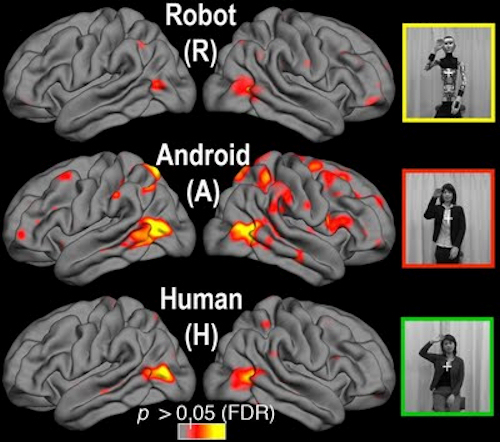
[Image: Brain response as measured by fMRI to videos of a robot, android and human]

Your Brain on Androids

July 14, 2011
By Inga Kiderra

Ever get the heebie-jeebies at a wax museum? Feel uneasy with an anthropomorphic robot? What about playing a video game or watching an animated movie, where the human characters are pretty realistic but just not quite right and maybe a bit creepy? If yes, then you’ve probably been a visitor to what’s called the “uncanny valley.”

The phenomenon has been described anecdotally for years, but how and why this happens is still a subject of debate in robotics, computer graphics and neuroscience. Now an international team of researchers, led by Ayse Pinar Saygin of the University of California, San Diego, has taken a peek inside the brains of people viewing videos of an uncanny android (compared to videos of a human and a robot-looking robot).

Published in the Oxford University Press journal Social Cognitive and Affective Neuroscience, the functional MRI study suggests that what may be going on is due to a perceptual mismatch between appearance and motion. Read more on Your brain on androids: An fMRI study of the Uncanny Valley…

Posted in Presence in the News | 1 Comment
  • Find Researchers

    Use the links below to find researchers listed alphabetically by the first letter of their last name.

    A | B | C | D | E | F| G | H | I | J | K | L | M | N | O | P | Q | R | S | T | U | V | W | X | Y | Z